
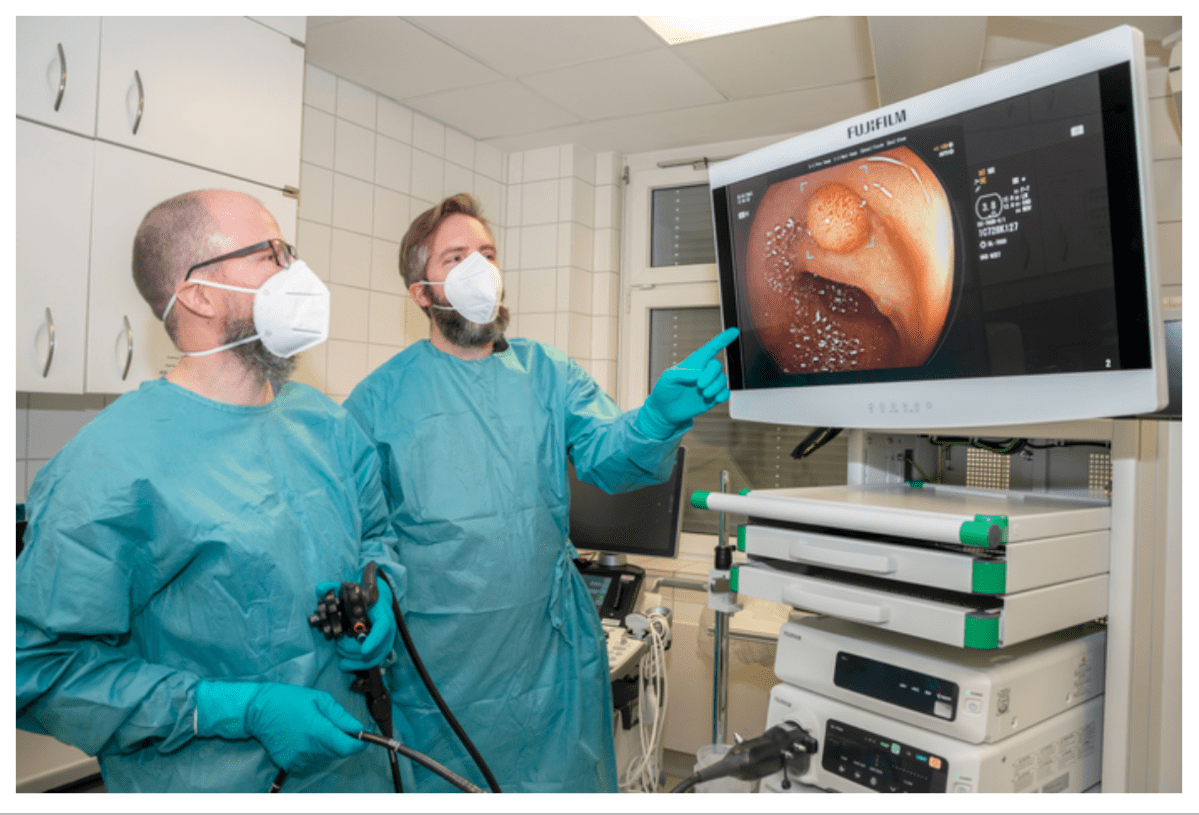
People with Lynch syndrome have a much higher risk of developing colorectal cancer, so they have regular colonoscopies to find and remove precancerous growths (adenomas). Artificial intelligence (AI) can help doctors spot these growths during colonoscopy in people at average risk, but it was unclear whether it would also help in people with Lynch syndrome.
This international study compared standard high-definition colonoscopy with colonoscopy assisted by an AI system called CAD EYE in 733 people with Lynch syndrome across nine specialist centres in Europe.
The researchers found that AI did not significantly increase the number of patients in whom adenomas were detected.
The study also assessed whether the AI could correctly identify whether detected polyps were likely to be precancerous (neoplastic) or non-precancerous (non-neoplastic). While the AI showed good accuracy, it did not perform better than experienced specialist endoscopists, limiting its added value in expert Lynch syndrome surveillance programmes.
Overall, the study suggests that adding AI to colonoscopy does not meaningfully improve adenoma detection or polyp characterisation in specialist surveillance for people with Lynch syndrome, where colonoscopies are already performed by highly experienced endoscopists using high-quality equipment.
https://www.thelancet.com/journals/langas/article/PIIS2468-1253%2826%2900163-9/fulltext

