Shift towards Prevention….

Lynch Syndrome: Exploring the Potential of mRNA in Cancer Prevention.

Moderna recently received authorisation from the UK’s Medicines and Healthcare products Regulatory Agency (MHRA) for a Phase 1/2 clinical study evaluating mRNA-4194, an investigational mRNA-based vaccine for people with Lynch syndrome, an inherited condition that increases the risk of cancer. 

They anticipate the first trial participant to be dosed sometime this summer, this is the first step toward advancing a novel mRNA approach that aims to shift care from treating cancer after its diagnosis to preventing cancer from occurring.

By applying mRNA technology earlier in the patient journey, the goal is to harness the immune system when it could have the greatest impact.

mRNA technology works by instructing cells to produce specific proteins that can train the immune system to recognize and respond to disease. In the case of Lynch syndrome and mRNA-4194, they are investigating whether similar principles could train the immune system, specifically T cells, to detect and eliminate cells that carry these abnormal mutations before they grow into tumours. 

This is just at the beginning of this journey, and there will be important insights along the way, deepening understanding of Lynch syndrome and the potential of mRNA technology to address this high unmet need.

https://www.modernatx.com/media-center/all-media/blogs/potential-mRNA-cancer-prevention

Advancing early detection and personalised prevention of Lynch syndrome.

Focuses on early detection and personalised prevention of Lynch syndrome, an inherited cancer-predisposition condition.Aims to improve risk assessment tools by integrating:

  • Genetic markers
  • Family history
  • Lifestyle and environmental factors

Supports tailored screening and prevention strategies for individuals at increased risk.

Seeks to reduce the incidence of colorectal, endometrial, and other Lynch syndrome–associated cancers. Brings together leading medical institutions and researchers to advance hereditary cancer prevention.

Promotes precision medicine by providing more accurate, individualised risk predictions.

Emphasises patient education and awareness to help individuals understand and manage their cancer risk. Prioritises accessibility and usability, ensuring risk prediction tools are available to diverse populations. Bridges the gap between research findings and clinical practice.

Empowers both patients and healthcare professionals with actionable insights for informed decision-making.

Contributes to improving long-term health outcomes and quality of life for people at risk of Lynch syndrome–related cancers.

Updates in Vaccine Chemoprevention in Lynch Syndrome

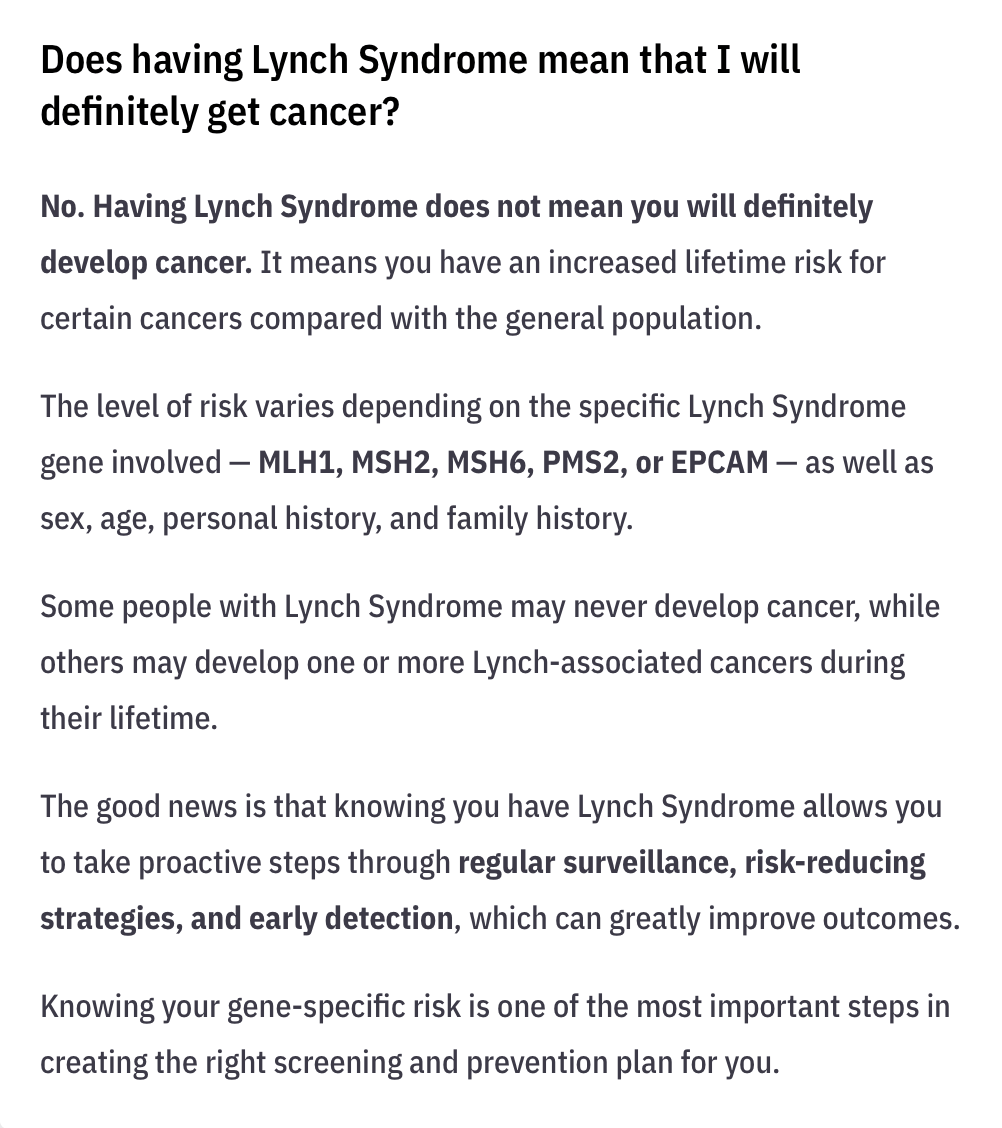
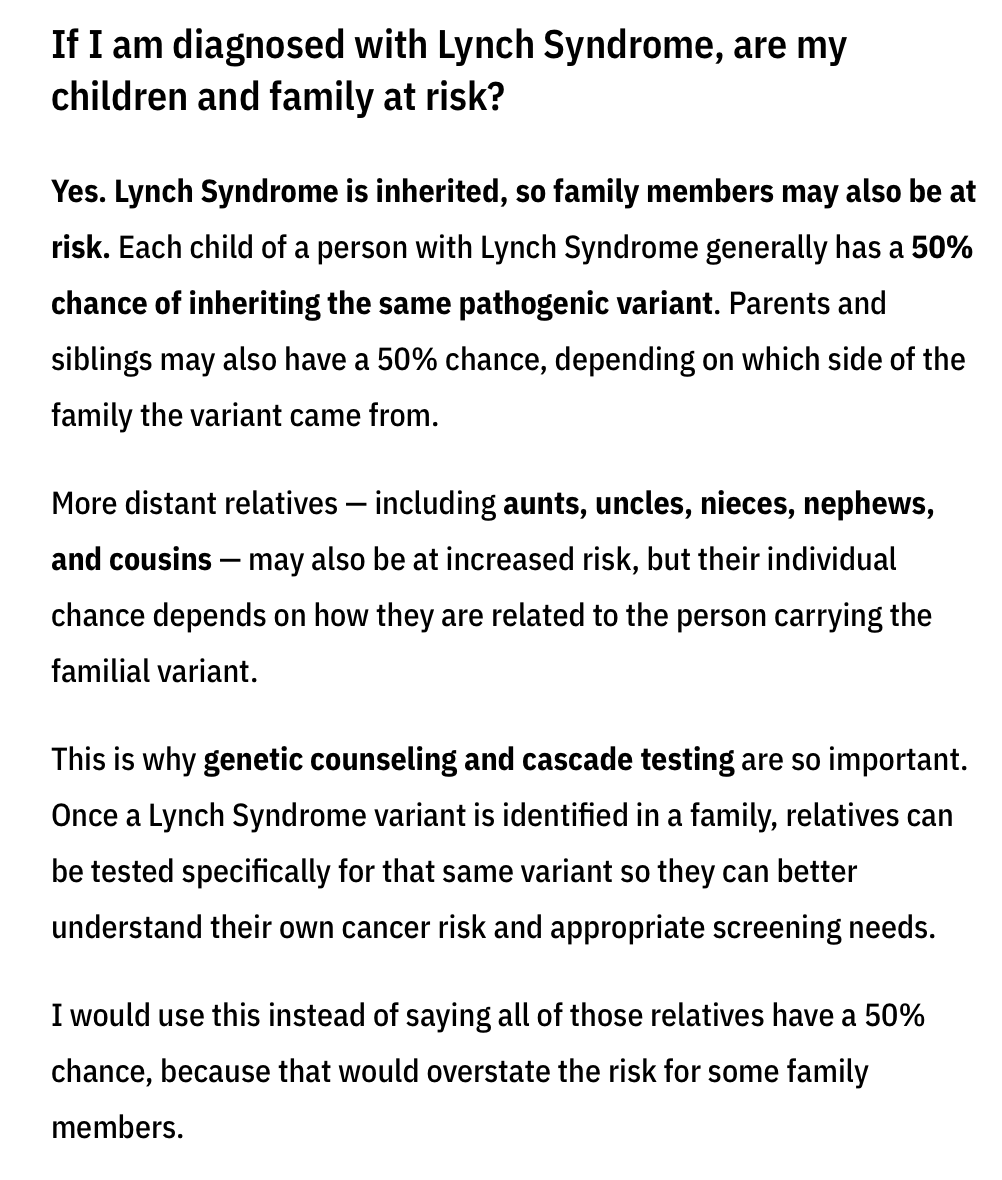
What is Lynch syndrome?

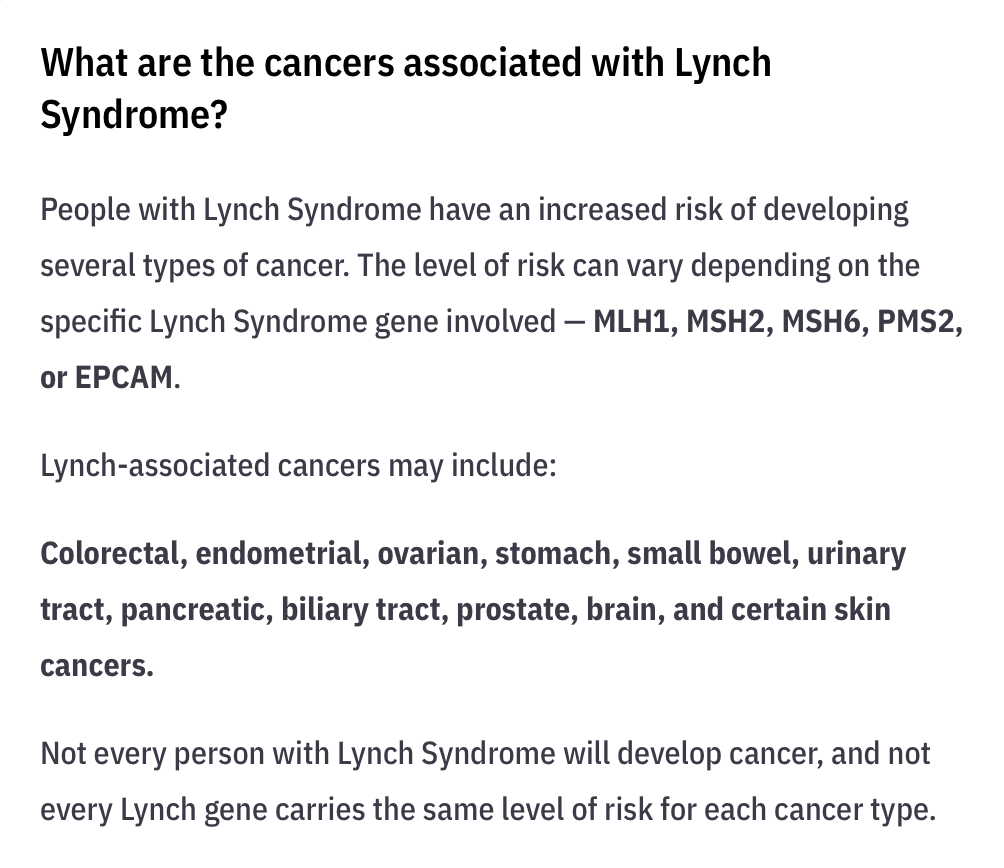
Lynch syndrome is an inherited condition that increases the risk of several cancers, especially colorectal cancer.

What is a cancer-prevention vaccine?

Unlike vaccines that prevent infections (such as flu or COVID-19), these vaccines are designed to train the immune system to recognise and destroy abnormal cells before they become cancer.

What are researchers working on?

Scientists have found that many Lynch syndrome–related precancerous cells share common genetic changes (called neoantigens). This means it may be possible to create a vaccine that helps the immune system target these cells early. 

Key updates

  • Researchers have identified promising vaccine targets in Lynch syndrome–associated precancers. 
  • Several early-stage vaccine studies and clinical trials are underway.
  • The goal is to reduce the risk of cancer developing, rather than treating cancer after it appears.
  • These vaccines are still experimental and are not yet part of standard care.

What does this mean for people with Lynch syndrome?

  • The research is encouraging and could lead to new ways of preventing cancer in the future.
  • Regular screening (such as colonoscopies) remains the most important proven method of cancer prevention right now.
  • Some people may be eligible to participate in clinical trials studying preventive vaccines.

Bottom line

Researchers are making progress toward a vaccine that could help prevent cancer in people with Lynch syndrome. The science is promising, but these vaccines are still being tested and are not yet available for routine use. Regular surveillance and current prevention strategies remain essential. 

https://www.cgaigc.com/post/updates-in-vaccine-chemoprevention-in-lynch-syndrome

Men’s Health Week 2026

Men, on the island of Ireland, experience a disproportionate burden of ill-health.

The week focuses on several actionable and educational targets: 

  • Awareness: Highlighting that males, on average, die younger and face higher death rates across most leading causes.
  • Early Detection: Emphasising prevention, regular check-ups, and seeking help early to prevent medical issues from escalating.
  • Actionable Steps: Challenging men to take small, realistic actions to improve physical and mental wellbeing, rather than striving for perfection. 

Are Women Braver or Smarter than Men in this vital area???

Click to access ActionMan2023.pdf

Patient Advocates IN not OUT

Patients hold the key to better research, better healthcare and better outcomes.

“UCAN Ireland welcomes the publication by IPHA of important new clarity on patient advocate access at medical conferences, now live on the IPHA website.

The guidance makes clear that while there is a legislative basis for restricting non-Healthcare Professional access to promotional areas at conferences, this should never be used as a reason to exclude patient advocates and other non-HCP delegates from valuable non-promotional scientific sessions or communal spaces.”

’Patients’’ includes:

“Individual Patients” who are persons with personal experience of living with a disease. They may or may not have technical knowledge in R&D or regulatory processes, but their main role is to contribute with their subjective disease and treatment experience.

“Patient Advocates” who are persons who have the insight and experience in supporting a larger population of Patients living with a specific disease. They may or may not be affiliated with an organisation.

“Patient Experts”, who, in addition to disease-specific expertise, have the technical knowledge in R&D and/or regulatory affairs through training or experience.

“Patient Organisation Representatives” who are persons who are mandated to represent and express the collective views of a patient organisation on a specific issue or disease area.

“Carers”, who are persons supporting individual Patients such as family members as well as paid or volunteer helpers.

Waiting Lists….whats happening?

Over a 15 month period the HSE recorded an average of over 42,000 missed appointments each month.

What is going on? At a time when it is difficult to get an appointment to see most Physicians.

The main reasons could be….. forgotten appointments, long waiting times, communication problems (letters or texts not received), transport or work commitments, illness, and patients deciding they no longer need the appointment.

Is it just poor administration management by the HSE?

Or should there be more Patient engagement around appointments?

Prevention isn’t profitable

I have learnt that effective cancer treatment can be life-saving.

I have also learnt that surviving cancer is profoundly life-limiting.

My life was saved by the very best of our reactive model of cancer care, and I live with its costs every day. These costs have at times been extreme. Because of the urgency of my diagnosis, I was not able to store a sperm sample and, when I was later offered the chance after treatment, little remained. There are many parts of the world I will probably never visit because I need to remain within reach of hospitals in case of obstruction. Because of my acquired anatomy, I develop many kidney infections each year, travel with prophylactic antibiotics and live with regular discomfort. Yet I am alive, and that was not expected.

I belong to a transitional generation. My parents’ generation faced cancer largely as a death sentence. Mine faces it as survivable but devastating, a bargain in which you trade your body and your simplest pleasures for the right to keep breathing.

The question now is whether the generation after mine will have to make that same bargain, or whether we will have had the courage to spare them from it entirely.

We need healthcare systems to understand that without prevention, the projected rise in cancer cases will overwhelm them. And we need political leaders to fund cancer prevention not as a footnote to treatment budgets but as a priority in line with what is at stake: millions of lives that need never be disrupted, diminished or destroyed by this disease.

Prevention….Prevention….Prevention

https://www.thetimes.com/uk/healthcare/article/cancer-research-cure-prevention-scientist-oxford-fnpmzqfbr

What do patients wish they had known when they first heard the words, “you have cancer”?

In this powerful conversation, three cancer survivors share what it was really like to navigate diagnosis, treatment decisions, and immunotherapy – often without the guidance or support they needed.

“Hope in Action: A Patient’s Guide to Cancer Immunotherapy is a clear, compassionate resource designed for anyone impacted by cancer-patients, caregivers, and loved ones alike. It explains what immunotherapy is, how it works, what to expect during treatment, and how to get support every step of the way.

Click to access CRI_Patients-Guide-25.pdf

Minister details plan to review system for approving new drugs

Minister for Health Jennifer Carroll MacNeill says she has signed off on a plan for an end-to-end review of Ireland’s system for approving access and funding for new drugs and medical treatments.

The review to take around six months and it would form part of wider efforts to ensure medicine reimbursement decisions are made within 180 days of an application being submitted by pharmaceutical companies.

“This builds on new framework agreement targeting that reimbursement decisions are made within 180 days versus where we currently sit at around 600 days for oncology treatments. Getting from where we are to where we need to be requires exactly the kind of structural review that has now been commissioned.” UCAN Ireland

https://www.rte.ie/news/primetime/2026/0611/1578030-minister-signs-off-on-review-of-system-for-approving-new-drugs