Experiences of living with Lynch Syndrome: A reflexive thematic analysis 

Highlights

  • Lynch Syndrome is a hereditary cancer condition, mainly impacting colon cancer.
  • Being identified as having Lynch Syndrome can be distressing.
  • Those with Lynch Syndrome find difficulty in navigating the health care system.
  • There is a perceived lack of knowledge in the medical field about Lynch Syndrome.
  • A model of care for people with Lynch Syndrome could assist with the distress felt.

https://www.ejoncologynursing.com/article/S1462-3889(22)00025-4/fulltext#main-menu

Podcast: Pat talks to Dave Dubin

David Dubin’s most recent Podcast….

I sit down with my cousin from another mother Pat Fahey, founder of Lynch Syndrome Ireland. Pat talks about his long lost sister in the States and her history with cancer and how she found him. Pat talks about why he started LS Ireland and his associate Roberta Horgan. https://www.aliveandkickn.org/podcast/episode/1aaf3ec6/aliveandkickn-podcast-pat-fahey.

Why can’t insurers use genetic test results?

So why is this?

Well, we all have the Disability Act 2005 to thank.

This pretty sound piece of legislation prohibits the insurance companies from asking about genetic tests

When you apply for life insurance, you must disclose a certain amount of personal information, such as:

  • Family medical history
  • Personal medical history – Your insurer may ask for access to your medical records, but you have to provide your permission for this.
  • Your age
  • Height & weight
  • Whether you are a smoker or a drinker
  • Any prescription drugs you take
  • Your occupation – high-risk occupations can increase your premiums)
  • Any hazardous hobbies you take part in
  • Star sign
  • Pet’s name
  • Mother maiden name
  • How many photos contain traffic lights

And that’s just to name a few.

Insurers are pretty damn thorough when it comes to how they calculate your life insurance premium.

They’ll ask for as much information as they can get away with, but any genetic testing results you have are a no-fly zone. (www.lion.ie)

You won’t find a genetic testing question on a life insurance application, but you will find the following guidance:

However, it is important that you are aware that in accordance with the provisions of Part 4 of the Disability Act 2005
you should NOT disclose the result of any Genetic (DNA or RNA) test. Some medical conditions are genetic and can be
passed from generation to generation. Advances in medical science have made it possible in certain circumstances to take
a genetic test and to ascertain if a specific condition has been passed on. If you have had such a genetic test then you
should not disclose it.

And if you look hard enough, you will also spot this paragraph:

You must disclose if you are having treatment for, experiencing symptoms of, or having investigations (other than a genetic
test) for a genetic condition as well as disclosing all other conditions.

However, it is important that you are aware that in accordance with the provisions of Part 4 of the Disability Act 2005
you should NOT disclose the result of any Genetic (DNA or RNA) test. Some medical conditions are genetic and can be
passed from generation to generation. Advances in medical science have made it possible in certain circumstances to take
a genetic test and to ascertain if a specific condition has been passed on. If you have had such a genetic test then you
should not disclose it.

And if you look hard enough, you will also spot this paragraph:

You must disclose if you are having treatment for, experiencing symptoms of, or having investigations (other than a genetic
test) for a genetic condition as well as disclosing all other conditions.

Looking Behind the Headlines to Understand Cancer in the News (by Kelly Owens, PhD)- FORCE 2021 Conference

What’s New in Hereditary Cancer – Lynch Syndrome (2021)

An update on the latest research for people with Lynch syndrome. Presented by Matthew Yurgelun, MD (Dana-Farber Cancer Institute). (FORCE 2021 Conference)

What is Lynch syndrome?

It is estimated that around 1 out of every 125 people are at risk of Lynch syndrome.

However, it’s thought 95% of the carriers of these Lynch Syndrome mutations are unaware that they are at risk.

https://ovarian.org.uk/ovarian-cancer/lynch-syndrome/

£2 million awarded to Newcastle scientists rolling out new cancer screening method

A team of scientists in Newcastle have been awarded £2 million by NHS England, to roll out a new method of screening for cancer. Sir John and his colleagues, including Ms Rachel Phelps, a research PhD student in the Cancer Research UK-funded Cancer Prevention Group at Newcastle University, redesigned the Newcastle MSI-Plus Assay.

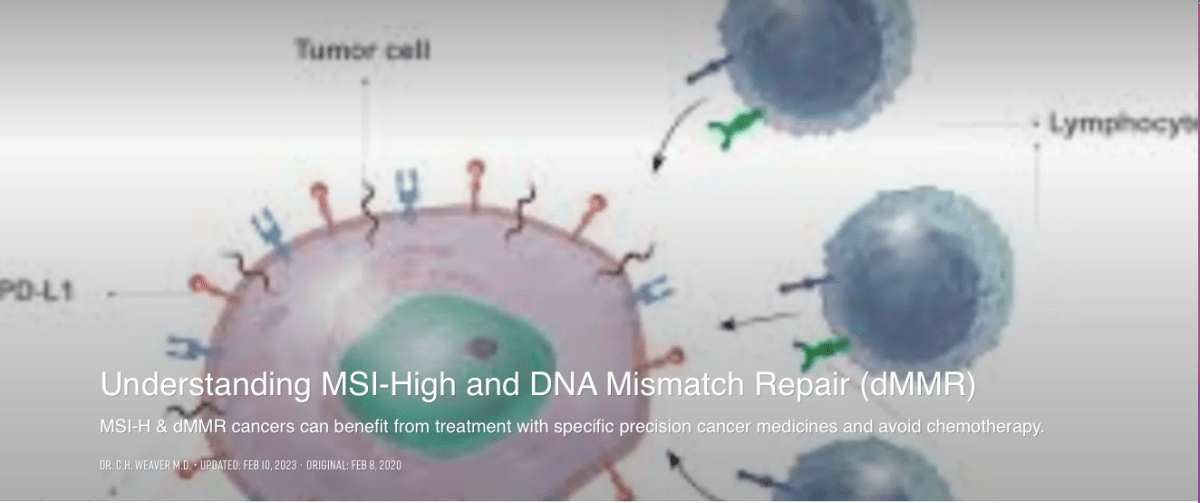
This has recently become the standard test in North East England to find people with LS among those diagnosed with bowel cancer. MSI, which stands for microsatellite instability, shows that an important DNA repair system isn’t working. Most LS patients are in this group. The test is being evaluated for national rollout.

People with Lynch Syndrome can benefit from screening programmes that enable cancers to be found at an early stage when they can be cured. LS carriers are at high risk of cancers of the bowel and womb, and screening is available for these using colonoscopy for the large bowel and ultrasound for the womb. Unfortunately, the urinary tract has been ignored because there are currently no cheap, non-invasive screening methods that can reliably detect tumours here. Cancer of the upper urinary tract is the third most common cancer associated with LS.

This test can be carried out at low cost and in high numbers. It will help to identify thousands of cancers earlier, when it is easier to treat, giving a much more positive outcome for patients and families.”

If a person with cancer is detected as having Lynch syndrome, a DNA test can then be offered to their relatives to see who else has the condition, so that they can then be put on a regular programme of checks. 

Cancer Moonshot Blue Ribbon Panel (2016-USA)

The report describes a set of consequential recommendations for accelerating cancer research to achieve the ambitious goal of making a decade’s worth of cancer research progress in five years and to bring the most promising science and clinical developments to all cancer patients in the near term. https://www.cancer.gov/research/key-initiatives/moonshot-cancer-initiative/blue-ribbon-panel/blue-ribbon-panel-report-2016.pdf

G. Prevention and Early Detection: Implementation of Evidence-Based Approaches: “Currently, there is a need for nationwide efforts to identify individuals with hereditary cancer syndromes, and to determine and implement optimal intervention strategies, such as earlier cancer screenings, that would reduce the risk of developing malignant disease. For example, in the case of LS, which leads to increased risk of colorectal and endometrial cancers as well as other malignancies, tumor testing is recommended for all individuals with CRC; however, fewer than 5% receive this screening, representing a missed opportunity to identify individuals and family members who may have inherited a substantially higher cancer risk.

thisisGO.ie

thisisGO.ie is an online personalised resource for you and your partner who have been impacted by a gynaecological cancer.

Gynaecological cancers refer to any cancer of the female reproductive system which includes the uterus (womb), the ovaries, the cervix (the neck of the womb), the vulva (the outer part of the female genitals) or the vagina.

Patient and public involvement throughout the project. An Irish resource for an Irish audience.

Lynch Syndrome: A Common Yet Under-Recognized Hereditary Cancer Predisposition

Lynch syndrome is the most common inherited predisposition to colorectal and endometrial (uterine) cancers, yet is it under-diagnosed. Around 90-95% of people who have Lynch syndrome are not aware of their condition. This is a major concern because many of the cancers associated with Lynch syndrome are preventable or could be detected earlier through intensive cancer surveillance. Identifying patients with Lynch syndrome also helps with testing other members of their family who may be at risk and helps ensure access to care for patients who have high risks for cancer.

https://www.aboutgeneticcounselors.org/Resources-to-Help-You/Post/lynch-syndrome-a-common-yet-under-recognized-hereditary-cancer-predisposition