The English National Lynch Syndrome Registry

Comprising over 9,000 patients with Lynch syndrome….Aims to improve the treatment of all patients living with the genetic condition.

Researchers from the Institute of Cancer Research (ICR), in collaboration with the National Disease Registration Service, the NHS Genomic Medicine Service Alliances and the NHS Regional Clinical Genetics Services, have set up the UK’s first-ever comprehensive database registry for Lynch syndrome patients to prevent cancer.

 “By centralising patients’ genetic data, together with detailed information about the cancer diagnosis and treatments that these patients have received, researchers will gain crucial insights into Lynch syndrome… [unlocking] new opportunities for precision medicine and prevention, ultimately improving the lives of patients living with the condition.”
https://pharmatimes.com/news/icr-collaboration-forms-national-nhs-patient-database-registry-for-lynch-syndrome-patients/#:~:text=Researchers%20from%20the%20Institute%20of,Lynch%20syndrome%20patients%20to%20prevent

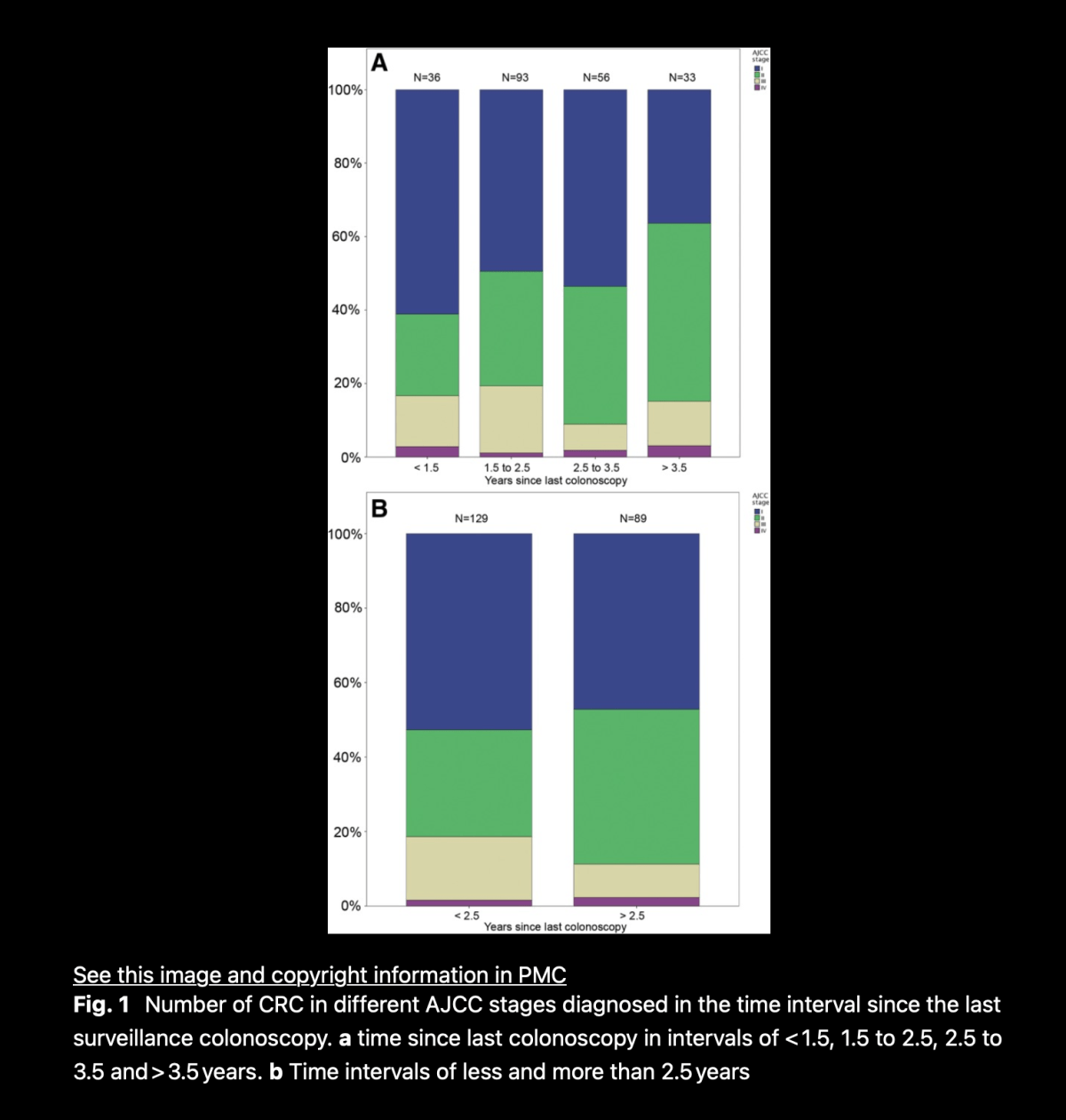
Lack of association between screening interval and cancer stage in Lynch syndrome may be accounted for by over-diagnosis; a prospective Lynch syndrome database report

Recent epidemiological evidence shows that colorectal cancer (CRC) continues to occur in carriers of pathogenic mismatch repair (path_MMR) variants despite frequent colonoscopy surveillance in expert centres. This observation conflicts with the paradigm that removal of all visible polyps should prevent the vast majority of CRC in path_MMR carriers, provided the screening interval is sufficiently short and colonoscopic practice is optimal.

Our findings raise the possibility that some CRCs in path_MMR carriers may spontaneously disappear: the host immune response may not only remove CRC precursor lesions in path_MMRcarriers, but may remove infiltrating cancers as well. If confirmed, our suggested interpretation will have a bearing on surveillance policy for path_MMR carriers.

https://pubmed.ncbi.nlm.nih.gov/30858900

Challenges and opportunities for Lynch syndrome cascade testing in the United States

Individual barriers such as feelings of fear, guilt, and anxiety and limited knowledge about Lynch syndrome as well as interpersonal barriers including complex family dynamics and language barriers limit family communication about Lynch syndrome and prevent uptake of genetic screening for relatives. 

Organisational and environmental barriers including a shortage of genetics professionals, high costs, and fears of discrimination also reduce cascade testing.

These multi-level barriers may disproportionately impact underserved populations in the United States, such as individuals with lower incomes, limited English-speaking proficiency, lower educational attainment, and inadequate access to health systems. 

https://link.springer.com/article/10.1007/s10689-024-00374-3

How I Deal With Scanxiety

Scanxiety is a term coined to describe the mix of fear, anxiety and stress associated with medical scans.

The anticipation of undergoing medical procedures only adds another layer of stress. The anxiety and discomfort during scans heighten my sense of vulnerability and helplessness. As someone who has witnessed the toll of cancer on my brothers, the death of my eldest brother firsthand triggers traumatic memories, intensifying the emotional turmoil.

By acknowledging and addressing my emotional needs, I’m learning to navigate the rollercoaster of anxiety with resilience and grace and looking forward to brighter days ahead.

https://www.curetoday.com/view/s-c-a-n-x-i-e-t-y

Is a Lynch syndrome vaccine on the way?

The advances in vaccine technologies, such as in Lynch Syndrome, is a promising field of research that has the potential to reduce the risk of developing cancer, thereby preventing disease and modifying surveillance regimens for high-risk patients.

What To Do While We Wait for a Vaccine

While the possibility of a Lynch Syndrome vaccine certainly brings a lot of hope and anticipation, it’s important to continue other preventative measures in the meantime. It is recommended that Lynch Syndrome patients:

  • Receive regular cancer screenings as advised by their healthcare providers.
  • Discuss the option of prophylactic surgery to remove at-risk organs.
  • Comply with medication management – such as Aspirin and Naproxen – that may be prescribed to help reduce the risk of developing certain cancers.
  • Maintain a healthy lifestyle through diet and exercise, while avoiding smoking, excess alcohol, and other known carcinogens. 

Regardless of whether or not you are diagnosed with Lynch Syndrome, it is important that everyone be aware of:

https://colorectalcancer.org/article/lynch-syndrome-vaccine-way

A guide to LYNCH SYNDROME

Don’t wait, like me….until you develop cancer to discover that the predisposition to cancer called Lynch syndrome runs in your family.

Why does Lynch Syndrome increase the risk of some cancers?
In our cells, there are natural processes that defend us from cancer – from
repairing damaged DNA to destroying potentially dangerous cells. In Lynch
Syndrome, the ability to properly ‘proofread’ newly formed DNA is lost.

This means that any errors are not spotted or corrected. These errors can
build up, eventually affecting the bodily processes that usually prevent
cancer formation.
When this happens, an individual is at a greater risk of
developing cancer.

Not everyone who has Lynch syndrome will develop cancer.

Easy read guide…..

What Is CMMRD?

CMMRD, like Lynch Syndrome, is a genetic condition that makes it more likely for a person to get certain types of cancer, except this time it occurs when a child has inherited mutated genes from both parents, and the cancer risk is even higher. PMS2 is the most commonly affected gene in CMMRD.

To illustrate this: my mum has one “good” copy of the gene and one bad copy, so I could have inherited her good gene or her bad gene. And the same goes for my dad. My sister inherited both of their good copies, and therefore doesn’t have Lynch Syndrome or CMMRD, and neither do her children. Whereas I inherited both of their bad genes and therefore have CMMRD. We believe my brother, who passed away many years ago, also had Lynch Syndrome or CMMRD.

As many as 1 in every 300 people may have Lynch Syndrome, while the odds of having CMMRD are one in a million – or 0.0001%. 

Important information about Womb Cancer

Lynch syndrome may affect up to 175,000 people in the UK and is linked to 3% of cases of womb cancer.

To develop Lynch syndrome you need to have one parent that carries the gene. Someone diagnosed with Lynch syndrome has up to 60% chance of developing womb cancer in their lifetime.

Lynch syndrome is also associated with an increased risk of bowel cancer.

Those diagnosed with Lynch syndrome undergo regular tests to check for bowel cancer and womb cancer, many will be offered a hysterectomy (operation to remove the womb) to prevent womb cancer once they feel their family is complete.

Lynch syndrome is often diagnosed when a strong family history of bowel or womb cancer is noted. If you feel this may apply to you, please speak to your doctor about being referred to a genetics service.

Updates in gynaecologic care for individuals with lynch syndrome

As the landscape of gynaecologic cancer treatment shifts towards treatment based on molecular classification of tumours, knowledge of targeted therapies well-suited for mismatch repair deficient Lynch tumours will be crucial.

 Identifying barriers and improving access to risk reduction measures is another future direction in the study of Lynch syndrome, and perhaps the greatest frontier is determining whether Lynch-associated endometrial and ovarian tumors should be treated differently than sporadic endometrial and ovarian tumors.

https://www.frontiersin.org/journals/oncology/articles/10.3389/fonc.2023.1127683/full

Genomics Toolkit: Gynae-Macmillan Cancer Support

The Macmillan Genomics Toolkit is designed to guide healthcare professionals to multiple education resources, pathway guidelines, clinical documents, patient support information and case studies to demonstrate the ‘Gold Standard’ of care once genomics has been embedded into practice. It has been developed in collaboration with expert healthcare professionals and the NHS England National Genomics Education team.

https://www.macmillan.org.uk/healthcare-professionals/innovation-in-cancer-care/genomics-toolkit/gynae