National Electronic Health Record (EHR)

EHR will be a digital system that holds a person’s full health and social care information in one place. It will replace paper files and local IT systems by allowing staff to record, update and access all health information in one place.

Access to digital health records has been a long-sought objective in Irish healthcare for many years.

To date(March 25), the Health Service has rolled out a number of electronic health record (EHR) systems in different sites in recent years. These include the National Rehabilitation Hospital, the National Forensic Mental Health Service, St. James Hospital, Mater Misericordiae University Hospital, roll-out across the bigger Maternity Hospitals extending EHR coverage to 70% of births nationally by the end of 2025. The National Children’s Hospital EHR deployment will be the most comprehensive EHR deployment in the state when the hospital is commissioned.

Ireland needs one digital health record for every citizen that can be access by health professionals across the service.

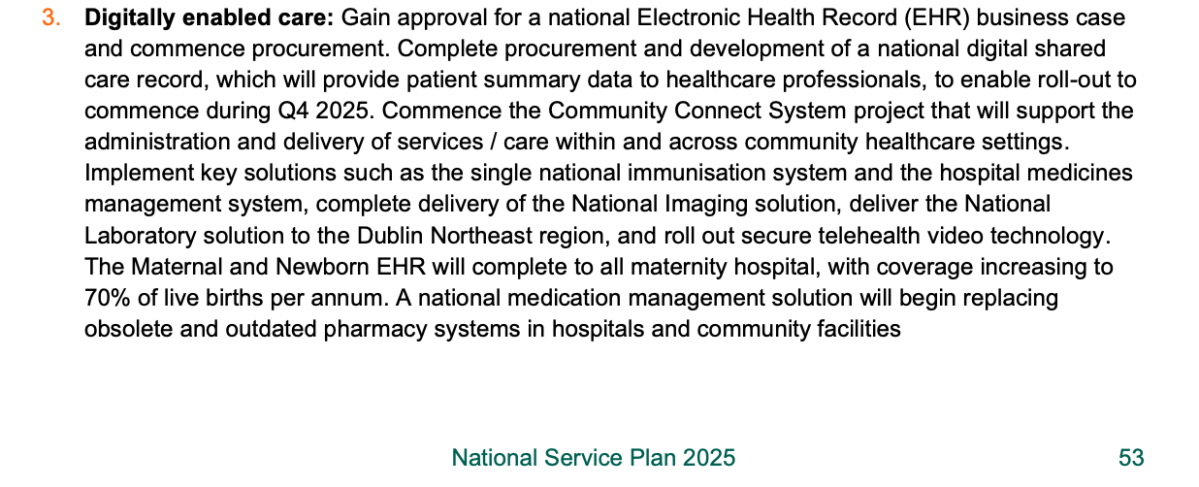
To achieve this, the HSE are following a three-step approach: delivering the HSE Health App, developing a National Shared Care Record (NSCR), and regional deployments of enterprise level Electronic Health Record systems that span acute and community healthcare.

HSE has completed the procurement for the National Shared Care Record (NSCR) programme and has now been mobilised, with the contract for building the NSCR technology platform awarded to EY, Better and Kainos.

The NSCR brings together healthcare information from various sources such as hospitals, GP practices, and Community care into a single place, making them available at the point of care and self-care in read only format. By having access to key healthcare information in one place means healthcare professionals will be able to make more informed, safer decisions and to focus more time on direct patient care while patients will be better informed and empowered to manage their own healthcare. 

A phased roll-out of the national shared care record is due to commence in Q4 2025 in the South-East region with University Hospital Waterford. The system will then extend to other regions from 2026 with additional information being added over time.

https://www.oireachtas.ie/en/debates/question/2025-03-04/696/
Digital for Care —A Digital Health Framework for Ireland: 2024-2030

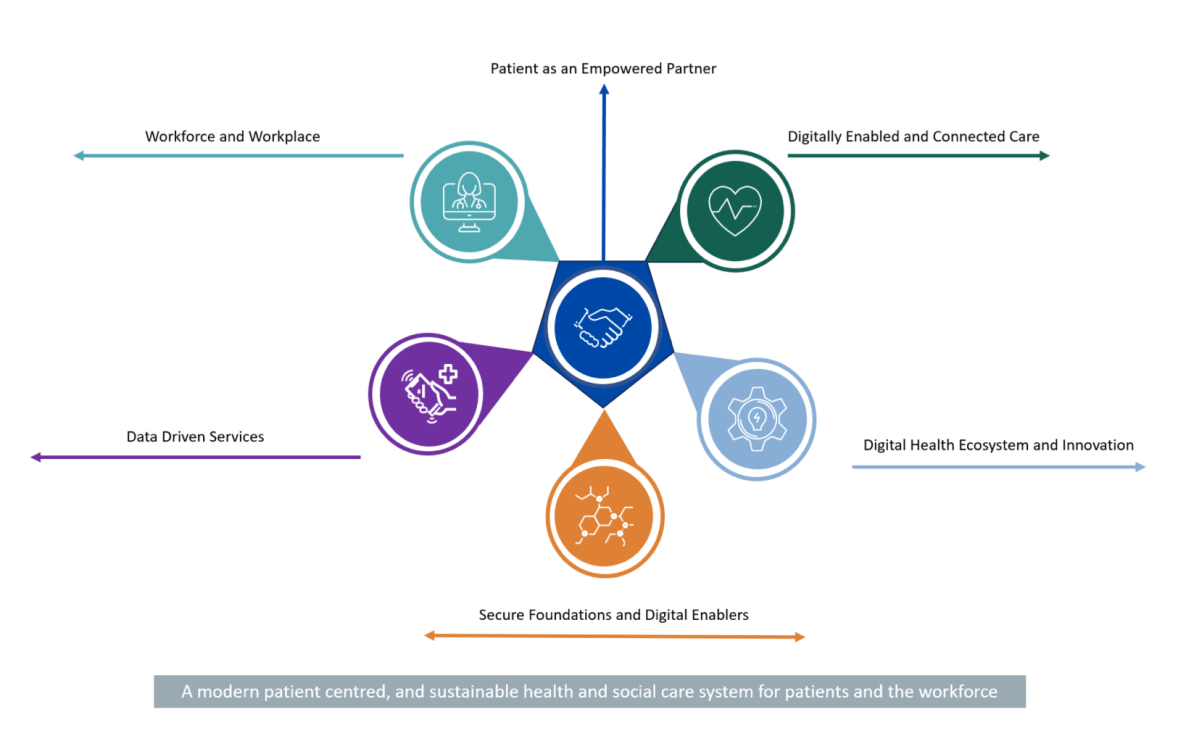
-Patient as an empowered partner: We will empower patients by giving them broader access to their own health information through a patient app, provide access to more digital health services, including virtual care offerings, whilst enabling greater autonomy and choice over their care options.

Workforce and workplace: We will enable our workforce by providing them with the technology, systems, and skills they need to deliver the best possible care and services to patients in the modernised healthcare system. 

Digitally Enabled and Connected Care: We will drive future investment and make architectural decisions based on the ability of systems to share clinical information and deliver connected care. We will make it possible for healthcare professionals, and others who support delivery of care, to be able to access the information needed about their patients when and where they need it, regardless of where those patients were treated previously. 

Data driven services: We will leverage data analytics, business intelligence, visualisation, dashboards, and other digitally enabled management tools to provide greater insights into the health service and its operation. This will create opportunities for increased productivity, efficiency and more precise direction of resources to areas of greatest need, and where they will have the maximum impact. 

Digital health ecosystem & innovation: We will embed continuous improvement within the health and social care system. This will be enabled by innovation via improving ongoing collaboration, improved procurement pathways, increased participation, and promoting research excellence. This strategic principle also details key considerations for the Digital health ecosystem as we prepare for the technologies of the future.

Secure foundations & digital enablers: We will continue to build cyber resilience and put in place the key enablers needed to deliver this digital health strategic roadmap, underpinned by strong governance, cultural change, standards, interoperability, infrastructure, architecture, and legislation.

https://www.gov.ie/en/publication/0d21e-digital-for-care-a-digital-health-framework-for-ireland-2024-2030/

European Health Data Space (EHDS) Regulation

What are the implications for patients?

The primary goal of the EHDS is to empower patients to access their health data and enable health professionals to consult patients’ medical records, through Electronic Health Records (EHRs). It will enable citizens in the EU to access, manage, and share their health data electronically (primary use), and facilitate its use for public interest, policy making, and research (secondary use). 

To ensure a successful enforcement of the regulation and mitigate any unintended consequences, we call on Member States and the European Commission to prioritise the following key actions during the implementation period: 

  • Accessibility and Usability: EHR systems must be user-friendly, with clear interfaces. 
  • Transparency: Patients should have transparent information in lay language on how their health data is collected, stored, used, and protected within the EHDS framework. 
  • Consent: It is crucial to provide patients with complete information on the opt-out mechanism from the re-use of health data for secondary purposes. 
  • Digital Health Literacy: It is essential to continue promoting digital health literacy programmes, especially in underserved and rural communities. 
  • Stakeholder Engagement: The EHDS stakeholder forum should function as a true advisory board, whose feedback and recommendations are actively incorporated and acted upon. 
  • Financial Considerations: Addressing concerns about the financial burden on Member States and regions is crucial for sustainable implementation.  
  • Security and Privacy: Ensuring state-of-the-art security measures to strengthen the protection and cybersecurity surrounding data storage and processing is of utmost importance. 
  • Minimising Legal Uncertainty: It is critical to reduce legal uncertainties surrounding the implementation of EHDS. 

Drug Approval/Reimbursement Process in Ireland

Once a medicine has been approved at a European level, the pharmaceutical company will make separate applications for reimbursement at a national level in different EU or EEA countries. In Ireland these applications are made to the HSE Corporate Pharmaceutical Unit (CPU) who then commission the National Centre for Pharmacoeconomics (NCPE) to carry out an assessment on that medicine.

A full health technology assessment (HTA) is a systematic assessment of the clinical and cost-effectiveness of a medicine. Only a selection of medicines are required to undergo a full HTA as part of the drug reimbursement process. The NCPE full HTA assessment takes approximately 18 weeks to complete, exclusive of the duration the HTA is queried with the Applicant (approximately five weeks as part of the stop/clock process). The full HTA report consists of the following information:

  • Disease background and epidemiology
  • Detailed description of current clinical practice and treatment options
  • Detailed description of the intervention (drug) under assessment
  • Detailed review of the clinical and comparative efficacy of the drug under assessment
  • Detailed review of the safety and comparative safety of the drug under assessment
  • Detailed review of the cost-effectiveness of the drug under assessment
  • Detailed review of the budget impact of the drug under assessment.

The outcome of a full HTA is a recommendation to the HSE on reimbursement. 

I’m confused…

Do public cancer patients have the same chance of living as those with health insurance? It appears you have across all cancers a better, faster access to cutting-edge drugs in the private system compared to the public system

Are pharmaceutical companies making separate applications for reimbursement at a national level in a timely manner? If so why is this?

Is NCPE adhering to its own time frames? If not why?

It appears that up to 40% of the new medicines approved by the EMA are not even assessed by the HSE because its approval system is so protracted it can sometimes take up to three years for the health authority to decide whether to provide the drug free of charge.Is this a process being used to slow down the approval of new drugs to save money?

Who is actually in Charge of spending the Taxpayers money?????