
It is the condition under which the rest of what we do works properly.
Every clinician has a version of this. Mine involves a woman with a complex abdominal history, three prior operations in two hospitals, and a discharge summary that told me what had been done without telling me what had been found.
The information existed. It had been recorded carefully by competent people. It simply did not travel, and so a large part of that morning went on phone calls to reconstruct something that was already written down somewhere.
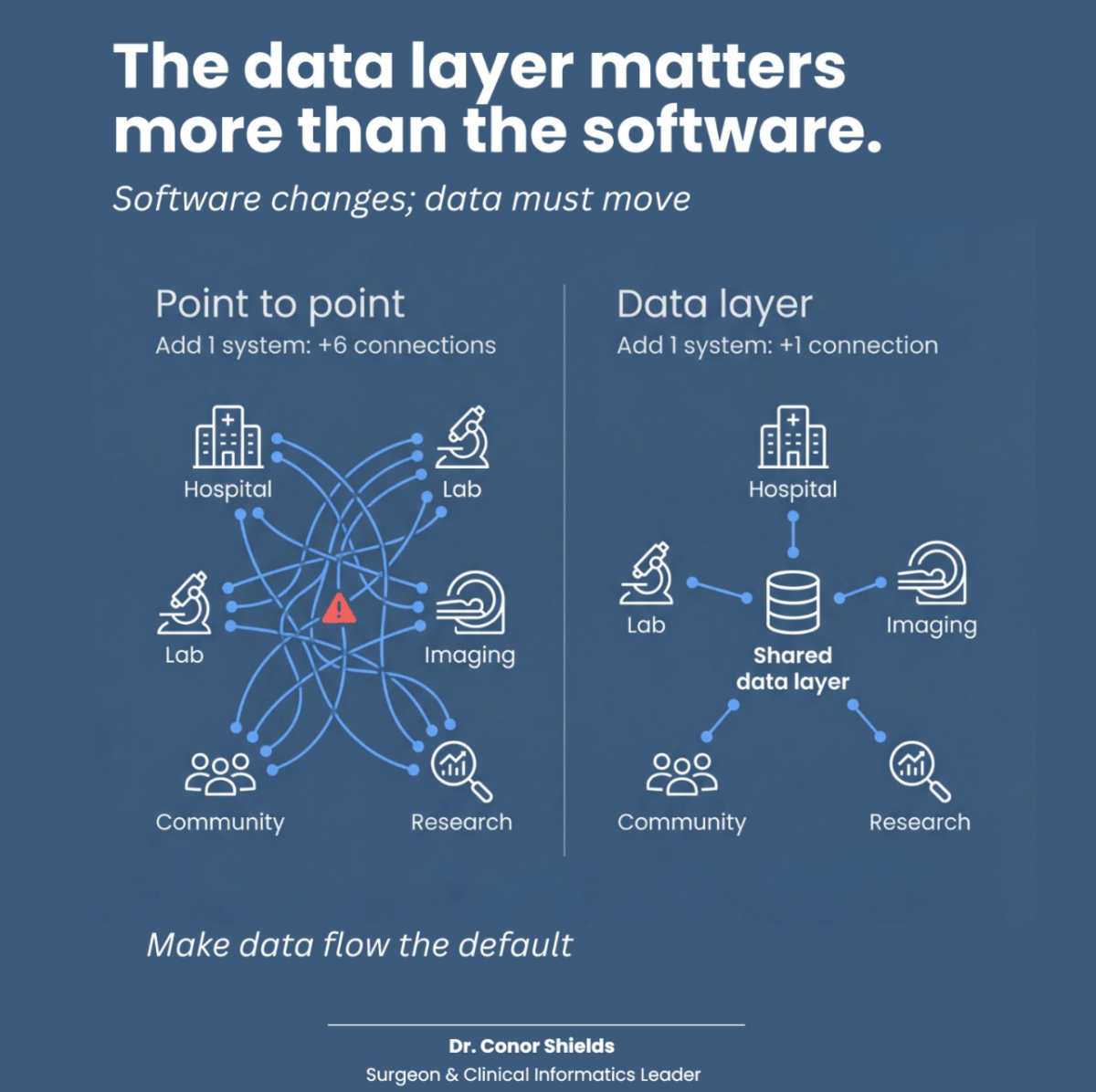
We tend to describe this as an interoperability problem, which makes it sound like a technical matter for other people. From where I sit it is a clinical safety issue with a measurable cost, paid in duplicated investigations, delayed decisions and the specific risk that comes from operating with an incomplete picture.
The part that troubles me is how normalised it has become. We have built local workarounds so effective that the underlying failure stops registering as a failure. The secretary who knows who to ring, the registrar who remembers which system holds the histology, the consultant who requests the scan again rather than chase the report. These are heroic and they are load-bearing, which is the problem.
A record that follows the patient rather than the institution is not a technical aspiration. It is the condition under which the rest of what we do works properly.
For those of you working across acute, community and primary care for the same patients, how much of your week goes on reconstructing information that already exists?
From LinkedIn…Conor Shields (Surgeon & Clinical Informatics Leader | Delivering Clinician-Centric EHR Solutions & Digital Health Programmes | Clinical Lead (Ireland) Dedalus)

