
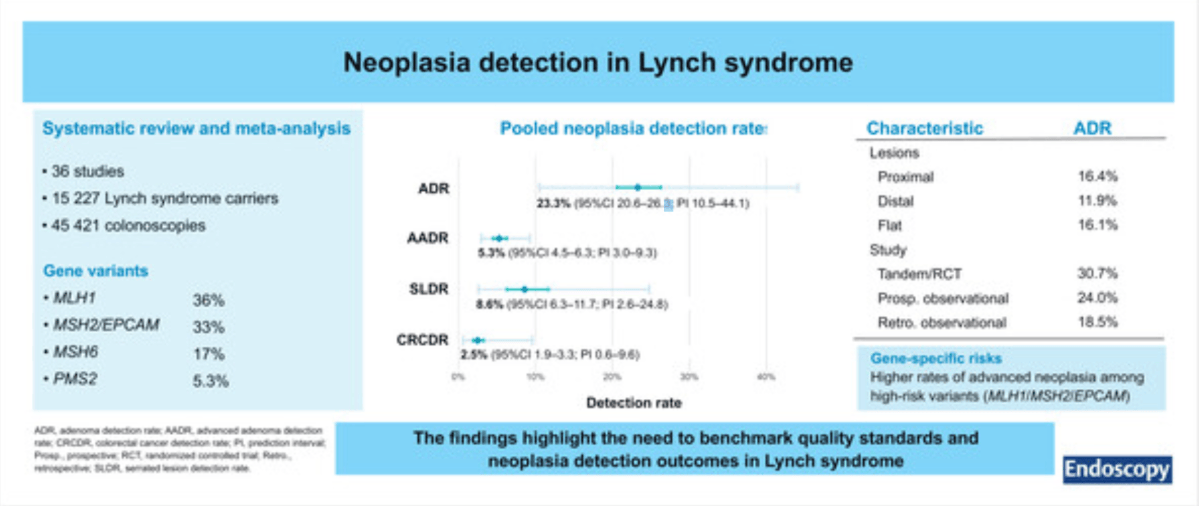
Contemporary trials consistently achieve ADRs around 30% (including the recently published CADLY2 trial from Robert Hüneburg), supporting a provisional minimum ADR benchmark of 25% for colonoscopy surveillance in Lynch syndrome carriers with an intact or near-intact colon.
This is not an aspirational target, but a pragmatic starting point to identify underperformance, drive quality improvement, and ultimately test whether better colonoscopy translates into fewer post-colonoscopy CRCs.
Time to benchmark adenoma detection in Lynch syndrome surveillance.
https://www.thieme-connect.com/products/ejournals/abstract/10.1055/a-2934-4134
Validation is now feasible. The English National Lynch Syndrome Programme provides an ideal platform, combining systematic carrier identification, standardised pathways, and prospective data capture.
It could determine whether ADR, alone or integrated with other indicators, predicts PCCRC in real-world surveillance. Such validation should predefine eligible procedures, account for clustering by patient and endoscopist, examine temporal changes, and evaluate whether improvement in ADR is accompanied by reductions in advanced neoplasia and PCCRC rather than merely increased detection of diminutive lesions over time.
The field should move beyond asking whether colonoscopy “works” in Lynch syndrome and define the measurable conditions under which it most effectively prevents cancer.

