

Check out the presentations on YouTube.
Up to date information on Lynch Syndrome
Check out the presentations on YouTube.
Up to date information on Lynch Syndrome
England’s latest Lynch syndrome patient database may transform the disease’s detection and monitoring, becoming a blueprint for other genomic diseases.
The English National Lynch Syndrome Registry holds over 9,000 patient records, but what is it about Lynch syndrome that warrants a national database? It ticked a number of boxes, from researchers knowing a lot about it to there being a strong public health argument to focus on.
Lynch syndrome is a fairly well-understood condition with a high penetrance. This makes cascade testing, which is where the patient’s family members are considered for testing, very likely to pick up new cases before Lynch syndrome-associated cancer develops – which can include colorectal and endometrial cancers. When new cases are found, there are ways in which risk can be reduced for those affected that are relatively cheap, available and simple. Advice on this includes a NICE recommendation to take aspirin and attending colonoscopies.
The advances in vaccine technologies, such as in Lynch Syndrome, is a promising field of research that has the potential to reduce the risk of developing cancer, thereby preventing disease and modifying surveillance regimens for high-risk patients.
What To Do While We Wait for a Vaccine
While the possibility of a Lynch Syndrome vaccine certainly brings a lot of hope and anticipation, it’s important to continue other preventative measures in the meantime. It is recommended that Lynch Syndrome patients:
Regardless of whether or not you are diagnosed with Lynch Syndrome, it is important that everyone be aware of:
https://colorectalcancer.org/article/lynch-syndrome-vaccine-way
If you would like to know more about whether there is a cancer trial suitable for you, the first thing you do is to talk to your doctor and/or the cancer trials research team in your hospital.
This is a fantastic trial….. the link to clinicaltrials.gov to have a look at the protocol. There are great investigators and great centers, and this is a very sensible randomised phase 2 trial design.
Until recently we thought of cancer as being defined by its location in the body – moving forward it will be defined by the cancer’s unique growth driving mutations and biomarkers. In effect, the genetics – biomarker define the cancer rather than the organ where the cancer began.
Groundbreaking vaccine trials aimed at preventing cancers associated with the genetic disorder Lynch syndrome are currently underway.
Sanchez explained that patients with Lynch syndrome are born with a genetic defect in a gene that is involved in DNA repair.
“What happens is that everytime one of our cells is dividing there is new synthesis of DNA and spontaneously in that process there are DNA errors. There are natural systems in our cells that are equipped to recognize that error and correct it so we don’t get mutations all the time,” Sanchez explained.
“What happens in patients with Lynch syndrome is that the genetic defect they are born with is in one of the genes involved in this process of self repair of DNA errors,” he continued.
This means that people with Lynch syndrome are more prone than others to replicate these DNA errors over their lifetime which means an increased risk of cancer.
https://ascopubs.org/doi/abs/10.1200/JCO.2023.41.16_suppl.e14665
Conclusions: The combination of Nous-209 and pembrolizumab is safe, well tolerated and shows encouraging clinical efficacy in patients with treatment-naive dMMR/MSI-H mCRC eligible for anti-PD-1 therapy.
The study is ongoing and expanding to Phase II randomisation with a new accelerated Nous-209 vaccination schedule.
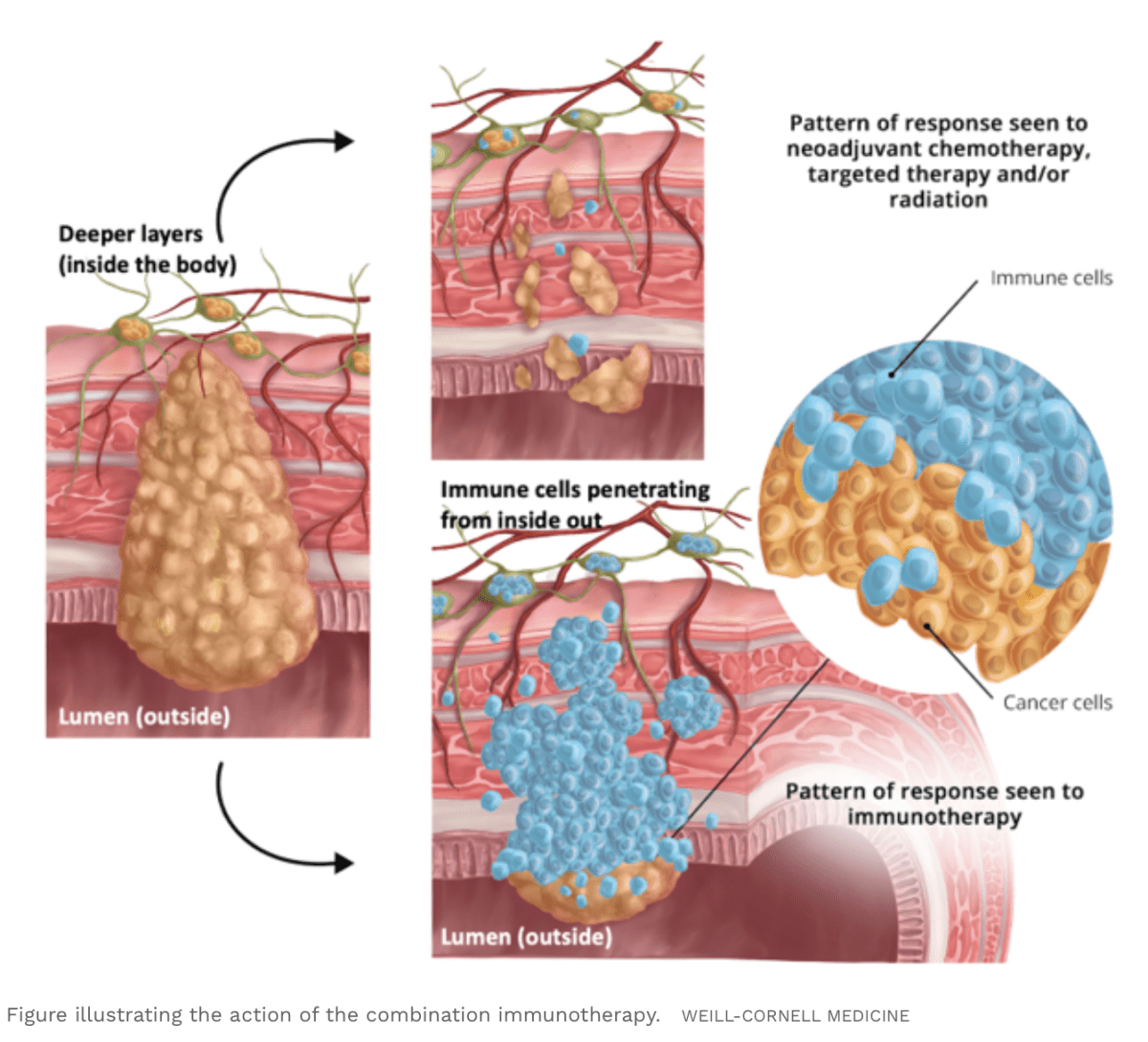
What’s noteworthy about this result is that the patients here, like about 85% of colorectal cancer patients, have what are called “mismatch repair proficient” cancers, which produce highly mutated tumor cells that typically do not respond to immunotherapy. What’s more, Kasi added that based on the results, it may be possible to reduce or even eliminate the need for chemotherapy after surgery, which would otherwise be standard in these kinds of cases.
Colorectal cancers (CRCs) with deficient DNA mismatch repair (dMMR) account for 15% of all CRCs. Deficient MMR is a predictive biomarker associated with responsiveness to immune checkpoint inhibitors (ICIs) in solid tumors, including CRC. The remarkable effectiveness of ICIs in metastatic CRC has led to their evaluation in the neoadjuvant and adjuvant treatment of localized disease.
Conclusions and Relevance:
While this review found that early results of neoadjuvant immunotherapy for localized dMMR CRC show high rates of major and complete pathological response, longer-term follow-up data are needed to ensure that oncologic outcomes are not compromised and are ideally improved. Neoadjuvant ICI therapy in localized dMMR CRC represents a potential paradigm shift with implications for organ preservation.
https://jamanetwork.com/journals/jamaoncology/article-abstract/2809269




 Lynch Syndrome Ireland