
Cancer came as no surprise for one survivor.
Learn how the family history and a genetic syndrome put them at high risk.
Delving into the role of genetic counsellors in cancer care.
And the hope for a vaccination.
Cancer came as no surprise for one survivor.
Learn how the family history and a genetic syndrome put them at high risk.
Delving into the role of genetic counsellors in cancer care.
And the hope for a vaccination.
Lynch syndrome is an inherited condition that increases the risk of developing certain cancers, including colorectal, endometrial, and ovarian cancer.
On this page
https://www.canceraustralia.gov.au/impacted-by-cancer/lynch-syndrome#what-is-lynch-syndrome
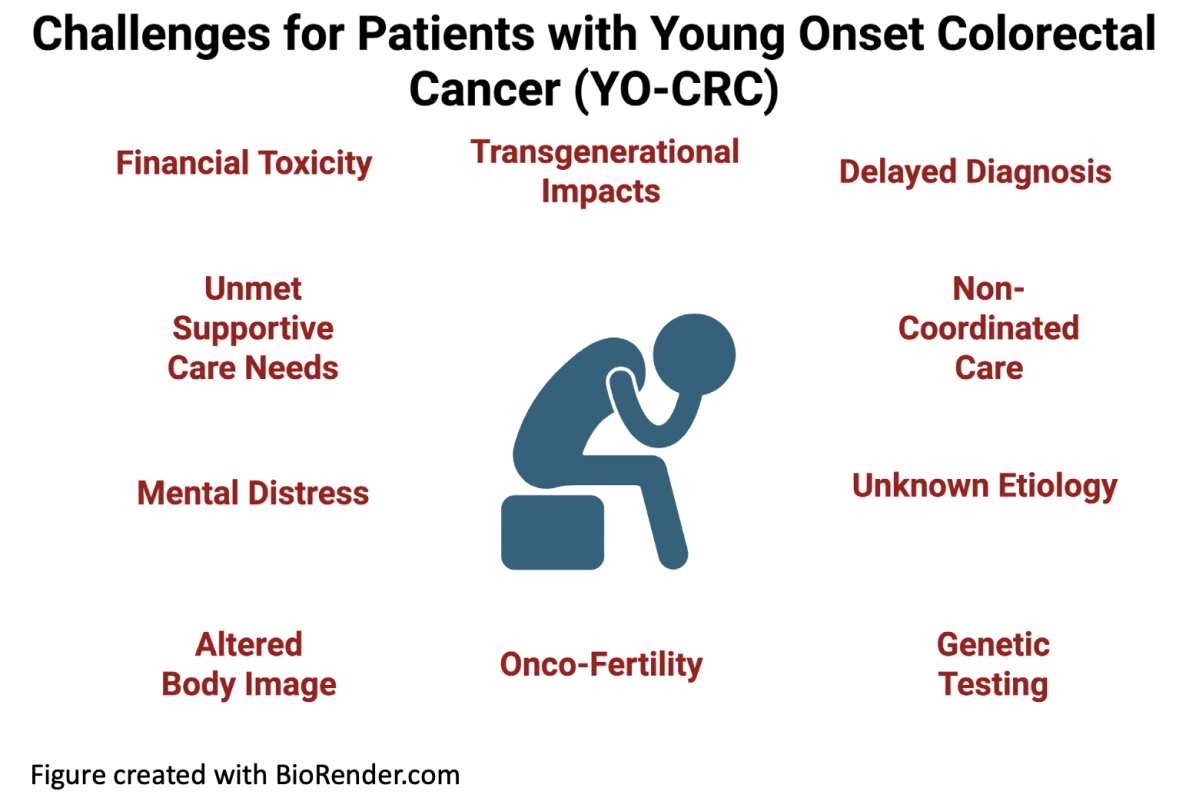
The global incidence and mortality of early-age onset colorectal cancer (EOCRC, or CRC diagnosed under 50 years) has increased in recent decades.
High-risk surveillance and personalised oncological treatment may improve patients’ outcomes. This study aims to characterise real-world somatic and germline molecular profiles in European EOCRC patients.
Results support universal and paired somatic and germline multi-gene panels for all EOCRC patients, regardless of MMR status or family history. Systematic molecular testing approaches are necessary to address disparities in people with EOCRC. Larger unselected cohort studies would support validation of testing prediction models and estimates of clinically relevant variant actionability.
(Somatic testing analyses acquired genetic changes (mutations) in a person’s tumor cells to guide cancer treatment, while germline testing looks for inherited genetic mutations present in every cell of the body since birth)
The platform (on-line portal) which was developed ‘by patients for patients’ in partnerships with healthcare professionals, was launched in Sept 2021 and is aiming to change the landscape in how we support those with gynaecological cancers, including cervical, ovarian, endometrial, vulval and vaginal cancers.
Currently there are still significant deficits in the provision of information and support for women affected by gynaecological cancer the team at thisisGO.ie are working, whilst acknowledging the power of cooperation and collection action, to provide this one-stop shop for these women, their families and Health Care Providers via thisisGO.ie
The platform includes articles, videos, podcasts, useful resources, symptom tracker, decoding the science and service directory content. These materials address every stage of the specific cancer diagnosis, treatment and life with and after this cancer. The platform also supports Health Care Professionals in their clinical practice, offering useful articles such as How to Break Bad News and How to take a Sexual History from a Patient.’
thisisGO.ie is kindly supported by the Irish Cancer Society through its Women’s Health Initiative and by UCD Clinical Research Centre (CRC), OvaCare, GSK, Pfizer and patient donations.
Please see https://thisisgo.ie/
The Irish Network for Gynaecological Oncology comprises over 30 of Ireland’s foremost gynaecological cancer campaigners, researchers and patient advocates.
The aim of the group is to raise awareness of gynaecological cancers across the Island of Ireland. The group are part of an international effort for 2 major awareness events annually; World Ovarian Cancer Day on May 8th and World Gynaecological Oncology Day on September 20th.
If you live with Lynch syndrome, regular bowel screening is one of the most effective ways to reduce your risk of bowel (colorectal) cancer and catch problems early. The NHS Bowel Cancer Screening Programme has produced a clear, plain-English leaflet, Helping You Decide, to walk you through the offer and help you choose what’s right for you.
For people with Lynch syndrome, regular screening by having a colonoscopy has been shown to reduce the chance of becoming seriously ill or dying from bowel cancer, as well as reducing the chance of bowel cancer developing in the first place.
This is because screening through a colonoscopy can detect bowel cancer when it is at an early stage when treatment is more likely to be effective. It can also help to find polyps. These are small growths on the lining of the bowel. Polyps are not cancers but may develop into cancers over time. Polyps can be easily removed, which reduces the risk of bowel cancer developing.
Your clinical genetics team will continue to help you manage your other Lynch syndrome needs and risks (such as gynae and skin checks).

Epidemiology is the study of how often diseases occur in different groups of people and why.
Below you’ll find short summaries of each talk, with a link to the YouTube recordings on our YouTube channel, as well as links to additional useful resources at the end.
https://www.lynch-syndrome-uk.org/post/lynch-syndrome-conference-2025-highlights
Universal germline testing may not only transform the outlook for those with traditional hereditary cancer syndromes but also identify a wider range of associations and penetrance for germline variants.
If we are serious about winning the war against cancer, we need to have every bit of intelligence about it, both to treat cancer and to detect it early. The potential impact of the host should be considered in every patient with cancer.
Applying universal germline testing to patients with cancer routinely is one of the major opportunities that can revolutionise precision medicine practice and is needed to win the war against cancer (and possibly many other diseases).
Many arguments against testing are centered around the cost. Yet, the cost of germline testing (and next-generation sequencing in general) has markedly decreased over the past decade. Furthermore, patients get repeat routine prevention testing (mammograms, computed tomography scans for lung cancer, colonoscopies, or laboratory tests), which are quite expensive, compared with one time hereditary testing cost, which may be invaluable for the patient over an entire lifetime and informative for their family.
In addition, the cost of the test must be weighed against the cost of expensive (and possibly futile) therapy the patient will be subjected to because this genetic information was not available in a timely manner.






 Lynch Syndrome Ireland