
Category: Genetic Testing

New Lynch syndrome registry ‘game-changing’ for patients

England’s latest Lynch syndrome patient database may transform the disease’s detection and monitoring, becoming a blueprint for other genomic diseases.
Why Lynch syndrome?
The English National Lynch Syndrome Registry holds over 9,000 patient records, but what is it about Lynch syndrome that warrants a national database? It ticked a number of boxes, from researchers knowing a lot about it to there being a strong public health argument to focus on.
Lynch syndrome is a fairly well-understood condition with a high penetrance. This makes cascade testing, which is where the patient’s family members are considered for testing, very likely to pick up new cases before Lynch syndrome-associated cancer develops – which can include colorectal and endometrial cancers. When new cases are found, there are ways in which risk can be reduced for those affected that are relatively cheap, available and simple. Advice on this includes a NICE recommendation to take aspirin and attending colonoscopies.
- GeNotes In the Clinic: Presentation: Patient with a genetic diagnosis of Lynch syndrome
- GeNotes knowledge hub: Lynch syndrome
- Patient film: Tom’s story: genomic testing and treatment for Lynch syndrome
Challenges and opportunities for Lynch syndrome cascade testing in the United States

Individual barriers such as feelings of fear, guilt, and anxiety and limited knowledge about Lynch syndrome as well as interpersonal barriers including complex family dynamics and language barriers limit family communication about Lynch syndrome and prevent uptake of genetic screening for relatives.
Organisational and environmental barriers including a shortage of genetics professionals, high costs, and fears of discrimination also reduce cascade testing.
These multi-level barriers may disproportionately impact underserved populations in the United States, such as individuals with lower incomes, limited English-speaking proficiency, lower educational attainment, and inadequate access to health systems.
https://link.springer.com/article/10.1007/s10689-024-00374-3
Is a Lynch syndrome vaccine on the way?

The advances in vaccine technologies, such as in Lynch Syndrome, is a promising field of research that has the potential to reduce the risk of developing cancer, thereby preventing disease and modifying surveillance regimens for high-risk patients.
What To Do While We Wait for a Vaccine
While the possibility of a Lynch Syndrome vaccine certainly brings a lot of hope and anticipation, it’s important to continue other preventative measures in the meantime. It is recommended that Lynch Syndrome patients:
- Receive regular cancer screenings as advised by their healthcare providers.
- Discuss the option of prophylactic surgery to remove at-risk organs.
- Comply with medication management – such as Aspirin and Naproxen – that may be prescribed to help reduce the risk of developing certain cancers.
- Maintain a healthy lifestyle through diet and exercise, while avoiding smoking, excess alcohol, and other known carcinogens.
Regardless of whether or not you are diagnosed with Lynch Syndrome, it is important that everyone be aware of:
- Their family history of cancer.
- Signs and symptoms
https://colorectalcancer.org/article/lynch-syndrome-vaccine-way
Preventing Lynch Syndrome Cancers: Study Suggests Immunotherapy Could Work

Lynch syndrome is linked to cancers of the gastrointestinal tract, including colon cancer, rectal cancer, and stomach (gastric) cancer, and cancers of the small intestine.
It also increases the risk of uterine (endometrial) cancer, ovarian cancer, and some cancers of the upper urinary tract.
People with Lynch syndrome have such a high risk of developing cancer because they carry a gene mutation that prevents their cells from being able to repair genetic damage. This leads to a condition called DNA mismatch repair deficiency (MMRd).
These MMRd cancers have a lot of mutations, which makes them visible to the immune system. Therefore, drugs that enlist the immune system to fight cancer cells are particularly effective. Past research from Dr. Diaz and others found that tumors with MMRd are more likely to respond to checkpoint inhibitors. Thanks to that discovery, these drugs are now widely used to treat patients whose tumors have MMRd, including those whose cancers are due to Lynch syndrome.
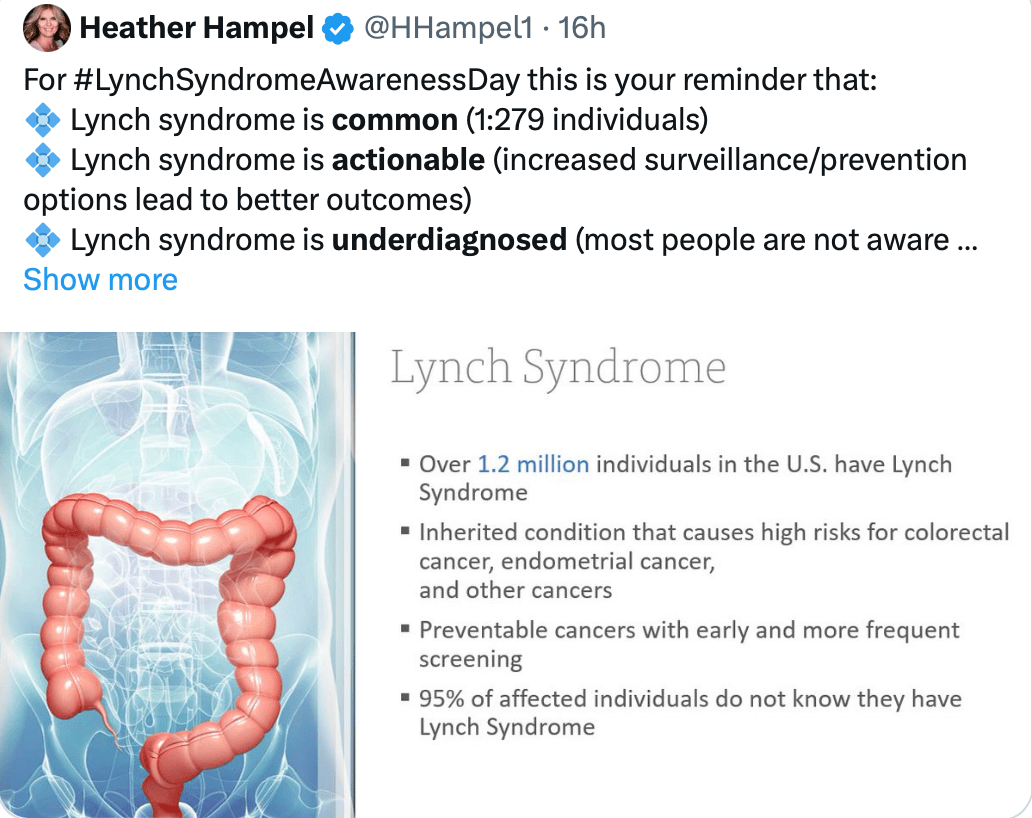
Lynch syndrome is Common, Actionable and Underdiagnosed
Family matter

Lynch Syndrome awareness week

Lynch syndrome is an inherited disease.
This means it is passed down from generation to generation, from parent to child. If one parent has Lynch syndrome and the other does not, there is a 50% chance that their child will have it.
It is among the most common hereditary cancer syndromes. It is estimated that 1 in 300 people have Lynch syndrome.
However, most people do not know they have it.
Indications that a family might have the disease is that on the same side of a family, there has been a diagnosis of cancer in multiple relatives. Besides, these cancers tend to appear at a young age.
This syndrome happens because of alterations passed down in genes that impact DNA repair, which is responsible for correcting cell DNA errors when copied. There are five genes implied in this, which are called:
- MLH1, MSH2, MSH6, PMS2 and EPCAM.
Having Lynch Syndrome doesn’t mean you will definitely get cancer, but it does significantly increase your risk. Those with Lynch Syndrome who do get cancer, often do so before the age of 50.
Germline Cancer Susceptibility Gene Testing in Unselected Patients With Colorectal Adenocarcinoma: A Multicenter Prospective Study
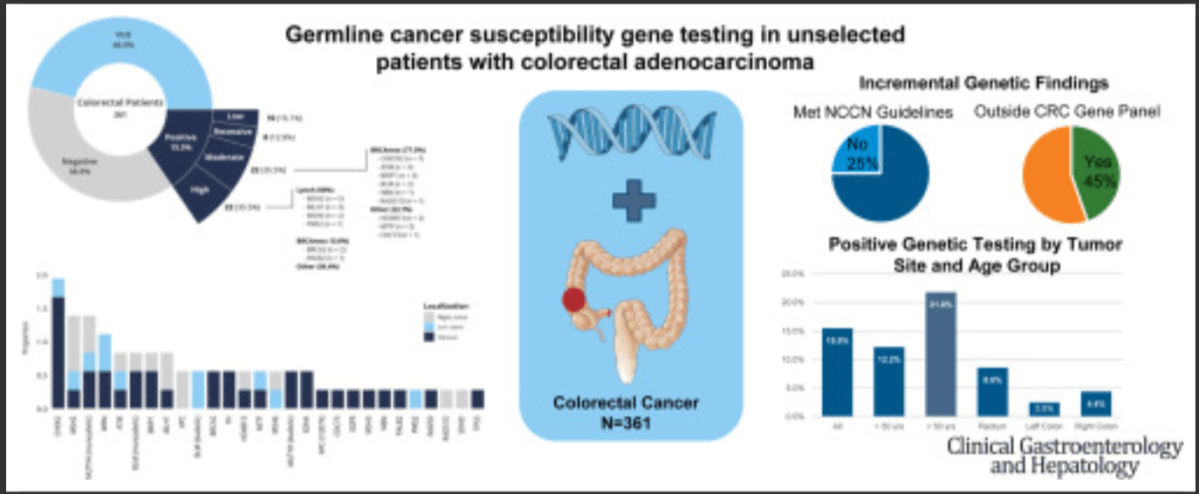
Hereditary factors play a role in the development of colorectal cancer (CRC). Identification of germline predisposition can have implications on treatment and cancer prevention.
Conclusions:
Universal multigene panel testing in CRC was associated with a modest, but significant, detection of heritable mutations over guideline-based testing. One in 10 patients had changes in their management based on test results. Uptake of cascade family testing was low, which is a concerning observation that warrants further study.
https://www.cghjournal.org/article/S1542-3565(21)00447-X/fulltext
Reliable Information….

Check out www.thisisGo.ie
An online personalised resource for you and yours who have been impacted by a gynaecological cancer.
Menopause is a unique experience for every women.
Getting the correct information is key. http://thisisGO.ie gives you relevant, up to date and factual information on all aspects. Reflecting national @MenoAfterCancer and international studies. Check us out!
 Lynch Syndrome Ireland