
A cancer support centre provides emotional and practical support for people dealing with cancer. This includes those who have had a cancer diagnosis and their family and loved ones. Cancer support centres in Ireland are registered with the Charities Regulator. They are self-governed and self-funded.
Category: Information
New national electronic patient health record system proposed

About time….loooong overdue.
Ireland has a Digital Health Strategy, but currently no centralised electronic health record system is in place.
The system allows 24-hour access by doctors and patients to their health information using a secure, free, open-source non-commercial platform.
It has been piloted by the HSE and is currently operational for around 15,000 patients, including Ukrainian refugees, International Protection Applicants, the homeless, the Roman Community and others.
It envisages that doctors will be able to access them in real time, from any location, reducing duplication of tests and making the system more efficient and safer.
https://www.rte.ie/news/health/2024/0626/1456756-digital-health/
National Cancer Strategy(2017-2026) has only been adequately funded in two of the last seven budgets.

As a result, the Irish Cancer Society is calling for:
- An additional €20 million in 2025 in new recurrent funding for the National Cancer Strategy.
- An assessment of the funding needs of cancer services, above this €20 million minimum additional annual funding level, to ensure full implementation of the National Cancer Strategy by 2026.
- End the recruitment embargo by allocating the necessary funding to fill crucial healthcare sector posts based on up-to-date workforce plans.
https://www.cancer.ie/about-us/cancer-advocacy/prebudget-submission-2025
What is Lynch syndrome?

Lynch syndrome (LS) is a genetic condition that is passed on between families (inherited). A syndrome is a group of signs and symptoms that occur together and point to a particular condition.
Most people who have Lynch syndrome are well and don’t know they have LS.
However, someone with LS is more at risk of developing certain types of cancer than other people of a similar age.
Men’s Health

Check out our Men’s Health hub, full of helpful tips for healthy living and how to #SpotCancerEarly at: https://brnw.ch/21wKBEG
Also…
Many men with cancer in the family worry that they are at greater risk of getting it themselves. But this isn’t the case for most people. Cancer is a common disease among older people, so most families will include at least one person who has had cancer.
5 – 10% of cancers are linked to an inherited gene fault.
The strength of your family history depends on:
- Who in your family has had cancer.
- How old they were at diagnosis.
The more relatives who have had cancer, and the younger they were at diagnosis, the stronger your family history. You may have a strong family history if any of these situations apply to you:
- More than two close relatives on the same side of your family have had cancer.
- The cancers developed when they were young (under the age of 50).
- One of your relatives has had a gene fault found by genetic tests.
What should I do if I have a family history of cancer?
Talk to your doctor who can help you find out if your family history of cancer is of concern. Your doctor may suggest that you visit regularly for screening. In this way, you can pick up problems early.
Your family history of cancer can change over time, so it is important to keep your doctor updated about any new cancers diagnosed in your family.
Lynch Choices
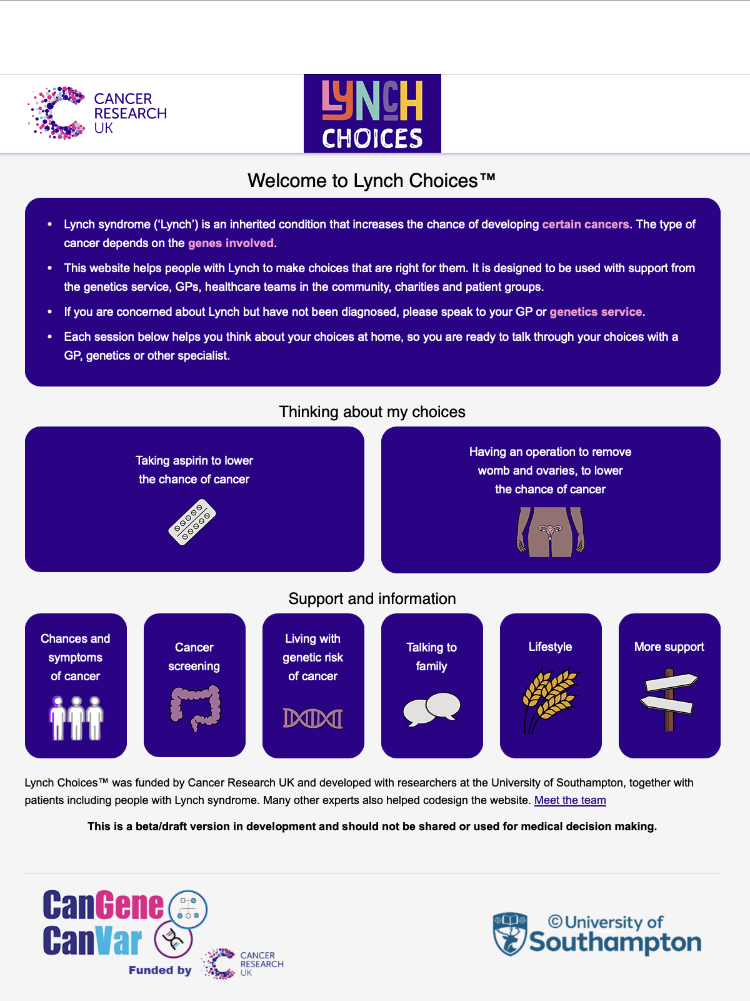
- Lynch syndrome (‘Lynch’) is an inherited condition that increases the chance of developing certain cancers. The type of cancer depends on the genes involved.
- This website helps people with Lynch to make choices that are right for them. It is designed to be used with support from the genetics service, GPs, healthcare teams in the community, charities and patient groups.
- If you are concerned about Lynch but have not been diagnosed, please speak to your GP or genetics service.
- Each session below helps you think about your choices at home, so you are ready to talk through your choices with a GP, genetics or other specialist.
Leveraging Electronic Health Record Data to Understand Gaps Underlying the Underdiagnosis of Lynch Syndrome

Family history may not make its way into the EHR at all. Barriers to obtaining a detailed and accurate family history have been well described, and improvements will require system-level strategies such as the genetic education of nongenetics providers, point-of-care risk assessments, interactive patient-facing software, and other solutions.
The EHR can play an important role in identifying candidates for LS screening and advancing the clinical care of patients with LS.
However, many limitations of the EHR need to be addressed and complementary approaches that incorporate input from all stakeholders are key to improving the lives of individuals with LS.
What I Wish I Was Told About Lynch Syndrome

“The most challenging part of dealing with Lynch syndrome for me is the uncertainty surrounding my son’s health. The fear of him possibly inheriting the mutation gives me anxiety, especially since he hasn’t been tested yet. If it were solely about me, I might have approached things differently — I may have postponed my prophylactic surgeries until after achieving menopause.”
“I didn’t have to face Lynch syndrome alone after realizing that support is always available. That support system, as well as staying ahead on check-ups and focusing on my wellbeing, guided my path after being diagnosed.”
The landscape of Lynch syndrome has significantly evolved over the past decade, with advancements in genetic testing, universal screening and predictive models improving early detection.
https://www.curetoday.com/view/what-i-wish-i-was-told-about-lynch-syndrome
Study: Colorectal Cancer Rates Are Rising Rapidly Among Children and Teens

This rise in colorectal cancer cases among young people has been well-documented in recent years. However, experts are still working to figure out what’s behind the trend.
The myth that someone can be too young to get cancer is just not true.
- Colorectal cancer rates are rising significantly among people as young as 10, a new study has found
- The report sheds more light on the fact that colorectal cancer is increasingly affecting people under the 45 years old—the age at which screenings are recommended to begin(USA).
- Health officials should invest in more research on colorectal cancer in young people to reverse current trends, experts said.
https://www.health.com/study-colorectal-cancer-rates-children-teens-8648696
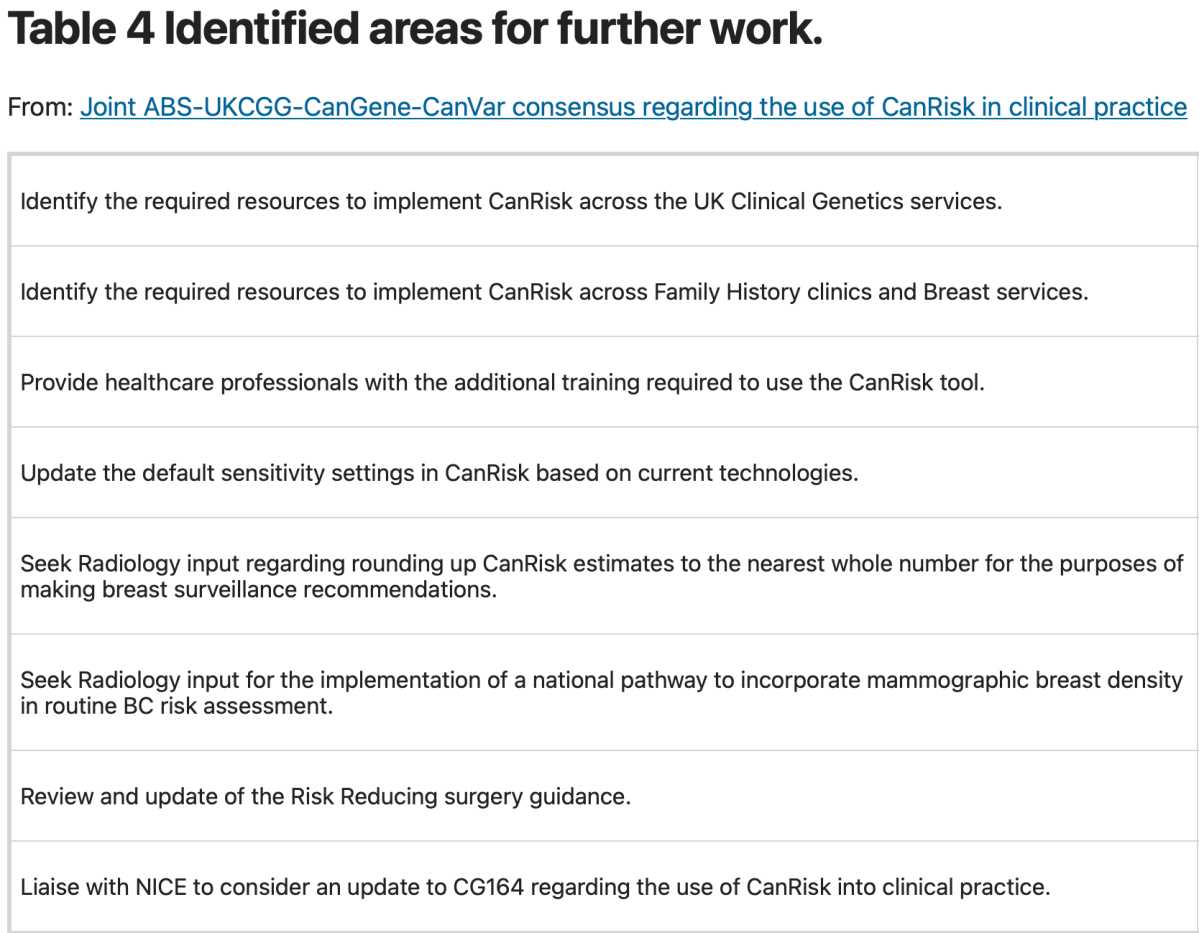
Joint ABS-UKCGG-CanGene-CanVar consensus regarding the use of CanRisk in clinical practice
Background
The CanRisk tool, which operationalises the Breast and Ovarian Analysis of Disease Incidence and Carrier Estimation Algorithm (BOADICEA) is used by Clinical Geneticists, Genetic Counsellors, Breast Oncologists, Surgeons and Family History Nurses for breast cancer risk assessments both nationally and internationally. There are currently no guidelines with respect to the day-to-day clinical application of CanRisk and differing inputs to the model can result in different recommendations for practice.
Conclusions
Whilst consensus recommendations were achieved, the meeting highlighted some of the barriers limiting the use of CanRisk in clinical practice and identified areas that require further work and collaboration with relevant national bodies and policy makers to incorporate wider use of CanRisk into routine breast cancer risk assessments.
 Lynch Syndrome Ireland