

http://gyncsm.blogspot.com/2024/03/march-13-2024-using-immunotherapies-to.html
Category: Ovarian
Managing menopause after cancer
Managing menopausal symptoms after cancer can be challenging, and more severe than at natural menopause. Menopausal symptoms can extend beyond hot flushes and night sweats (vasomotor symptoms). Treatment-induced symptoms might include sexual dysfunction and impairment of sleep, mood, and quality of life.
Menopausal hormone therapy is an effective treatment for vasomotor symptoms and seems to be safe for many patients with cancer.
When hormone therapy is contraindicated or avoided, emerging evidence supports the efficacy of non-pharmacological and non-hormonal treatments, although most evidence is based on women older than 50 years with breast cancer.
https://www.sciencedirect.com/science/article/pii/S0140673623028027?dgcid=coauthor#fig2
Updates in gynaecologic care for individuals with lynch syndrome

As the landscape of gynaecologic cancer treatment shifts towards treatment based on molecular classification of tumours, knowledge of targeted therapies well-suited for mismatch repair deficient Lynch tumours will be crucial.
Identifying barriers and improving access to risk reduction measures is another future direction in the study of Lynch syndrome, and perhaps the greatest frontier is determining whether Lynch-associated endometrial and ovarian tumors should be treated differently than sporadic endometrial and ovarian tumors.
https://www.frontiersin.org/journals/oncology/articles/10.3389/fonc.2023.1127683/full
Genomics Toolkit: Gynae-Macmillan Cancer Support
The Macmillan Genomics Toolkit is designed to guide healthcare professionals to multiple education resources, pathway guidelines, clinical documents, patient support information and case studies to demonstrate the ‘Gold Standard’ of care once genomics has been embedded into practice. It has been developed in collaboration with expert healthcare professionals and the NHS England National Genomics Education team.
Reliable Information….

Check out www.thisisGo.ie
An online personalised resource for you and yours who have been impacted by a gynaecological cancer.
Menopause is a unique experience for every women.
Getting the correct information is key. http://thisisGO.ie gives you relevant, up to date and factual information on all aspects. Reflecting national @MenoAfterCancer and international studies. Check us out!
Lynch Decision Aid – Lynch Choices
“Please help us to make sure families with Lynch are invited to complete a short digital patient survey to tell us what they think, before we roll this out into clinical practice:
https://southampton.qualtrics.com/jfe/form/SV_1FvPJJEZPVX62aO
If you have an X/Twitter account, please see this post and share it if you can:https://x.com/kohut_kelly/status/1765675956159623324?s=20
https://thisisgo.ie

A personalised online resource for women impacted by cervical cancer. If you have a partner in your life, this platform can also support them. If you are a health care provider working in the area this can also support you and your
practice.
If you are newly diagnosed, receiving treatment, in surveillance
or living well with and beyond cancer this has information that is
tailored to meet your needs.
Also information on Ovarian, Uterine, Vulval and Vaginal cancers.
In addition a genetic pathway for those impacted by BRCA and Lynch Syndrome.
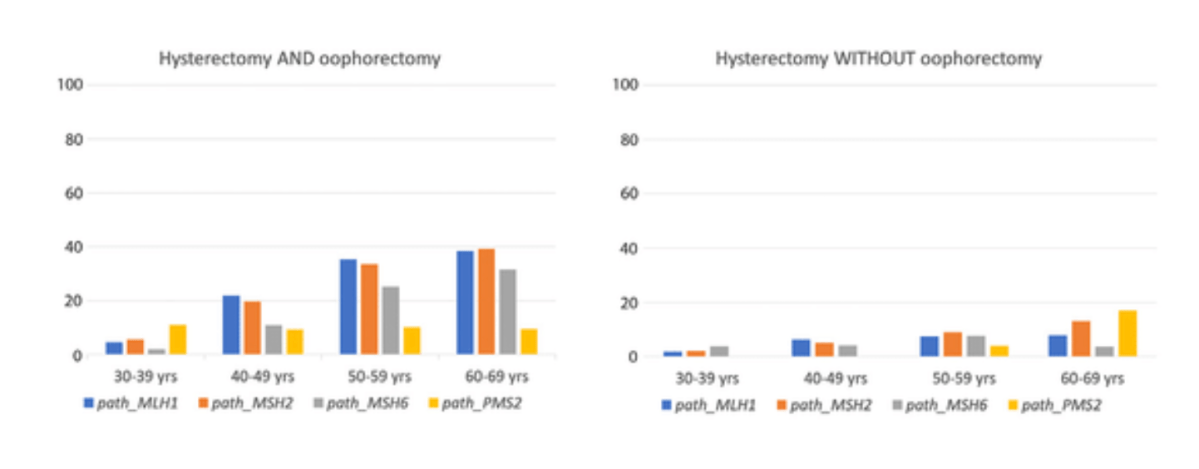
Uptake of hysterectomy and bilateral salpingo-oophorectomy in carriers of pathogenic mismatch repair variants: a Prospective Lynch Syndrome Database report(2021)
Conclusion:
Uptake of RRS before 50 years of age was low, and RRS was rarely undertaken in association with surgical treatment of CRC.
Uptake of RRS aligned poorly with gene- and age-associated risk estimates for endometrial or ovarian cancer that were published recently from PLSD and did not correspond well with current clinical guidelines.
The reasons should be clarified. Decision-making on opting for or against RRS and its timing should be better aligned with predicted risk and mortality for endometrial and ovarian cancer in Lynch syndrome to improve outcomes.
Aging After Oophorectomy

“In navigating the effects of accelerated aging post-oophorectomy, HRT can be an essential tool for those who have not achieved menopause. While it can alleviate various symptoms and health risks, it is crucial to discuss its potential benefits and drawbacks with a healthcare provider.”
(thisisGO.ie) is an online personalised resource for you and yours who have been impacted by a gynaecological cancer.

Phase 1 was launched on September 20th 2021. It is a personalised
online resource for women impacted by cervical cancer. If you have a partner in your life, this platform can also support them. If you are a health care provider working in the area this can also support you and your
practice.
If you are newly diagnosed, receiving treatment, in surveillance
or living well with and beyond cancer thisisGO.ie has information that is
tailored to meet your needs.
During 2022 the remaining 4 gynaecological cancers Ovarian, Uterine, Vulval and Vaginal were launched as well as the addition of a genetic pathway for those impacted by BRCA and Lynch Syndrome.
 Lynch Syndrome Ireland