NCCN guidelines

Genetic/Familial High-Risk Assessment: Colorectal

– Adenomatous Polyposis Testing Criteria

– Attenuated Familial Adenomatous Polyposis

– Colonic Adenomatous Polyposis of Unknown Etiology

– Familial Adenomatous Polyposis

– Juvenile Polyposis Syndrome

– Lynch Syndrome

– MUTYH-Associated Polyposis

– Peutz-Jeghers Syndrome

– Serrated Polyposis Syndrome

Fallopian Tubes and Ovarian Cancer: What’s the Connection?

Ovarian cancer almost always starts in the fallopian tubes.

Why is it called ovarian cancer if it doesn’t start there? For a long time, the ovaries were assumed to be the source because that is where the cancer is concentrated at the time of diagnosis.

Who should consider the procedure? 

Women who have an average risk of ovarian cancer who no longer desire fertility but also want to reduce the risk of developing ovarian cancer might consider the procedure. Women with an elevated risk due to a gene mutation or family history should speak to their genetic counselor or doctor for more information. 

What are the benefits and drawbacks? 

For women with an average risk of ovarian cancer, the surgery has the potential to reduce the likelihood of ovarian cancer. The surgery is not reversible and causes infertility. Pregnancy is still possible, though only via in-vitro fertilization. For pre-menopausal women, removal of the fallopian tubes only, and not the ovaries, does not induce menopause.

The recovery time for fallopian tube removal is a few days to a few weeks, though the overall recovery time will depend on the primary reason for surgery. 

A Guide to Lynch Syndrome

Lynch Syndrome is an inherited condition that increases your risk of developing some cancers, including bowel, womb and ovarian cancer. This is a guide to run through everything you need to know about Lynch.

This guide has been made with input from experts, people with Lynch Syndrome and Ask Eve nurses to provide you with all the information you need when offered testing for, or navigating a diagnosis of, Lynch Syndrome.  

We also have an Easy Read guide to Lynch Syndrome, which you can download here 

#GOforTesting #GOforPrevention

What do negative results from a genetic test mean?

Sounds like good news. Negative test results means that the laboratory didn’t find any mutations in one´s 🧬 DNA that are known to increase the risk of developing cancer.

☝️ But don’t forget! It is still necessary to undergo regular check-ups and take care of your health every day.

The English National Lynch Syndrome Transformation Project

There is consistent evidence of the cost-effectiveness and clinical benefit of a structured diagnostic pathway in patients with LS following a diagnosis of cancer linked to cascade testing in families. 

Existing guidelines recommend universal testing of newly diagnosed colorectal and endometrial cancer for Lynch syndrome.

….Another approach to deliver effective diagnosis is to develop ‘mainstreaming’ models whereby patients are offered constitutional genetic testing by their cancer treating teams locally, rather than relying on referral of eligible patients to tertiary services such as clinical genetics.

Conclusions

Whilst there is increased awareness of the cancer risks associated with LS, and other aspects of the condition, by clinicians, there remain significant gains which can be made in diagnosis and subsequent lifelong management of people with LS.

Effective diagnosis needs to deliver people with this condition to effective clinical risk mitigation through a range of mechanisms including nationally coordinated and quality-assured colonoscopic surveillance.

In this project, we have aimed to develop expertise within cancer teams across England, with clear responsibilities, leadership from within which will ensure that the patients they are managing with cancer will receive appropriate testing and delivery diagnosis.

The responsibility for managing cascade testing remains with specialist genomics services.

However lifelong care of people diagnosed with this condition depends on awareness of who this population is, as defined through a national registry, and access to regional multidisciplinary expertise.

https://www.bsg.org.uk/service-success-stories/the-english-national-lynch-syndrome-transformation-project/

Be aware of gene changes and cancer in your family and take part in screening to reduce your risk of cancer.

https://www.cancer.ie/cancer-information-and-support/cancer-types/bowel-colorectal-cancer/lynch-syndrome

Lynch Syndrome Booklet -Eve Appeal(UK)

Lynch Syndrome and understanding your options

People with Lynch Syndrome are at a higher risk than the general population of developing some cancers. Identifying people who have Lynch Syndrome can have important benefits, including prevention of cancer, spotting it early and helping doctors decide on the best treatment for people who do develop cancer.

This booklet aims to help you understand more about the syndrome, what your options are

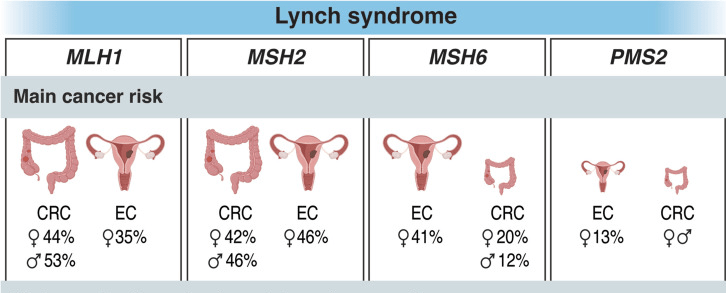
Lynch Syndrome: A Single Hereditary Cancer Syndrome or Multiple Syndromes Defined by Different Mismatch Repair Genes?

The risks of cancer (cumulative risks for various cancer types) differ among Lynch syndrome patients based on the specific altered MMR gene.

It may be appropriate to consider categorising Lynch syndrome as 4 distinct syndromes based on the specific altered MMR gene.

The varying carcinogenic mechanisms and associated cancer risks indicate the need for gene-specific surveillance recommendations in Lynch syndrome.

Moreover, the growing understanding of gene-specific differences will likely affect treatment options and efficacy of Lynch syndrome vaccines.

Studies of larger sample series are needed to definitively confirm the differences in mutational features identified across Lynch syndrome tumors and to evaluate the associated clinical consequences.

https://www.gastrojournal.org/article/S0016-5085(23)00696-0/fulltext