Adventures in Annual Endoscopies

Today was the day of my annual endoscopies – a flexible sigmoidoscopy, a gastroscopy, and a capsule endoscopy placed via gastroscopy.

Every little win is a win. There’s no point just bouncing onto the next worry, especially if it might never come.

Find joy now, in getting at least one out of three clear tests, and freedom to eat an ice cream sandwich.

National Cancer Strategy(2017-2026) has only been adequately funded in two of the last seven budgets. 

As a result, the Irish Cancer Society is calling for: 
  • An additional €20 million in 2025 in new recurrent funding for the National Cancer Strategy.
  • An assessment of the funding needs of cancer services, above this €20 million minimum additional annual funding level, to ensure full implementation of the National Cancer Strategy by 2026.
  • End the recruitment embargo by allocating the necessary funding to fill crucial healthcare sector posts based on up-to-date workforce plans.

https://www.cancer.ie/about-us/cancer-advocacy/prebudget-submission-2025

Dominantly inherited micro-satellite instable cancer – the four Lynch syndromes – an EHTG, PLSD position statement

In the Lynch syndromes (LS) we now recognize a dynamic balance between two stochastic processes: MSI producing abnormal cells, and the host’s adaptive immune system’s ability to remove them.

The latter may explain why colonoscopy surveillance does not reduce the incidence of colorectal cancer in LS, while it may improve the prognosis.

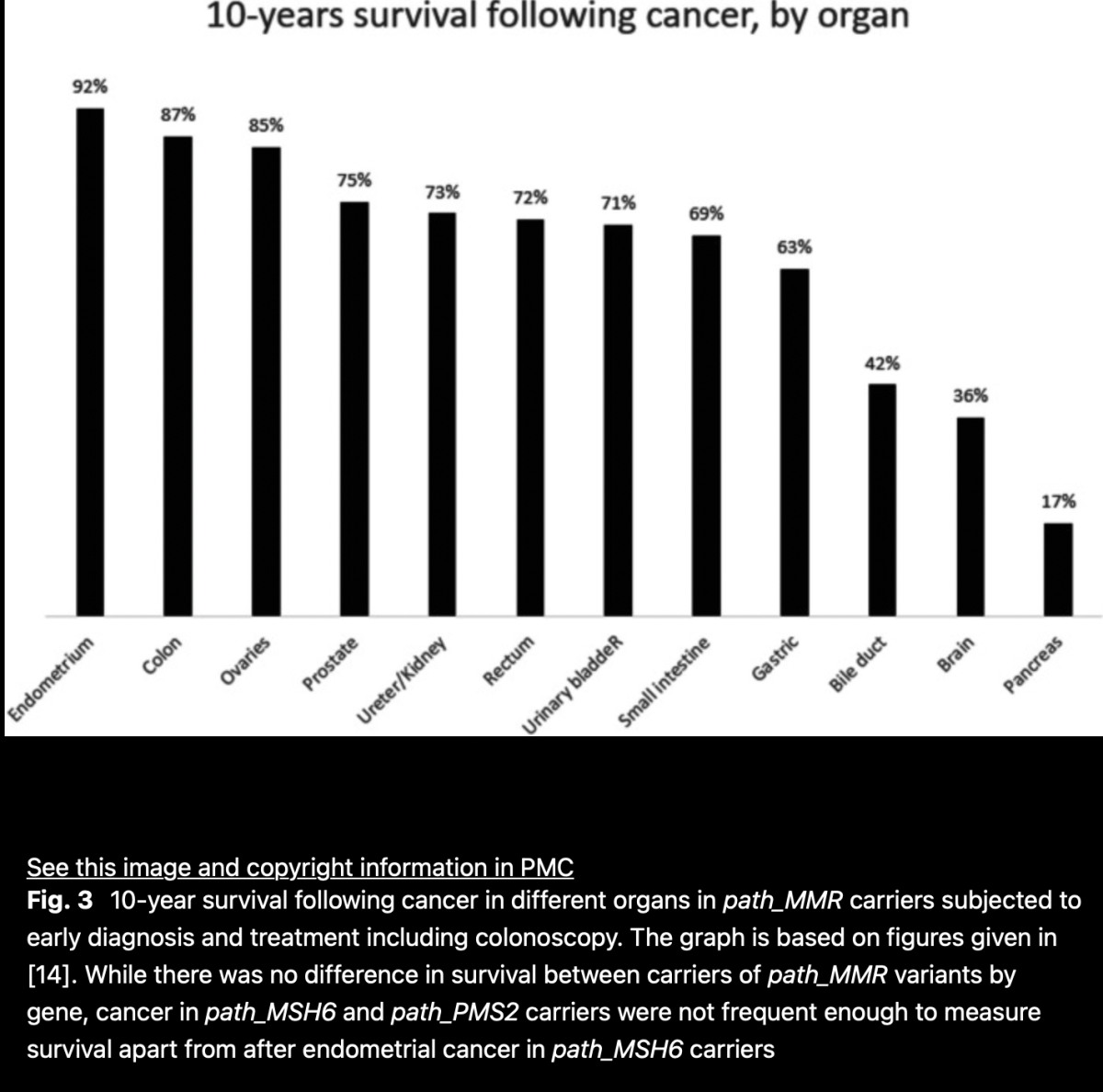
Most early onset colon, endometrial and ovarian cancers in LS are now cured and most cancer related deaths are after subsequent cancers in other organs.

Aspirin reduces the incidence of colorectal and other cancers in LS.

Immunotherapy increases the host immune system’s capability to destroy MSI cancers.

Colonoscopy surveillance, aspirin prevention and immunotherapy represent major steps forward in personalized precision medicine to prevent and cure inherited MSI cancer.

https://pubmed.ncbi.nlm.nih.gov/37821984/

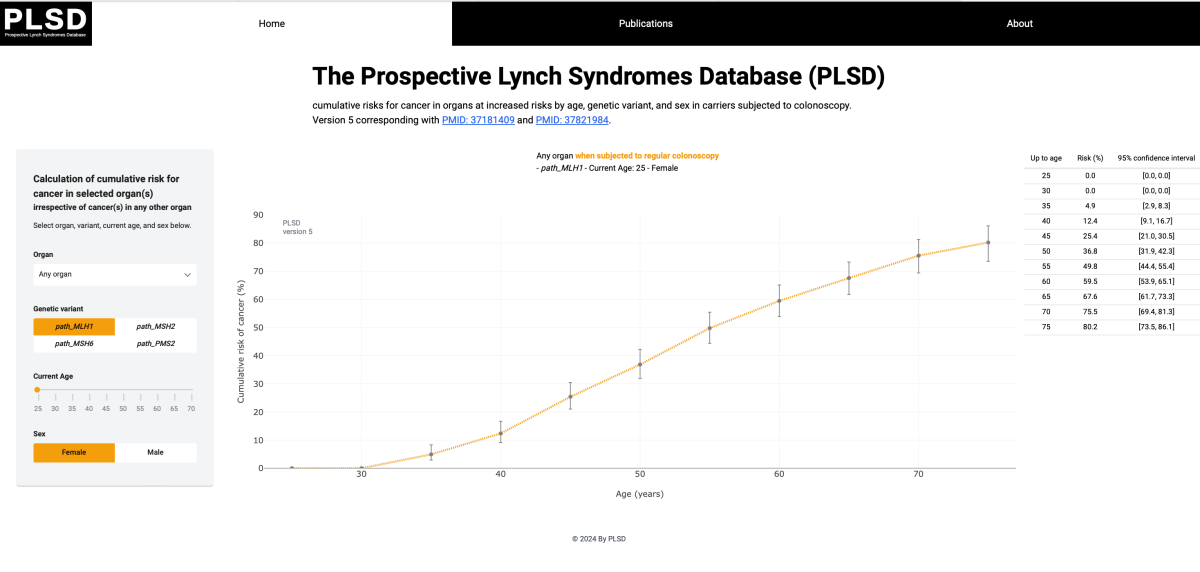
The Prospective Lynch Syndromes Database (PLSD)

cumulative risks for cancer in organs at increased risks by age, genetic variant, and sex in carriers subjected to colonoscopy.

Version 5 corresponding with PMID: 37181409 and PMID: 37821984.

Aims of PLSD

Based on the observation that removal of adenomas with colonoscopy did not reduce CRC incidence as assumed, in 2012 the European Hereditary Tumor Group (EHTG), at that time denoted the Mallorca Group, decided to compile information on follow-up of path_MMR carriers across multiple specialist centres to answer three questions:

  • To what degree does colonoscopy surveillance reduce CRC incidence in path_MMR carriers?
  • What is the penetrance and expressivity of pathogenic variants in each of the four Lynch syndrome-associated genes?
  • What is the survival of carriers when followed-up as recommended, to facilitate early diagnosis and treatment?

http://www.plsd.eu

Modifiable risk factors for cancer among people with lynch syndrome: an international, cross-sectional survey

Lynch syndrome is the most common cause of hereditary colorectal and endometrial cancer. Lifestyle modification may provide an opportunity for adjunctive cancer prevention. In this study, they aimed to characterise modifiable risk factors in people with Lynch syndrome and compare this with international guidelines for cancer prevention.

Conclusions

They have characterised the modifiable risk profile of people living with Lynch syndrome, outlining targets for intervention based on lifestyle guidelines for the general population. As evidence supporting the relevance of modifiable factors in Lynch syndrome emerges, behavioural modification may prove an impactful means of cancer prevention.

https://hccpjournal.biomedcentral.com/articles/10.1186/s13053-024-00280-w

What is Lynch syndrome?

Lynch syndrome (LS) is a genetic condition that is passed on between families (inherited). A syndrome is a group of signs and symptoms that occur together and point to a particular condition. 

Most people who have Lynch syndrome are well and don’t know they have LS.

However, someone with LS is more at risk of developing certain types of cancer than other people of a similar age.

https://www.cancer.ie/cancer-information-and-support/cancer-types/bowel-colorectal-cancer/lynch-syndrome

Leveraging Electronic Health Record Data to Understand Gaps Underlying the Underdiagnosis of Lynch Syndrome

Family history may not make its way into the EHR at all. Barriers to obtaining a detailed and accurate family history have been well described, and improvements will require system-level strategies such as the genetic education of nongenetics providers, point-of-care risk assessments, interactive patient-facing software, and other solutions.

The EHR can play an important role in identifying candidates for LS screening and advancing the clinical care of patients with LS.

However, many limitations of the EHR need to be addressed and complementary approaches that incorporate input from all stakeholders are key to improving the lives of individuals with LS.

https://ascopubs.org/doi/full/10.1200/CCI.24.00032

New bowel cancer screening launches for Lynch syndrome patients in England

new NHS testing programme for bowel cancer has been launched for people with Lynch Syndrome, following an initiative to increase genomic testing for the condition.

 Around 10,000 people with Lynch syndrome will start receiving invitations to take part this year.

Dr Kevin Monahan, who led the NHS England Lynch syndrome transformation project, said: “Incorporating people with Lynch syndrome into the national colonoscopy screening programme is game-changing and will save many lives each year.

It will deliver prevention and early diagnosis of bowel cancer through timely and high-quality colonoscopy. Now diagnosis of this hereditary condition in England will be linked to lifelong patient-focused care.

What I Wish I Was Told About Lynch Syndrome

“The most challenging part of dealing with Lynch syndrome for me is the uncertainty surrounding my son’s health. The fear of him possibly inheriting the mutation gives me anxiety, especially since he hasn’t been tested yet. If it were solely about me, I might have approached things differently — I may have postponed my prophylactic surgeries until after achieving menopause.”

“I didn’t have to face Lynch syndrome alone after realizing that support is always available. That support system, as well as staying ahead on check-ups and focusing on my wellbeing, guided my path after being diagnosed.”

The landscape of Lynch syndrome has significantly evolved over the past decade, with advancements in genetic testing, universal screening and predictive models improving early detection.

https://www.curetoday.com/view/what-i-wish-i-was-told-about-lynch-syndrome

Study: Colorectal Cancer Rates Are Rising Rapidly Among Children and Teens

This rise in colorectal cancer cases among young people has been well-documented in recent years. However, experts are still working to figure out what’s behind the trend.

The myth that someone can be too young to get cancer is just not true.

  • Colorectal cancer rates are rising significantly among people as young as 10, a new study has found
  • The report sheds more light on the fact that colorectal cancer is increasingly affecting people under the 45 years old—the age at which screenings are recommended to begin(USA).
  • Health officials should invest in more research on colorectal cancer in young people to reverse current trends, experts said.

https://www.health.com/study-colorectal-cancer-rates-children-teens-8648696