Baseline Features and Reasons for Nonparticipation in the Colonoscopy Versus Fecal Immunochemical Test in Reducing Mortality From Colorectal Cancer (CONFIRM) Study, a Colorectal Cancer Screening Trial

The Colonoscopy Versus Fecal Immunochemical Test in Reducing Mortality From Colorectal Cancer (CONFIRM) randomized clinical trial sought to recruit 50 000 adults into a study comparing colorectal cancer (CRC) mortality outcomes after randomization to either an annual fecal immunochemical test (FIT) or colonoscopy.

Conclusions and relevance: In this cross-sectional analysis of veterans(enrollment was through 46 Department of Veterans Affairs medical centers, comprised veterans aged 50 to 75 years with an average CRC risk and due for screening). choosing nonenrollment in the CONFIRM study, those who declined participation more often preferred FOBT or FIT over colonoscopy. This preference increased over time and was strongest in the western US and may provide insight into trends in CRC screening preferences.
https://pubmed.ncbi.nlm.nih.gov/37432690/

RESEARCH PARTICIPANTS

Deciding to take part in a clinical study is an important personal decision. This section aims to help you understand more about clinical research and how you can get involved.

Clinical research is research involving humans, their bio samples (e.g. blood sample) or their data. Clinical research is carried out with the aim of improving existing healthcare for the benefit of current and future patients. 

A research study/trial can involve ‘healthy participants’ (i.e. people who do not have an underlying medical condition) but more often, studies/trials involve patients with a specific health condition that we want to study. Research studies are designed to answer specific questions on how to prevent, diagnose or treat a particular disease.

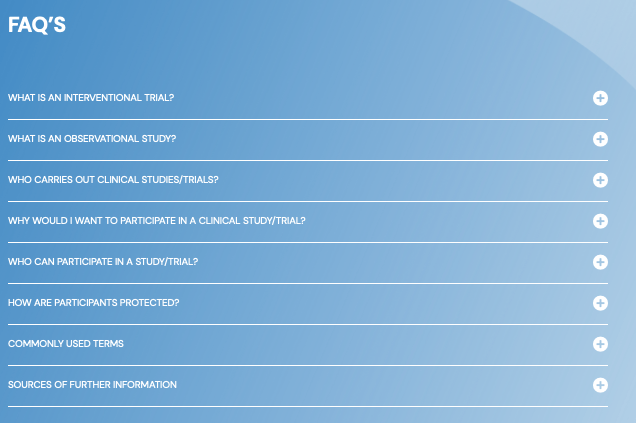
There are two main types of clinical studies: Interventional trials and Observational studies.

Researchers believe personalised medicine and vaccines are probably the next big thing in the quest to reduce cancer deaths

The next big advance in cancer treatment could be a vaccine that can shrink tumours and stop cancer from returning, US experts have said.

More than ever, scientists understand how cancer hides from the body’s immune system. Cancer vaccines, like other immunotherapies, boost the immune system to find and kill cancer cells. Some new ones use mRNA, which was developed for cancer but was first used for Covid-19 vaccines.

People with the inherited condition known as Lynch syndrome have a 60 per cent to 80 per cent lifetime risk of developing cancer. Recruiting them for cancer vaccine trials has been remarkably easy, said Dr Eduardo Vilar-Sanchez of MD Anderson Cancer Centre in Houston, who is leading two government-funded studies on vaccines for Lynch-related cancers.

https://www.irishtimes.com/business/innovation/2023/07/06/cancer-vaccine-research-has-reached-turning-point-experts-say/

A Safety and Efficacy Comparison of a New Sulfate-Based Tablet Bowel Preparation Versus a PEG and Ascorbate Comparator in Adult Subjects Undergoing Colonoscopy (2020)

https://www.ncbi.nlm.nih.gov/pmc/articles/PMC7864663/

(515 participants)

RESULTS:

A high rate of cleansing success was seen with OST(Oral sulfate tablets) (92%), which was noninferior to PEG-EA(Polyethylene glycol-electrolyte solution) (89%). Only a small proportion of subjects rated their expected gastrointestinal symptoms as severe (<5% for both preps). No clinically significant differences were seen between preps for chemistry and hematology parameters. No serious adverse experiences were reported with OST.

DISCUSSION:

Sulfate tablets achieved a high level of cleansing in the study, comparable with US FDA–approved preps. OST was noninferior to PEG-EA in this study and achieved significantly more Excellent preps overall and in the proximal colon. The OST prep was well-tolerated, with a similar rate of spontaneously reported adverse experiences to PEG-EA and a low rate of severe expected gastrointestinal symptoms.

Normal Human DNA Variation – Variant of Unknown Significance (VUS)

A short animation from Dr Sally Ann Lynch explaining Variants of Unknown Significance in medical genetics. (2018)

What is the Lynch syndrome registry? (England)

The Lynch syndrome registry records and analyses important information about people with Lynch syndrome.

This helps to understand how people with Lynch syndrome are looked after and cared for across England. All information is held on a secure and confidential computer database.

Why have a Lynch syndrome registry? 

The registry will collect information from people with Lynch syndrome and help to better understand how these people are currently being monitored and managed.

The registry will ultimately be an efficient system that with the help of the bowel cancer screening programme will allow nationally coordinated care for you and others with Lynch syndrome.

It will also become a valuable central research resource that could be used to support other studies.

Lynch Syndrome: A Single Hereditary Cancer Syndrome or Multiple Syndromes Defined by Different Mismatch Repair Genes?

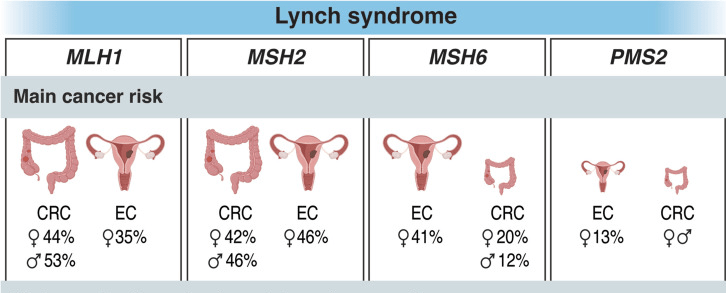
The risks of cancer (cumulative risks for various cancer types) differ among Lynch syndrome patients based on the specific altered MMR gene.

It may be appropriate to consider categorising Lynch syndrome as 4 distinct syndromes based on the specific altered MMR gene.

The varying carcinogenic mechanisms and associated cancer risks indicate the need for gene-specific surveillance recommendations in Lynch syndrome.

Moreover, the growing understanding of gene-specific differences will likely affect treatment options and efficacy of Lynch syndrome vaccines.

Studies of larger sample series are needed to definitively confirm the differences in mutational features identified across Lynch syndrome tumors and to evaluate the associated clinical consequences.

https://www.gastrojournal.org/article/S0016-5085(23)00696-0/fulltext

Dr Ian Frayling(President Association of Clinical Pathologists), Lynch Syndrome UK Patients Conference 2023

What’s going on in Lynch Syndrome?

Better way of diagnosing Lynch Syndrome…

Individualising treatment…

How common is Lynch Syndrome???

No Longer a rare issue.

Patient decision support resources inform decisions about cancer susceptibility genetic testing and risk management: a systematic review of patient impact and experience

Conclusion: Decision support resources about genetic cancer susceptibility are likely useful to support decision-making…..Tailored patient-facing decision aids should also be made available to patients identified as carriers of a pathogenic gene variant that increases future cancer risks, to complement traditional genetic counselling.

https://www.frontiersin.org/articles/10.3389/frhs.2023.1092816/full

thisisGO.ie is an online personalised resource for you and yours who have been impacted by a gynaecological cancer

The team at thisisGO.ie recognises the importance of having access to the latest scientific research.

See a sample of recent scientific papers pertinent to gynaecological cancers and summaries the key points from each of the papers referenced below.

If this is of interest to you, you can find lots more articles,  disease specific, when you “Create a Profile”. Once logged in just search ‘Decoding the Science’.