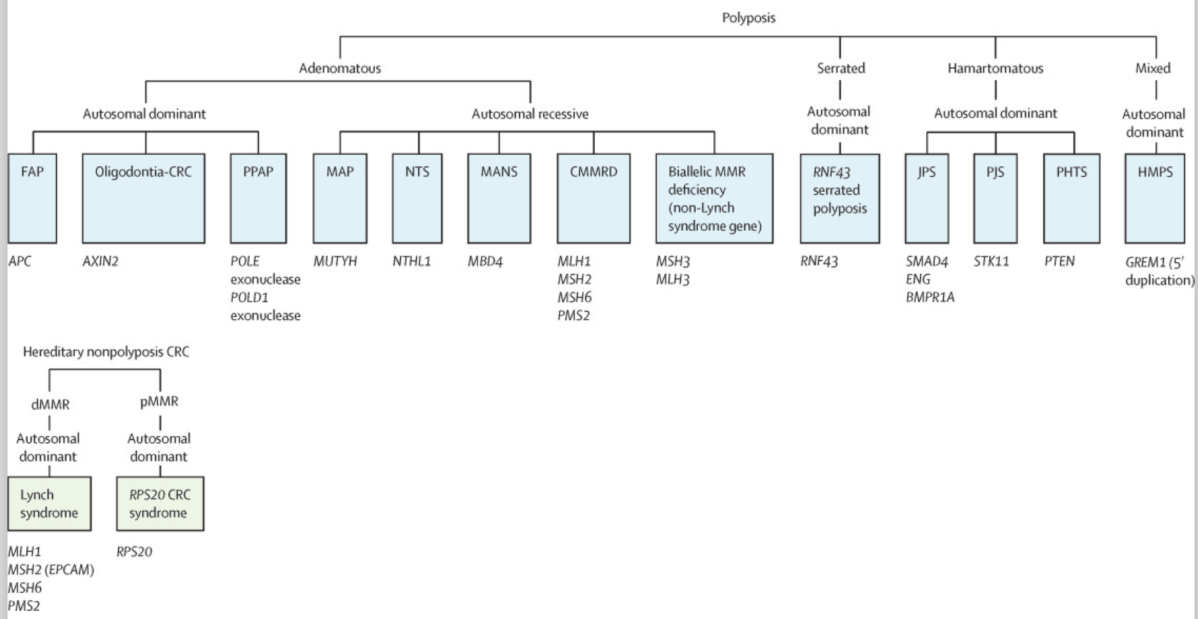
Genetic predisposition to gastrointestinal polyposis:

https://www.thelancet.com/journals/langas/article/PIIS2468-1253(23)00240-6/fulltext

This Review provides an overview of the known syndromes and genes, genetic testing, and clinical management of patients with polyposis, and recent advances and challenges in the field of gastrointestinal polyposis.

COLORECTAL Screening in Europe(2019)

The barriers for screening: (have they changed?)

Despite the obvious value of colorectal cancer screening, many barriers exist that must be taken into account when setting up programmes:

• Patient barrierssuch as fear, socio-demographic, psychosocial, economic or geographic factors as well as awareness, understanding or lifestyle.

• Health care providers’ barriersincluding low screening recommendation, poor coordination and communication between patients and providers, or lack of follow-up.

• Health system barriersincluding inadequate access, screening costs, test-specific factors or delays, as well as the capacity to move patients from screening to colonoscopy to effective treatment.

Lynch Syndrome? Why it’s important to know about it

Lynch syndrome is caused by an inherited mutation in one of these genes:

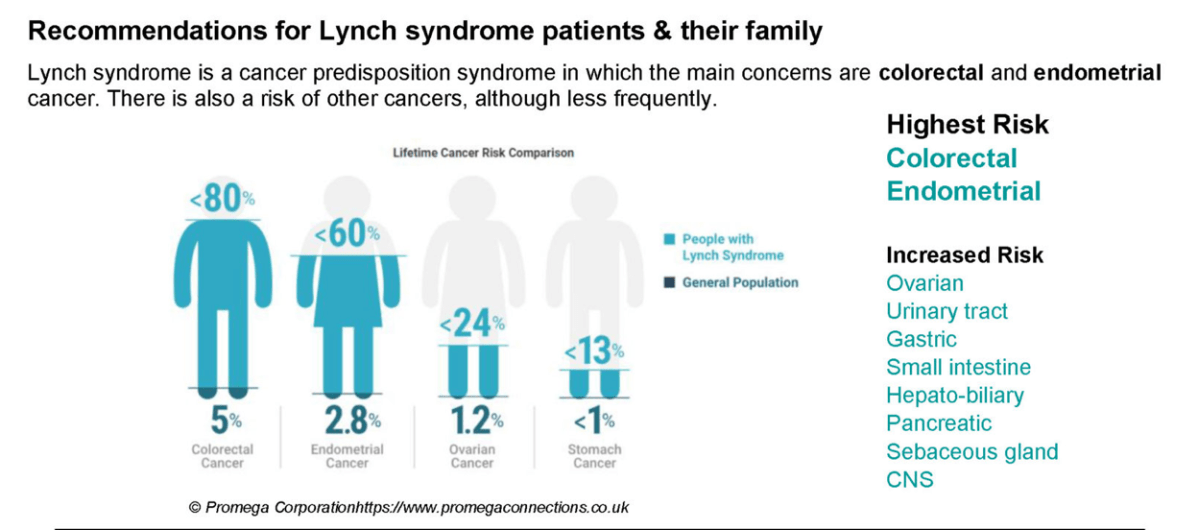
People with Lynch syndrome have an increased risk for colorectal, endometrial and other cancers. The cancer risk varies by gene mutation, therefore it is important for people with Lynch syndrome to know which gene mutation they have.

In the past, the risk-management guidelines were the same for people with an inherited mutation in any of the Lynch syndrome genes. As more research has shown different cancer risks for each gene, experts have started to separate the risks and medical options for each individual mutation. Despite these differences, some references discuss Lynch syndrome as though inherited mutations in these genes carry the same risks. 

If you have been told that you have Lynch syndrome, it is important to know which gene has a mutation, so that you can make informed decisions about your medical care. 

In the past, Lynch syndrome was also referred to as “hereditary nonpolyposis colorectal cancer” (HNPCC). This term has fallen out of favour because mutations in these genes also increase the risk for other cancers besides colorectal cancer. 

Methylated DNA Markers for Sporadic Colorectal and Endometrial Cancer Are Strongly Associated with Lynch Syndrome Cancers

Lynch syndrome (LS) markedly increases risks of colorectal and endometrial cancers. Early detection biomarkers for LS cancers could reduce the needs for invasive screening and surgical prophylaxis.

Prevention Relevance:

Methylated DNA markers previously identified in sporadic endometrial cancer and colorectal cancer discriminate between benign and cancer tissue in LS.

https://aacrjournals.org/cancerpreventionresearch/article-abstract/16/11/611/729696/Methylated-DNA-Markers-for-Sporadic-Colorectal-and?redirectedFrom=fulltext

Transforming the care of people with Lynch syndrome: a system-wide approach

Monahan et al describe progress in addressing the lack of diagnosis of Lynch syndrome in the English National Health Service with a bold attempt to fix a leaking pathway.

There remains much to do, not least inclusion of the many other tumour types seen in LS, but this programme has demonstrated the power of a national system of health provision and the willingness of the professional community to work together to improve the care of people with this common rare disorder.

https://bmjoncology.bmj.com/content/2/1/e000211

“Go ahead and screen” – advice to healthcare systems for routine lynch syndrome screening from interviews with newly diagnosed colorectal cancer patients

Conclusion: Our qualitative findings demonstrate patients with CRC have a strong desire for healthcare systems to regularly implement and offer UTS.

https://pubmed.ncbi.nlm.nih.gov/37978552/

Screening for Lynch Syndrome in people aged 18-40 using a saliva test

A new Australian study published in The Lancet suggests population-wide genetic screening for hereditary breast and ovarian cancer, familial hypercholesterolemia and Lynch syndrome, in people aged 18 to 40, would be cost effective and save lives.

Modelling demonstrates a marked improvement in the overall cost-effectiveness of offering population genomic screening in a combined fashion for multiple conditions together, versus criteria-based clinical genetic testing or screening for individual conditions.

The model structure can be applied to other healthcare systems, making our findings relevant for international jurisdictions, especially countries with national public healthcare systems capable of delivering nation-wide population screening programs.

https://www.thelancet.com/journals/eclinm/article/PIIS2589-5370(23)00474-1/fulltext

Lynch syndrome quick guide for Primary Care clinicians(NHS)

The training involves watching a short video which covers:

  • A brief overview of Lynch syndrome
  • Their personalised cancer prevention programme
  • An introduction to the Lynch syndrome quick guide and how it can help you identify and manage your patient’s care
  • How to manage their first-degree family members’ care

Exploring Stakeholders’ Perspectives on Implementing Universal Germline Testing for Colorectal Cancer: Findings From a Clinical Practice Survey

CONCLUSION: This study(Eighty CGA-IGC members participated) demonstrates wide support among hereditary GI cancer experts for implementation of UGT for patients with CRC. However, alternative service delivery models using nongenetics providers should be considered to address the logistical barriers to UGT implementation, particularly the growing demand for genetic testing.

In conclusion, there is broad support for UGT for all newly diagnosed patients with CRC among the members of the CGA-IGC.

However, changes to practice, such as alternative service delivery models or standardization of test choice, will likely have to be implemented to meet the increased patient volume.

Additional studies are needed to compare UGT implementation strategies (eg, traditional or alternative service delivery models) to ensure there is equitable access to genetic testing and improved outcomes for patients with CRC.

https://ascopubs.org/doi/full/10.1200/PO.23.00440

(thisisGO.ie) is an online personalised resource for you and yours who have been impacted by a gynaecological cancer.

Phase 1 was launched on September 20th 2021.  It is a personalised
online resource for women impacted by cervical cancer.
If you have a partner in your life, this platform can also support them. If you are a health care provider working in the area this can also support you and your
practice. 

If you are newly diagnosed, receiving treatment, in surveillance
or living well with and beyond cancer thisisGO.ie has information that is
tailored to meet your needs.

During 2022 the remaining 4 gynaecological cancers Ovarian, Uterine, Vulval and Vaginal were launched as well as the addition of a genetic pathway for those impacted by BRCA and Lynch Syndrome.