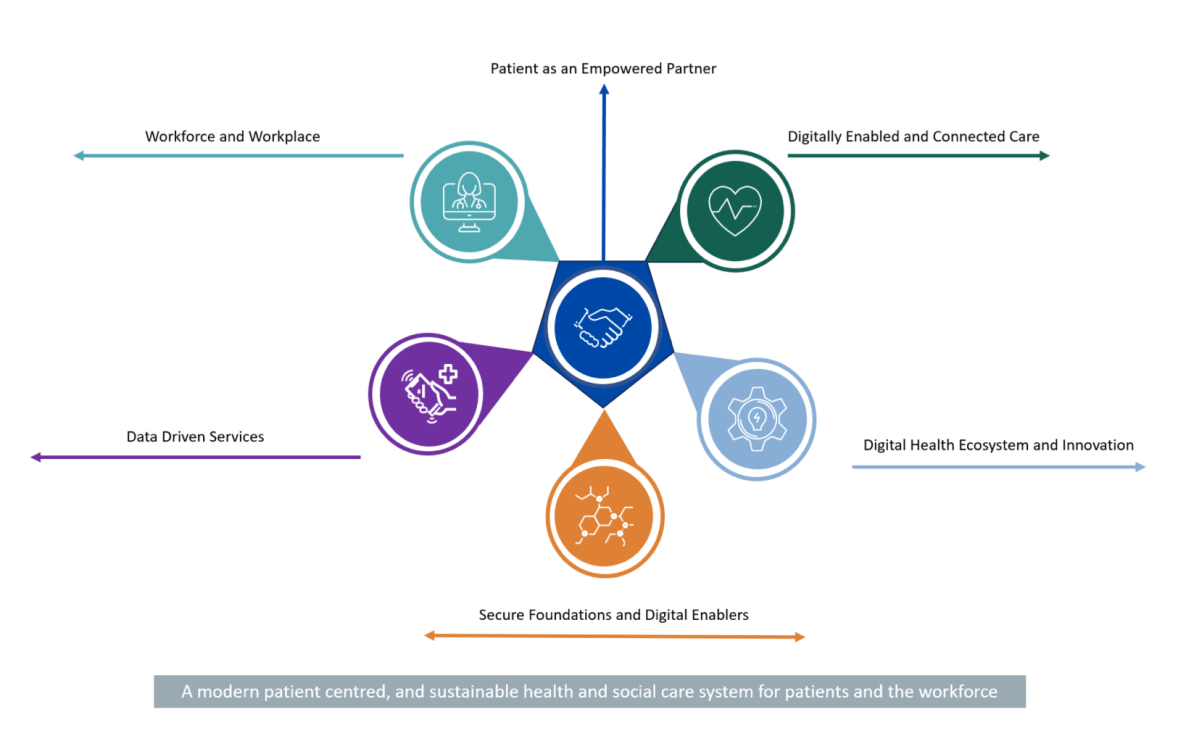
Digital for Care —A Digital Health Framework for Ireland: 2024-2030

-Patient as an empowered partner: We will empower patients by giving them broader access to their own health information through a patient app, provide access to more digital health services, including virtual care offerings, whilst enabling greater autonomy and choice over their care options.

Workforce and workplace: We will enable our workforce by providing them with the technology, systems, and skills they need to deliver the best possible care and services to patients in the modernised healthcare system. 

Digitally Enabled and Connected Care: We will drive future investment and make architectural decisions based on the ability of systems to share clinical information and deliver connected care. We will make it possible for healthcare professionals, and others who support delivery of care, to be able to access the information needed about their patients when and where they need it, regardless of where those patients were treated previously. 

Data driven services: We will leverage data analytics, business intelligence, visualisation, dashboards, and other digitally enabled management tools to provide greater insights into the health service and its operation. This will create opportunities for increased productivity, efficiency and more precise direction of resources to areas of greatest need, and where they will have the maximum impact. 

Digital health ecosystem & innovation: We will embed continuous improvement within the health and social care system. This will be enabled by innovation via improving ongoing collaboration, improved procurement pathways, increased participation, and promoting research excellence. This strategic principle also details key considerations for the Digital health ecosystem as we prepare for the technologies of the future.

Secure foundations & digital enablers: We will continue to build cyber resilience and put in place the key enablers needed to deliver this digital health strategic roadmap, underpinned by strong governance, cultural change, standards, interoperability, infrastructure, architecture, and legislation.
https://www.gov.ie/en/publication/0d21e-digital-for-care-a-digital-health-framework-for-ireland-2024-2030/

European Health Data Space (EHDS) Regulation

What are the implications for patients?

The primary goal of the EHDS is to empower patients to access their health data and enable health professionals to consult patients’ medical records, through Electronic Health Records (EHRs). It will enable citizens in the EU to access, manage, and share their health data electronically (primary use), and facilitate its use for public interest, policy making, and research (secondary use). 

To ensure a successful enforcement of the regulation and mitigate any unintended consequences, we call on Member States and the European Commission to prioritise the following key actions during the implementation period: 

  • Accessibility and Usability: EHR systems must be user-friendly, with clear interfaces. 
  • Transparency: Patients should have transparent information in lay language on how their health data is collected, stored, used, and protected within the EHDS framework. 
  • Consent: It is crucial to provide patients with complete information on the opt-out mechanism from the re-use of health data for secondary purposes. 
  • Digital Health Literacy: It is essential to continue promoting digital health literacy programmes, especially in underserved and rural communities. 
  • Stakeholder Engagement: The EHDS stakeholder forum should function as a true advisory board, whose feedback and recommendations are actively incorporated and acted upon. 
  • Financial Considerations: Addressing concerns about the financial burden on Member States and regions is crucial for sustainable implementation.  
  • Security and Privacy: Ensuring state-of-the-art security measures to strengthen the protection and cybersecurity surrounding data storage and processing is of utmost importance. 
  • Minimising Legal Uncertainty: It is critical to reduce legal uncertainties surrounding the implementation of EHDS. 

Individual Health Identifier (IHI)

Did you know….

The Health Identifiers Act 2014 was enacted by the government to allow two new national data collections–called the National Register of Individual Health Identifiers and the National Register of Health Service Provider Identifiers to be created and operated.

An Individual Health Identifier (IHI) has the following benefits for you:

Improved accuracy in identifying you and your medical records will
lead to safer and better care being provided to you.

Improved accuracy in identifying and associating your records in
different healthcare organisations.
Your health information can be shared safely and seamlessly
between health service providers, for example on referral letters
sent from a private GP to a public hospital.

The use of an Individual Health identifier also enables the
electronic transfer of your health information, which results in faster
care for you.

Medical or clinical information will NEVER be stored on your IHI record. Health
service providers may however use your IHI, to uniquely identify you, when
communicating with other health service providers about your care for example
when a medical consultant is corresponding with your GP or visa versa.