
“Tell your family” sounds straightforward. But in practice, it’s usually a bit more complicated…..

We don’t talk nearly enough about WHO is responsible for sharing genetic test results with family members.

While one person may undergo genetic testing, this information affects the entire family.

How we communicate that information matters.

This responsibility usually falls on the proband (the person who undergoes genetic testing first). But every family is different.

🔸 What if you’re still trying to process the result yourself?
🔸 What if you’re estranged from the person who needs to know?
🔸 What if someone else in the family is closer to the person you need to share with?

Primary burden: Patients are generally expected to pass on health and risk details to at-risk relatives.
Healthcare provider assistance: Doctors and genetic counsellors frequently supply family communication letters or record copies to make sharing easier.

Even at the best of times, family dynamics can be tricky (and not just around the holidays!). Now throw in the decision to have genetic testing, receiving powerful results, and having the responsibility of relaying those results to your family members. You guessed it – it can get complicated. The issues that can come up when sharing genetic test results have the potential to throw off any family. And with good reason: genetic test results are intensely personal. These results can change everything, as you probably already know.

Some suggestions I came across…

  • Call or meet face-to-face:  If you have a close relationship with a family member, this might be a good option
  • Send a letter or email, consider social media:  If you’re not as close with a family member, this could work. Your doctor or genetic counselor might even have examples to use, or be able to help you write this.  Social media can be an effective way to consider contacting relatives, particularly if you use direct messages (instead of public posts).
  • Give them what they need:  Your exact test result, with the gene and any mutation(s) found, is what relatives need if they want to do their own testing.
  • Be supportive, but not pushy:  Your relative may be hearing this information for the first time, which can be challenging
  • Give them space:  Time may help them digest the details
  • Offer to be available and share resources:  They might need your help to answer questions, or just to listen.
  • Don’t expect them to do what you did:  Even though they may support your decision to have testing, they may not want it themselves – and this is ok, because everyone is different

Preventive hysterectomy and quality of life: new research highlights the need for tailored support

What was the study about?

The researchers wanted to understand how women with Lynch syndrome feel after having a preventive hysterectomy(surgery to remove the uterus, sometimes along with the ovaries) to lower their risk of womb cancer. They looked at quality of life, emotional wellbeing, menopause symptoms, sexual health, and whether women regretted their decision. 

What did they find?

The good news:

  • Most women were happy they had the surgery.
  • Very few said they regretted their decision.
  • Many reported much less anxiety about developing womb cancer after surgery.
  • Overall quality of life was generally good, especially when menopause symptoms were well managed. 

The biggest challenge:

  • Women who had their ovaries removed before natural menopause often experienced significant menopausal symptoms, such as:
    • hot flushes
    • night sweats
    • vaginal dryness
    • lower sex drive
    • mood changes
    • sleep problems
  • These symptoms were much less severe in women who used hormone replacement therapy (HRT), when it was appropriate for them. 

Did it affect sex life?

For most women, sexual function was not dramatically worse after surgery. Some experienced changes, particularly if they went into surgical menopause, but many remained satisfied with their sexual relationships, especially when menopause symptoms were treated. 

What does this mean for someone with Lynch syndrome?

The study suggests that:

  • Preventive hysterectomy can provide significant peace of mind by greatly reducing the risk of endometrial (womb) cancer.
  • The decision isn’t just about preventing cancer—it’s also about preparing for the effects of surgery, particularly if the ovaries are removed.
  • Good counselling before surgery and appropriate HRT afterwards (for women who can safely take it) can make a big difference to quality of life. 

The bottom line

The message is reassuring rather than alarming. Most women with Lynch syndrome who chose preventive hysterectomy felt it was the right decision, experienced less worry about cancer, and had a good quality of life afterwards. The main issue wasn’t the hysterectomy itself—it was managing the symptoms of early menopause if the ovaries were also removed, and HRT helped many women cope with those symptoms. 

https://www.lynch-syndrome-uk.org/post/preventive-hysterectomy-quality-of-life-study

The role of the Genetic Counsellor in the multidisciplinary team: the perception of geneticists in Europe(2022)

Genetics has begun to be considered a key medical discipline which can have an impact on everyday clinical practice. Therefore, it is necessary to understand what the most effective way is of caring for people affected by or at risk of genetic disorders.

This new profession has difficulties in being recognised in some countries(including Ireland), it seems clear that these highly competent professionals are essential for in-patient care and in the multidisciplinary team.

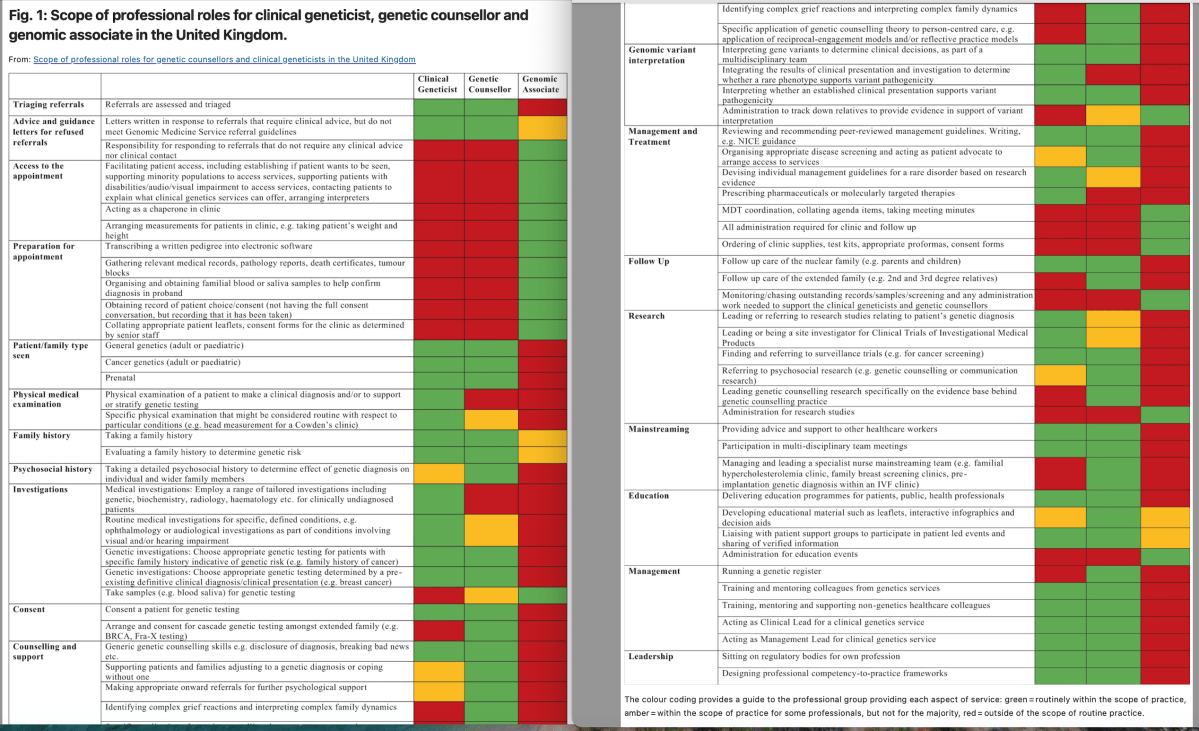
In the United Kingdom clinical geneticists are medically qualified Members/Fellows of the Royal College Physicians or equivalent, where Clinical Genetics is an affiliated medical specialty. Genomic or genetic counsellors are allied health professionals with Masters level accreditation from the Genetic Counsellor Registration Board included in the Academy for Healthcare Science register and clinical scientists (genomic counselling specialty) accredited by the Health and Care Professions Council. https://www.nature.com/articles/s41431-022-01214-7/figures/1

This research(although limited) brought to light the importance of the multidisciplinary team in caring for patients with or at risk of genetic disorders by highlighting the role and necessity of the genetic counsellor within the team. 

https://www.nature.com/articles/s41431-022-01189-5?fromPaywallRec=false

Individual Health Identifier (IHI)

Did you know….

The Health Identifiers Act 2014 was enacted by the government to allow two new national data collections–called the National Register of Individual Health Identifiers and the National Register of Health Service Provider Identifiers to be created and operated.

An Individual Health Identifier (IHI) has the following benefits for you:

Improved accuracy in identifying you and your medical records will
lead to safer and better care being provided to you.

Improved accuracy in identifying and associating your records in
different healthcare organisations.
Your health information can be shared safely and seamlessly
between health service providers, for example on referral letters
sent from a private GP to a public hospital.

The use of an Individual Health identifier also enables the
electronic transfer of your health information, which results in faster
care for you.

Medical or clinical information will NEVER be stored on your IHI record. Health
service providers may however use your IHI, to uniquely identify you, when
communicating with other health service providers about your care for example
when a medical consultant is corresponding with your GP or visa versa.