COLORECTAL Screening in Europe(2019)

The barriers for screening: (have they changed?)

Despite the obvious value of colorectal cancer screening, many barriers exist that must be taken into account when setting up programmes:

• Patient barrierssuch as fear, socio-demographic, psychosocial, economic or geographic factors as well as awareness, understanding or lifestyle.

• Health care providers’ barriersincluding low screening recommendation, poor coordination and communication between patients and providers, or lack of follow-up.

• Health system barriersincluding inadequate access, screening costs, test-specific factors or delays, as well as the capacity to move patients from screening to colonoscopy to effective treatment.

Serendipity Strikes: How Pursuing Novel Hypotheses Shifted the Paradigm Regarding the Genetic Basis of Colorectal Cancer and Changed Cancer Therapy

Discoveries enabled better understanding of how the DNA mismatch repair (MMR) system not only recognises DNA damage but also responds to damage by DNA repair or by triggering apoptosis(cell death) in the injured cell. 

What has happened over the past 37 years was not predictable when this journey began, but it does speak to the power of careful scientific experimentation, following the facts, perseverance in the face of opposition, and the willingness to think outside of established paradigms.

The conclusion that CRCs with MSI responded differently to classical cytotoxic chemotherapy than did non-MSI CRCs and eventually, the key clinical paradigm shift was the discovery of ICT(Immune checkpoint therapy and its unique effect on tumours with MSI.

Some of these concepts required brilliant thinking and interpretation and others seemingly announced themselves after the correct understanding of an unexpected observation. Since this astonishing series of events unfolded over about four decades, there is hope that this remarkable progress will continue into the future.

https://link.springer.com/article/10.1007/s10620-023-08006-z#Sec18

Prospective Lynch Syndrome Database (PLSD)

The Prospective Lynch Syndrome Database (PLSD) is the largest worldwide database on Lynch Syndrome. 
PLSD collates information on carriers of pathogenic or likely pathogenic MMR variants (path_MMR) who are receiving medical follow-up, including colonoscopy surveillance, which aims to achieve early diagnosis and treatment of cancers.

plsd.eu

image caption

The Six Questions Every Cancer Patient Should Ask Before Choosing Treatment

  1. What is the goal of the recommended treatment? Cure, prolong survival, maintain quality of life?
  2. What is my chance of achieving the goal if I do nothing?
  3. How does the recommended treatment improve the chance of reaching the goal?
  4. What are the side effects of the recommended treatment – many are minimal today?
  5. What is the role of clinical trials in the management of my cancer?
  6. If my cancer comes back, what is the goal and how should i best prepare for it now?

Until recently we thought of cancer as being defined by its location in the body – moving forward it will be defined by the cancer’s unique growth driving mutations and biomarkers. In effect, the genetics – biomarker define the cancer rather than the organ where the cancer began.

IS ANYONE LISTENING?

In health care, continuity of care can be defined both in terms of the patient’s experience (i.e., how well the patient feels they were treated) and in clinical quality—how well the sequence of patient services is delivered in the most effective, efficient way, according to clinical best practices, through “integration, coordination and the sharing of information between different providers.”

As patients’ health care needs are now rarely met by a single professional, multidimensional models of continuity have had to be developed to accommodate the possibility of achieving both ideals simultaneously. 

Can we be secure in the knowledge that someone is always listening to us in the healthcare system?

Not only applies to the Emergency Services but also to the medical profession on a successful approach to patient care: the concept of “continuity of care.”

https://www.iaedjournal.org/is-anyone-listening

Camidge and McVeigh Highlight the Role of the Clinical Geneticist Across Cancer Care and Research

Drs Camidge and McVeigh highlight the evolution of the clinical genetics field over time, the process of identifying pathogenic genetic variants, the difficulties of explaining genetic testing results to patients, and more.

https://www.onclive.com/view/camidge-and-mcveigh-highlight-the-role-of-the-clinical-geneticist-across-cancer-care-and-research

Lynch Syndrome? Why it’s important to know about it

Lynch syndrome is caused by an inherited mutation in one of these genes:

People with Lynch syndrome have an increased risk for colorectal, endometrial and other cancers. The cancer risk varies by gene mutation, therefore it is important for people with Lynch syndrome to know which gene mutation they have.

In the past, the risk-management guidelines were the same for people with an inherited mutation in any of the Lynch syndrome genes. As more research has shown different cancer risks for each gene, experts have started to separate the risks and medical options for each individual mutation. Despite these differences, some references discuss Lynch syndrome as though inherited mutations in these genes carry the same risks. 

If you have been told that you have Lynch syndrome, it is important to know which gene has a mutation, so that you can make informed decisions about your medical care. 

In the past, Lynch syndrome was also referred to as “hereditary nonpolyposis colorectal cancer” (HNPCC). This term has fallen out of favour because mutations in these genes also increase the risk for other cancers besides colorectal cancer. 

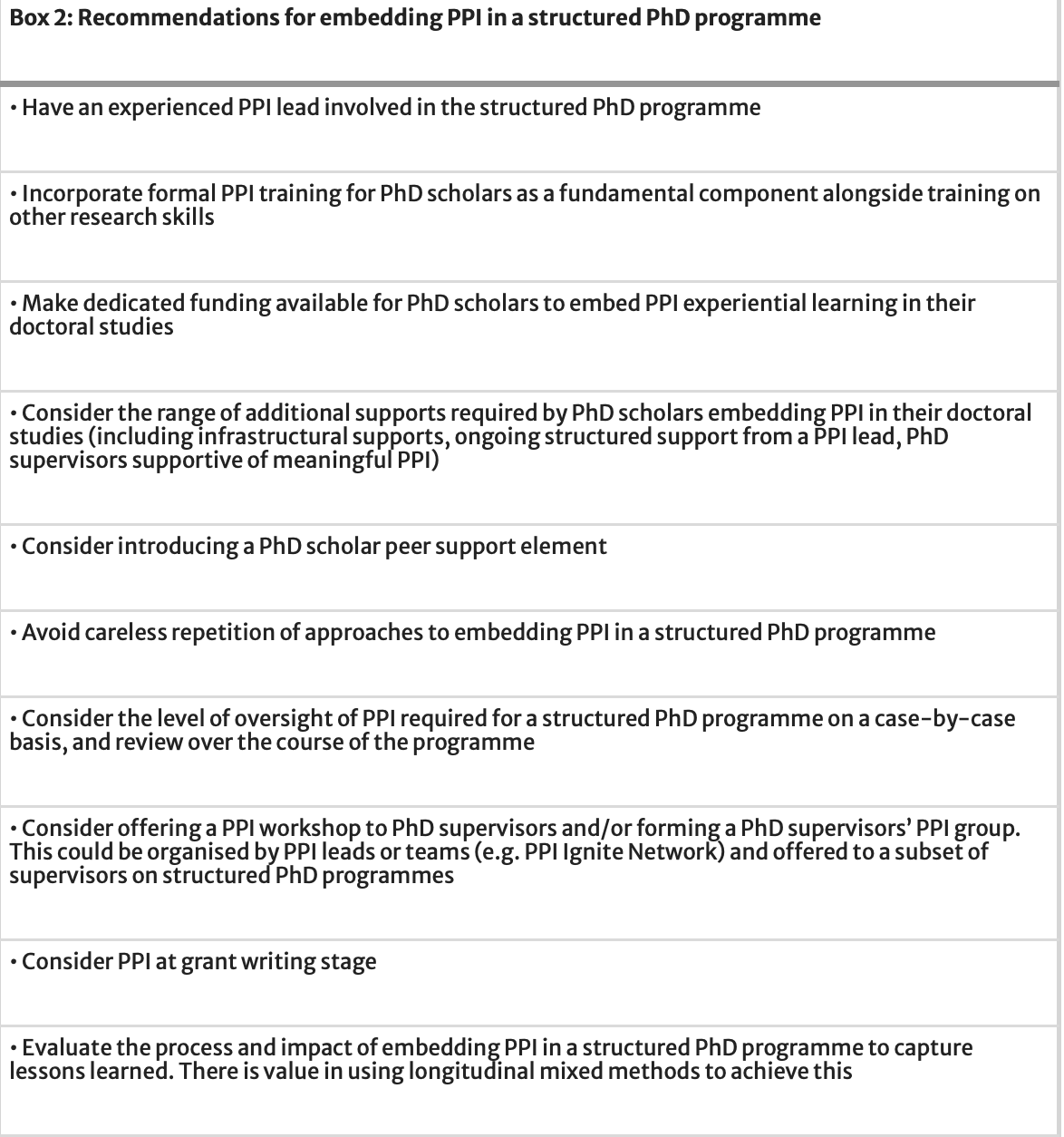
Embedding formal and experiential public and patient involvement training in a structuredPhD programme: process and impact evaluation

The international evidence shows that PPI is feasible, but evidence on the economic costs of PPI in research is sparse . It shows that drawing on the lived experience of PPI contributors can have positive benefits for health and social care research. It can lead to better outputs , and while it can enhance the quality and relevance of studies the evidence base on its impact remains weak.

There is evidence that PPI in health research can become tokenistic and concern that inviting patients and the public to ‘tinker at the edges’ undermines the broader aim of PPI to democratise research . International evidence shows that researchers are willing to change their practice, but lack of knowledge, skills and experience can hinder their involvement in PPI and they may be apprehensive about using PPI.

Conclusions

Embedding formal and experiential PPI training in a structured PhD programme is a novel approach. The evaluation has identified a number of lessons that can inform future doctoral programmes seeking to embed formal and experiential PPI training.

https://link.springer.com/article/10.1186/s40900-023-00516-4

Not curing cancer but preventing it

Groundbreaking vaccine trials aimed at preventing cancers associated with the genetic disorder Lynch syndrome are currently underway.

Why Lynch syndrome? 

Sanchez explained that patients with Lynch syndrome are born with a genetic defect in a gene that is involved in DNA repair. 

“What happens is that everytime one of our cells is dividing there is new synthesis of DNA and spontaneously in that process there are DNA errors. There are natural systems in our cells that are equipped to recognize that error and correct it so we don’t get mutations all the time,” Sanchez explained. 

“What happens in patients with Lynch syndrome is that the genetic defect they are born with is in one of the genes involved in this process of self repair of DNA errors,” he continued. 

This means that people with Lynch syndrome are more prone than others to replicate these DNA errors over their lifetime which means an increased risk of cancer. 

https://www.fox26houston.com/news/groundbreaking-vaccine-trial-aims-to-prevent-cancers-associated-with-lynch-syndrome?fbclid=IwAR0gWTf-QufrMY70RVmtHxS2DsfiaCnoFO9Sgpndi-ZzdYCu0k85MzG4J0Y

Methylated DNA Markers for Sporadic Colorectal and Endometrial Cancer Are Strongly Associated with Lynch Syndrome Cancers

Lynch syndrome (LS) markedly increases risks of colorectal and endometrial cancers. Early detection biomarkers for LS cancers could reduce the needs for invasive screening and surgical prophylaxis.

Prevention Relevance:

Methylated DNA markers previously identified in sporadic endometrial cancer and colorectal cancer discriminate between benign and cancer tissue in LS.

https://aacrjournals.org/cancerpreventionresearch/article-abstract/16/11/611/729696/Methylated-DNA-Markers-for-Sporadic-Colorectal-and?redirectedFrom=fulltext