Retrospective Cohort Study on the Limitations of Direct-to-Consumer Genetic Screening in Hereditary Breast and Ovarian Cancer

Among the people who tested positive for non-founder #BRCA mutations, 89.7% [had] false-positive results. A false-positive result means the #genetic test shows you have a genetic mutation when you really don’t.

CONCLUSION

Direct to Consumer genetic testing misses >90% of BRCA1/2 pathogenic/likely pathogenic variants in individuals of non-AJ(non-Jewish) ancestry and about 10% of BRCA1/2 PLPV among AJ individuals. There is a high false-positivity rate for non-AJ BRCA 1/2 PLPV with DTC genetic testing.

https://ascopubs.org/doi/10.1200/PO.22.00695

Inheriting a Cancer Risk

No parent wants to pass a genetic mutation to their child. But once people know they have an increased risk of developing cancer, they can take proactive steps to ensure the best outcome.

Patients often have to make decisions based on incomplete information. But when people learn they have a genetic mutation that increases their risk of cancer, they can arm themselves with information, proactive screening measures and prophylactic procedures to mitigate the risk of getting the disease.

https://www.curetoday.com/view/inheriting-a-cancer-risk

X or Exit

From Tweets to Threads: Exploring the Transforming Role of Social Media in the Lynch Syndrome Community.

https://www.curetoday.com/view/from-tweets-to-threads-exploring-the-transforming-role-of-social-media-in-the-lynch-syndrome-community?fbclid=IwAR3rPH9FrYXuN7QlNnoVZjLkMTEzVICTE9lR8IQZWeiXrnM_WEABZFJ6i0w

Beyond Cancer

This podcast series features cancer survivors sharing how they’ve navigated the physical side effects, emotional challenges, and different dynamics of life during and after cancer treatment.

https://www.dana-farber.org/health-library/articles/beyond-cancer/

When oncologists like me rain bad tidings on patients, they need one thing above all….

Anxiety is infectious. The conduct of a doctor can trigger a ripple of anxiety or inject a sense of order, even when the news is unpleasant. Bearing the scars of past illness, returning patients are especially not looking to be shielded from reality.

What they want is for someone to give bad news andremain steadfastly in their corner.

As is unfortunately the case for many, you can rain bad tidings on people but if you steer the conversation with calm, compassion and most of all, a sense of shared humanity, they will find their feet. This is the part that I have found surprising to predict and moving to absorb.

https://www.theguardian.com/commentisfree/2023/aug/16/when-oncologists-like-me-rain-bad-tidings-on-patients-calm-and-compassion-are-crucial

Cancer immune-interception in Lynch Syndrome: Neoantigen-based vaccine development (Dec. 22)

Lynch Syndrome (LS) is the most common cause of hereditary colorectal cancer and also conveys significantly increased risks for several other malignancies, including endometrial, small bowel, gastric, ovarian, adrenocortical tumors, and others.

Recent advances in next-generation sequencing and associated bioinformatic approaches are now allowing for more accurate profiling of the most frequently recurring and shared mutated neoantigens in LS-associated tumors. This allows for identification of the most immunogenic neoantigens that can be incorporated into different vaccine platforms to test the development of a population-based vaccine. 

A total of 45 participants will be enrolled to receive a prime and boost vaccination. Different secondary biomarkers will explore immunological aspects of this novel immune-interception strategy.

Introduction to Telemedicine and Digital Health-RCPI

Recently available from RCPI…https://courses.rcpi.ie/product?catalog=Introduction-to-Telemedicine-and-Digital-Health

This course is a standalone, asynchronous module which is open to all clinicians. This module will provide learners with foundational knowledge of Telemedicine and Digital Health. It is worth 5 ECTS and requires 125 hours of learning to gain the credits. 

The aim of this course is to enhance the outcomes of telemedical consultations for both patients and clinicians in Ireland. 

Learners will be covering introductory topics such as:

• Overview of telemedicine

• Overview of digital health

• Organisationl infrastructure 

• Patient perspective, accessibility, and digital literacy

• General Data Proctection Regulation (GDPR)

• Professionalism

• Communication

The role of virtual consultations in cancer genetics: challenges and opportunities introduced by the COVID-19 pandemic

There is a clear potential to mitigate geographical barriers, meet increasing patient expectations of implementing virtual consultations, reduce hospital carbon footprints, and decrease hospital costs while increasing efficiency. 

There are also significant challenges… Virtual healthcare consultations introduce another new level of digital exclusion for patients and clinicians. There are also potential challenges for maintaining patient confidentiality, and limited utility in circumstances where a physical exam may be warranted. For clinicians, there may be impacts on empathetic responses delivered and challenges in workflow and workload.

Summary: Both the opportunities and the challenges of virtual care must be considered to ensure the appropriate, successful, and long-term implementation of virtual care in cancer genetic services.

https://www.nature.com/articles/s44276-023-00009-7

Family Tree

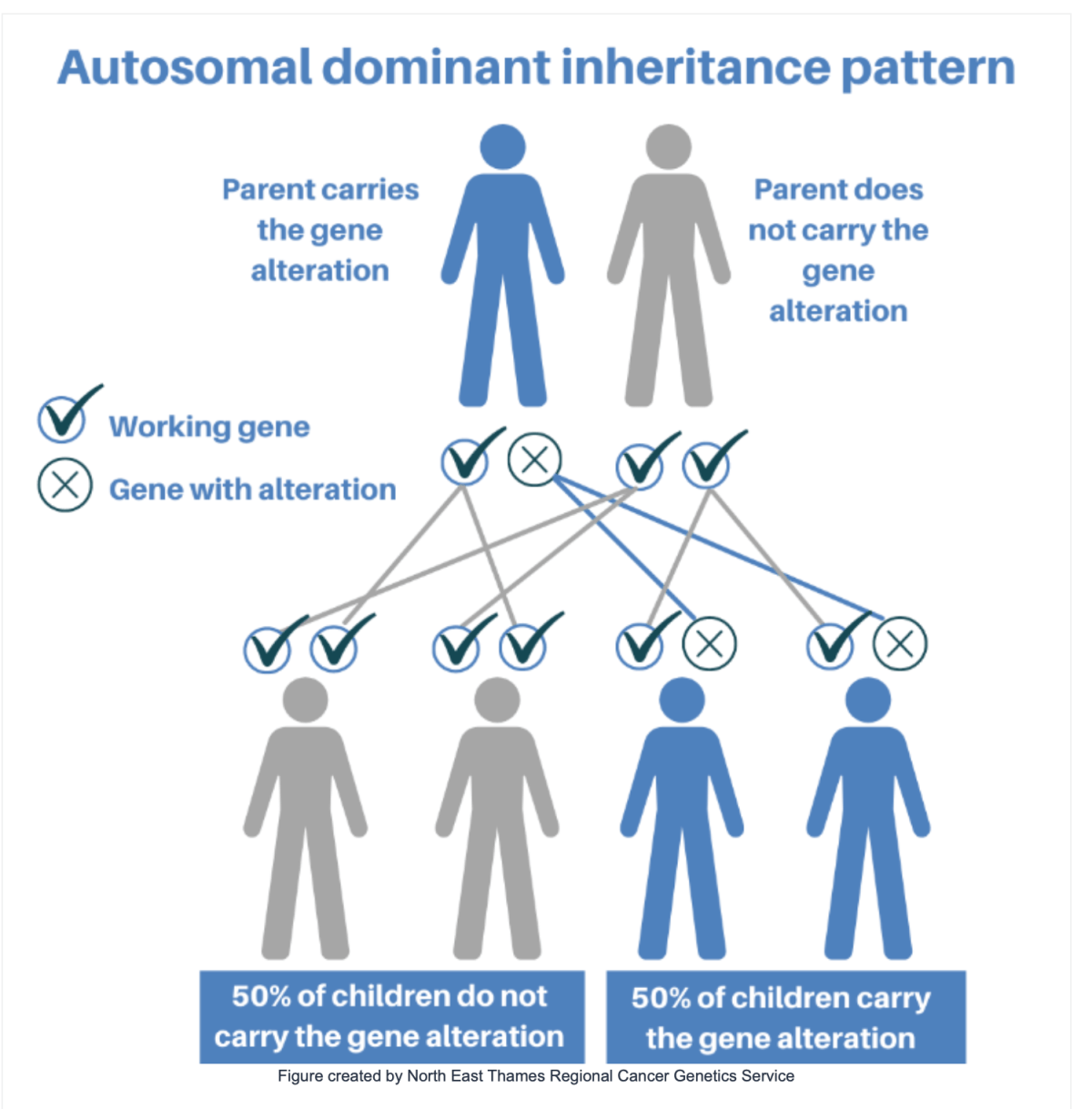
A genetic history captures details about the health of multiple generations.

This information can be important in diagnosing an inherited condition, revealing a pattern of inheritance, and informing clinical decisions regarding testing and management.