Navigating the Dual Nature of Social Media: A Patient Advocate’s Guide

The key to navigating the social media landscape successfully is knowing how to leverage the positives and stay vigilant about the negatives.

Online harassment, misinformation, and divisive behavior have become all too common. This harmful behavior can negatively impact both advocates and the causes we strive to support.

As advocates, we set the tone for the communities we work with. We can inspire and uplift others by cultivating an environment of respect, empathy, and support. Especially in a world that sometimes feels divided and polarized, cultivating kindness and understanding becomes even more important. Let’s work together to make the online world a better place, where compassion and understanding prevail, and where our collective efforts lead to meaningful change.

What is a Biomarker?

A biomarker (also called a biological marker) is a piece of information about your health. Biomarkers include your blood pressure, your blood type, and cholesterol or blood sugar levels measured in a blood test. The biomarkers of cancer are also known as tumor markers. Biomarkers can tell your medical team important information about you and your cancer.

Why are biomarkers important?

Colorectal cancer biomarkers can provide your medical team vital information about you and your cancer that is used to determine prognosis, guide treatment decisions, monitor treatment response, and look for recurrence after treatment. Biomarkers are also used in drug development to create and test targeted therapies for colorectal cancer.

Biomarkers of hereditary colorectal cancer

The biomarkers that can confirm hereditary colorectal cancer are the DNA mismatch repair genes causing Lynch Syndrome, and the genes causing Familial Adenomatous Polyposis (FAP) and associated syndromes. Lynch Syndrome is caused by mutations in MLH1, MSH2, MSH3, MSH6, EPCAM, or PMS2 genes, while FAP and other polyposis syndromes are caused by mutations in APC, MYH, BMPR1A, and SMAD4.

From diagnosis of colorectal cancer to diagnosis of Lynch syndrome: The RM Partners quality improvement project

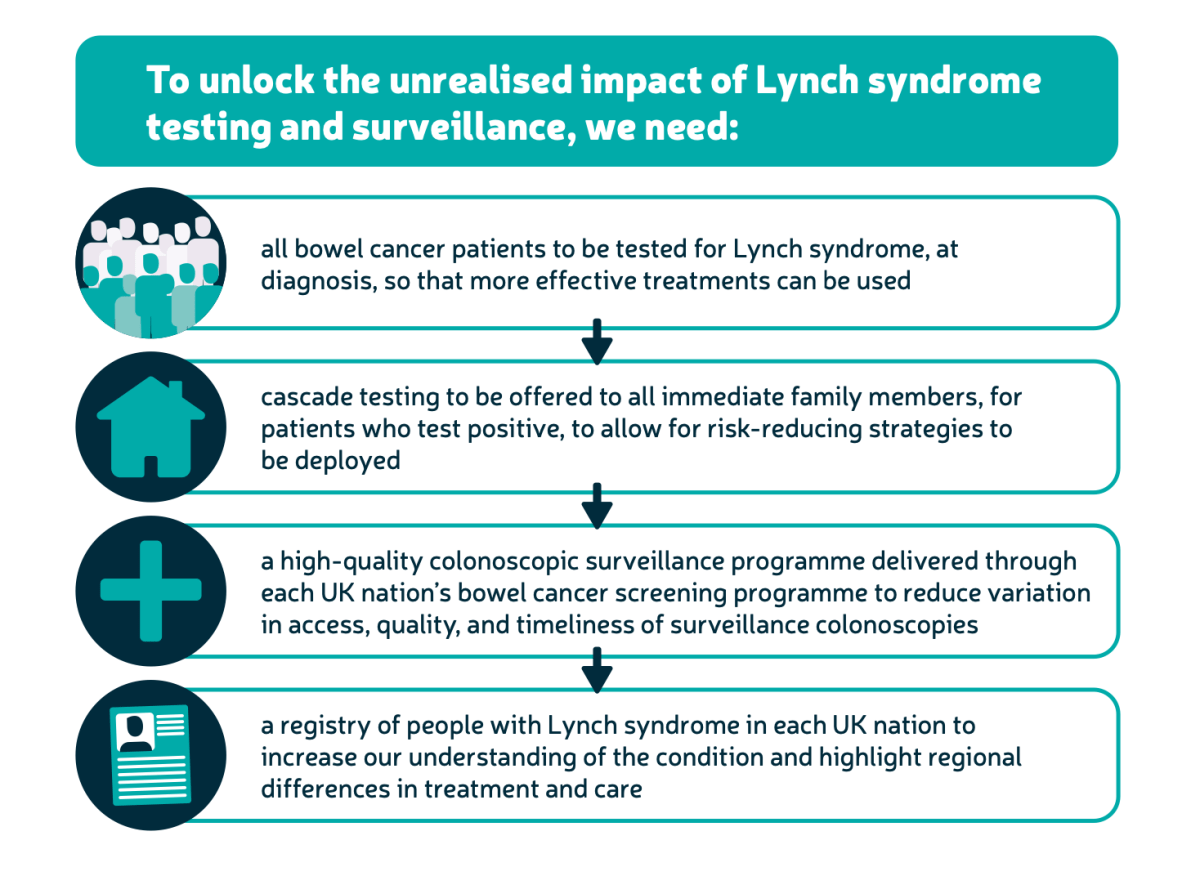
The UK National Institute for Health and Care Excellence recommends universal testing for Lynch syndrome (LS) in all newly diagnosed colorectal cancer (CRC) patients. However, implementation varies significantly by geography. This project was developed to measure variation and deliver an effective diagnostic pathway from diagnosis of CRC to diagnosis of LS (within the RM Partners (RMP) West London cancer alliance).

Conclusion

The LS project was completed by April 2022. We have implemented a systematic approach with workforce transformation to facilitate identification and ‘mainstreamed’ genetic diagnosis of LS. This work has contributed to the development of a National LS Transformation Project in England which recommends local leadership within cancer teams to ensure delivery of diagnosis of LS and integration of genomics into clinical practice.

Health Innovation Hub Ireland

Health Innovation Hub Ireland (HIHI) was established by the Department of Business, Enterprise and Innovation and the Department of Health and is supported by Enterprise Ireland (EI) and the Health Service Executive (HSE) to drive collaboration between the health service and enterprise.

We offer companies the opportunity for pilot and clinical evaluation studies, and we provide the health service access to innovative products, services, and devices that they may not otherwise be exposed to.

HIHI is built on the recognition that collaboration with enterprise can benefit patient care, patient pathways and outcomes.

So why do people not get tested?

Experts say that millions of people are walking around with a genetic variant that raises their risk of developing cancer. The vast majority of them have no clue.

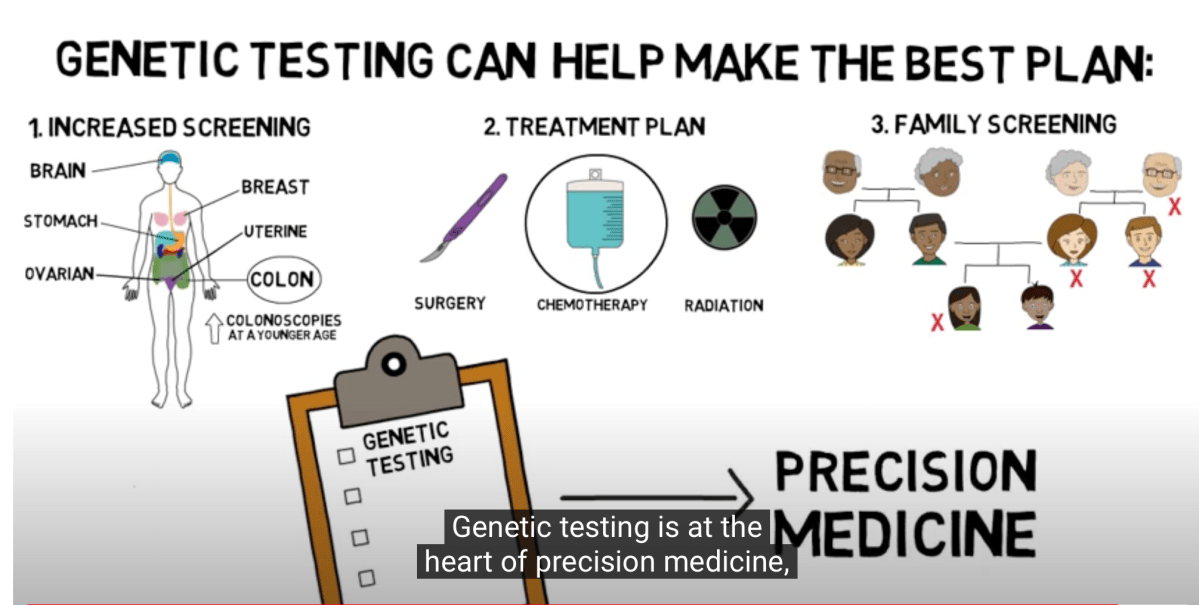
That’s a problem, because people who know they’re at a higher risk for certain cancers can take action, like going for more frequent screening tests such as colonoscopies and mammograms or even having preventive surgeries.

“Doctors are not up on this”

Asked why so few people get tested, both researchers and patients say that “many cancer doctors aren’t familiar with the latest research on inherited risk or that they don’t know the cost of testing has dropped”

https://www.npr.org/sections/health-shots/2023/08/02/1191419631/cancer-risk-test-genetic-genes-inexpensive-why-dont-more-people-get-tested

Biology of Precancers and Opportunities for Cancer Interception: Lesson from Colorectal Cancer Susceptibility Syndromes

The two best defined syndromes are Lynch syndrome (LS) and familial adenomatous polyposis (FAP). Studying these groups on regular cancer surveillance provides insight into the tumor biology, potential avenues for prevention, and their effectiveness. In this article, we will review some of the lessons that can be learned from these conditions which may afford opportunities for cancer prevention.

Conclusions

Hereditary syndromes provide an opportunity to study early precancer evolution surveillance and interventions to prevent cancer. Understanding genotype and phenotype in colorectal cancer susceptibility syndromes allows for customized clinical trials in preventive medicine to be highly effective in their outcomes.

The increasing knowledge of precancer lesions and their biology may aid novel strategies for individualized prevention. It is essential to consider the adverse effects of such interventions when weighed against quality of life, particularly considering the age at which medication may begin.

Exciting advancements are being made in the field of cancer vaccination against LS colorectal cancer, however until trials show their validity the recommended surveillance protocols must be upheld. Extrapolating information from these hereditary colorectal cancer studies can also help pinpoint how certain sporadic cancers evolve and offer opportunities for cancer prevention.

Lynch Syndrome online training for primary care clinicians

The training involves watching a short video which covers:

  • A brief overview of Lynch syndrome
  • Their personalised cancer prevention programme
  • An introduction to the Lynch syndrome quick guide and how it can help you identify and manage your patient’s care
  • How to manage their first-degree family members’ care

The Upsides and Downsides of Cancer Genetic Testing

Living with a hereditary cancer syndrome inevitably brings uncertainty. Despite taking preventative measures, the knowledge of increased risk frequently lingers in my mind.

https://www.curetoday.com/view/the-upsides-and-downsides-of-cancer-genetic-testing

Resistant Starch

Taking a supplement of 30 grams of “resistant starch” a day – about the amount in two slightly unripe bananas – reduced the risk of multiple forms of cancer in people with a rare genetic condition.

Consuming resistant starch – a dietary fibre found in oatmeal, beans and bananas – reduces the risk of upper gastrointestinal cancers by nearly 50 per cent in people with Lynch syndrome. This is the first time a nutrient has been shown to prevent these cancers in people with the condition.

The nutrient supplement finding is significant because upper gastrointestinal cancers tend to be the deadliest for people with Lynch syndrome, says Matthew Yurgelun at the Dana-Farber Cancer Institute in Boston, Massachusetts, who wasn’t involved in the work.

https://www.newscientist.com/article/2330638-starch-supplement-reduces-the-risk-of-some-hereditary-cancers/?_ptid=%7Bkpdx%7DAAAAweYhyn3zhAoKcmJhNGYxWmNwZRIQbGt0Z2dpOHVzaTBmZzY2OBoMRVhMRlE5SEFCMVVTIiUxODIwMW9nMDgwLTAwMDAzMmRsYWJpZm1hbjJybHVxZGMzaDhzKhtzaG93VGVtcGxhdGVRSU9EQUhKOTFLS1oyMjcwAToMT1Q5RzRJMVpFNkRHQg1PVFZJRUVNM0I3N1pLUhJ2LYUA8Bh5ZHJkd3pqNTdaDTUxLjE3MS4yNDkuMjhiA2Rtc2ifxa2mBnAKeAQ

See: Cancer Prevention with Resistant Starch in Lynch Syndrome Patients in the CAPP2-Randomized Placebo Controlled Trial: Planned 10-Year Follow-up. https://www.capp3.org/media/26287/capr-22-0044_published_paper.pdf

What is the Lynch syndrome registry?

The Lynch syndrome registry pilot study led by The Cancer Screening and Prevention Research Group at Imperial College London, records information about the health status of individuals with Lynch syndrome. A select group of Lynch syndrome patients who have previously taken part in the Cancer Prevention Project 3 (CaPP3) trial will be invited to participate in the pilot study from across four hospitals in England.

The Lynch syndrome registry records and analyses important information about people with Lynch syndrome. This helps to understand how people with Lynch syndrome are looked after and cared for across England. All information is held on a secure and confidential computer database.

The registry will ultimately be an efficient system that with the help of the bowel cancer screening programme will allow nationally coordinated care for Lynch syndrome families. It will also become a valuable central research resource that could be used to support other studies.

https://www.lynchregistry.org.uk/index.html