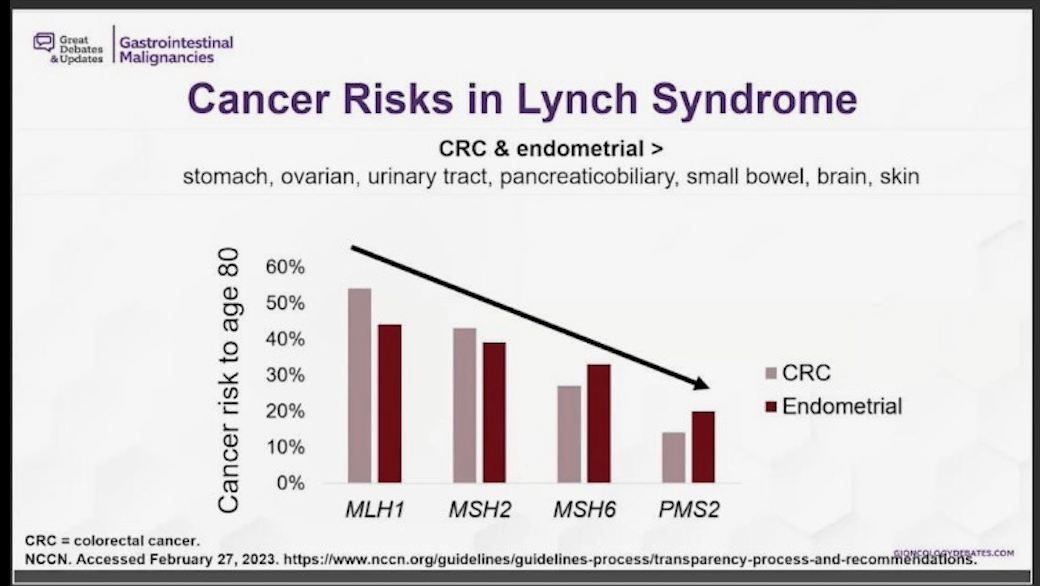
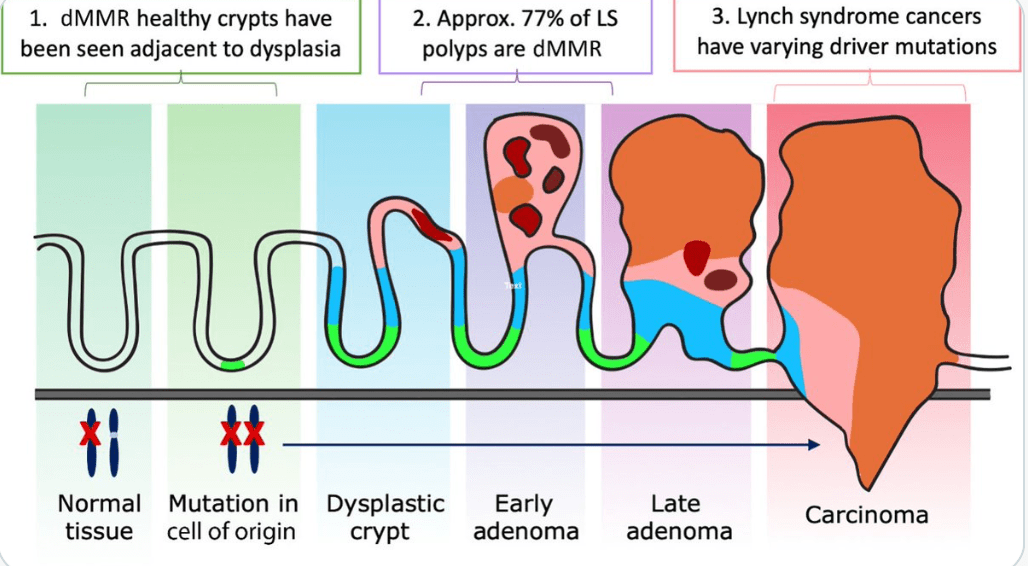
Lynch Syndrome Cancer Risks(to age 70)

Individuals with #LynchSyndrome are at increased risk for multiple cancer types (common ones shown here).

Note: MLH1 has the highest pancreatic cancer risk, MSH2 has the highest urothelial & prostate cancer risk, & PMS2 risks are mainly CRC & EC.

Lynch Syndrome

Individuals with Lynch syndrome can reduce their risk for Colorectal cancer by:

1. Taking daily aspirin (exact dose & duration TBD).

2. Getting colonoscopy every 1-2 y starting at age 20-25 for MLH1/MSH2 & every 1-3y starting at age 30-35 for MSH6/PMS2.

Early-Onset Colorectal Cancer (EOCRC)

Patients with EOCRC have a higher relative prevalence of inherited predisposition to cancer, with Lynch syndrome being the most common cause. 

Colorectal cancer in younger people

Similar factors increase the risk of early-onset colorectal cancer (EOCRC) and later-onset colorectal cancer (LOCRC), such as a sedentary lifestyle, obesity, and metabolic syndrome, but there are also important differences. EOCRC predominantly occurs on the left side of the colon and the rectum, whereas LOCRC arises more commonly on the right side of the colon. EOCRC is also more poorly differentiated and often metastatic at diagnosis.

Research is urgently needed to understand the increasing incidence of EOCRC and its pathophysiology to better detect and treat patients.

Demystifying genomics in cancer care

Cancer is a disease of the genome, caused by unchecked cell growth due to mutations or changes in our DNA. Cancer genomics involves studying the genetic changes in cancer cells, allowing us greater insight into prevention, early detection, treatment, prognosis and recurrence.

In the case of cancer, a change is introduced which causes the cells to multiply uncontrollably – they become cancer cells and allow a cancer to develop. Most of the time these cancer-causing genetic changes are acquired i.e. they occur from damage to genes in a particular cell during a person’s life (also known as sporadic cancer). 

Why does cancer run in families?

Around 5-10% of cancers are caused by inherited or germline changes. This is where a genetic alteration occurs in a sperm or egg cell. It passes from the parent to the child at the time of conception and the alteration in the initial egg or sperm cell is copied into every cell within the body.

As the genetic alteration affects reproductive cells it can pass from parent to child and onwards to subsequent generations. Conditions such as Lynch Syndrome, is an example of an inherited cancer syndrome. This dominantly inherited conditions can greatly increase an individuals risk of developing cancer and mean that there is a 50% (or 1 in 2) chance that a parent can pass the genetic alteration onto their child.

Identifying a person with an inherited form of cancer is important. It means they can be looked after more closely in the future but it also has important implications for the family.

Genomics allows us to develop more precise treatments for cancer. Targeting treatments that focus on a cancer’s genetic makeup rather than where it has grown in the body.

https://www.macmillan.org.uk/healthcare-professionals/news-and-resources/blogs/demystifying-genomics-in-cancer-care

Constitutional (germline) vs Somatic (tumour) variants

Constitutional (also known as germline) variants are present in all the body’s cells, including the germ cells, and can therefore be passed on to offspring; somatic variants arise during an individual’s lifetime in tissues other than the germ cells and so are not passed on.

The identification of a germline variant in a mismatch repair (MMR) gene in a patient with colorectal cancer has implications for the clinical management of the current cancer and the patient’s future cancer risk. It should also trigger cascade screening in the wider family.

(Cascade testing is the process of informing family members of a genetic condition discovered within the family, followed by family members getting tested for the condition.)

MSH2 is the very young onset ovarian cancer predisposition gene, not BRCA1

Our study has shown that while the genetic predisposition for many early onset ovarian cancers is still unknown, MSH2 is the most important EOC predisposition gene at age <35 years.

The cumulative likelihood of an EOC in MSH2 heterozygotes would appear to be >2% by 35, with this likelihood still below 0.5% for BRCA1 and rare for BRCA2; indeed, two-thirds of cases identified in BRCA2carriers may not have been driven by HRD.

This increased incidence despite the good long-term survival in MSH2 should prompt awareness of the increased risk and consideration for early risk-reduction strategies.

(Flaum N, Crosbie EJ, Woodward ER, et al MSH2 is the very young onset ovarian cancer predisposition gene, not BRCA1 Journal of Medical Genetics  Published Online First: 09 March 2023. doi: 10.1136/jmg-2022-109055)

https://jmg.bmj.com/content/early/2023/03/08/jmg-2022-109055.share

Cancer Prevention Recommendations

“Our Cancer Prevention Recommendations are the conclusions of an independent panel of experts – they represent a package of healthy lifestyle choices which, together, can make an enormous impact on people’s likelihood of developing cancer and other non-communicable diseases over their lifetimes.”

Lynch syndrome prediction model

The PREMM5 model is a clinical prediction algorithm that estimates the cumulative probability of an individual carrying a germline mutation in the MLH1, MSH2, MSH6, PMS2, or EPCAM genes. Mutations in these genes cause Lynch syndrome, an inherited cancer predisposition syndrome.

N.B.:This website is provided for informational purposes only. The content is not intended as a substitute for professional medical advice, diagnosis, or treatment. Always seek the advice of your doctor or other qualified health provider with any questions you may have regarding your personal health or medical condition.

https://premm.dfci.harvard.edu

Priorities for Research in Psycho oncology

“We are hosting a workshop to identify priorities for research in #psychooncology across Ireland. This will ensure our research is responsive to the needs and priorities of the Irish cancer community.”

Let us know what you think. https://nuigalwaybusiness.fra1.qualtrics.com/…/SV…

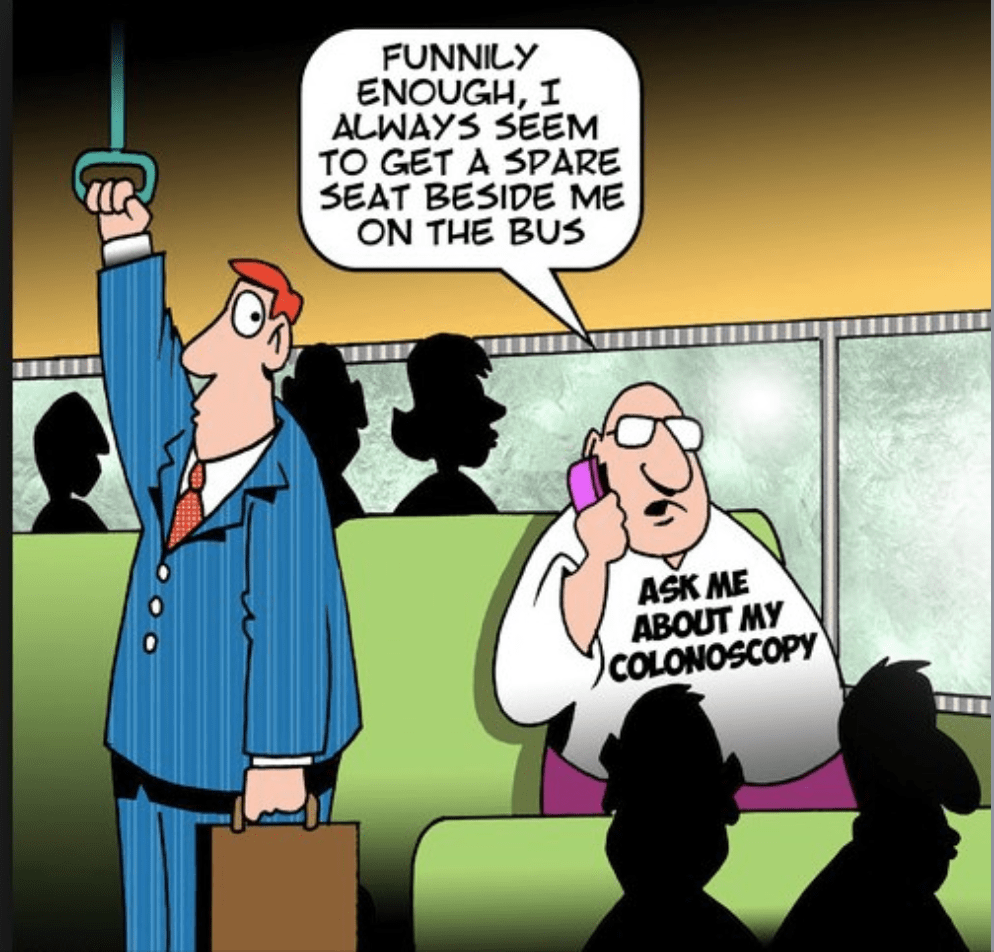
Prepping for a Colonoscopy: Tips from The Colonoscopy Queen

“I have had more colonoscopies at Mayo Clinic than I can count — they are not a big deal. One of the most significant issues I hear people complain about is the liquid prep, which cleans out your colon.”

I’ve had many colonoscopies over the last two decades, so here are my tips for preparing for and going through the procedure.

https://www.curetoday.com/view/prepping-for-a-colonoscopy-tips-from-the-colonoscopy-queen