Remembering My Brother Who Died of Cancer

Survivor guilt is a complex emotion that often plagues those who have lost loved ones to illness.

I question myself with overwhelming questions often: “Why have I not developed cancer? Why have I outlived him? Why did he have to die?” And “What could we as a family have done differently?

I have turned my grief into action and strive to make a positive impact in the fight against Lynch syndrome and its devastating consequences — his death has not been in vain.

https://www.curetoday.com/view/remembering-my-brother-who-died-of-cancer

COLORECTAL Screening in Europe(2019)

The barriers for screening: (have they changed?)

Despite the obvious value of colorectal cancer screening, many barriers exist that must be taken into account when setting up programmes:

• Patient barrierssuch as fear, socio-demographic, psychosocial, economic or geographic factors as well as awareness, understanding or lifestyle.

• Health care providers’ barriersincluding low screening recommendation, poor coordination and communication between patients and providers, or lack of follow-up.

• Health system barriersincluding inadequate access, screening costs, test-specific factors or delays, as well as the capacity to move patients from screening to colonoscopy to effective treatment.

Serendipity Strikes: How Pursuing Novel Hypotheses Shifted the Paradigm Regarding the Genetic Basis of Colorectal Cancer and Changed Cancer Therapy

Discoveries enabled better understanding of how the DNA mismatch repair (MMR) system not only recognises DNA damage but also responds to damage by DNA repair or by triggering apoptosis(cell death) in the injured cell. 

What has happened over the past 37 years was not predictable when this journey began, but it does speak to the power of careful scientific experimentation, following the facts, perseverance in the face of opposition, and the willingness to think outside of established paradigms.

The conclusion that CRCs with MSI responded differently to classical cytotoxic chemotherapy than did non-MSI CRCs and eventually, the key clinical paradigm shift was the discovery of ICT(Immune checkpoint therapy and its unique effect on tumours with MSI.

Some of these concepts required brilliant thinking and interpretation and others seemingly announced themselves after the correct understanding of an unexpected observation. Since this astonishing series of events unfolded over about four decades, there is hope that this remarkable progress will continue into the future.

https://link.springer.com/article/10.1007/s10620-023-08006-z#Sec18

Methylated DNA Markers for Sporadic Colorectal and Endometrial Cancer Are Strongly Associated with Lynch Syndrome Cancers

Lynch syndrome (LS) markedly increases risks of colorectal and endometrial cancers. Early detection biomarkers for LS cancers could reduce the needs for invasive screening and surgical prophylaxis.

Prevention Relevance:

Methylated DNA markers previously identified in sporadic endometrial cancer and colorectal cancer discriminate between benign and cancer tissue in LS.

https://aacrjournals.org/cancerpreventionresearch/article-abstract/16/11/611/729696/Methylated-DNA-Markers-for-Sporadic-Colorectal-and?redirectedFrom=fulltext

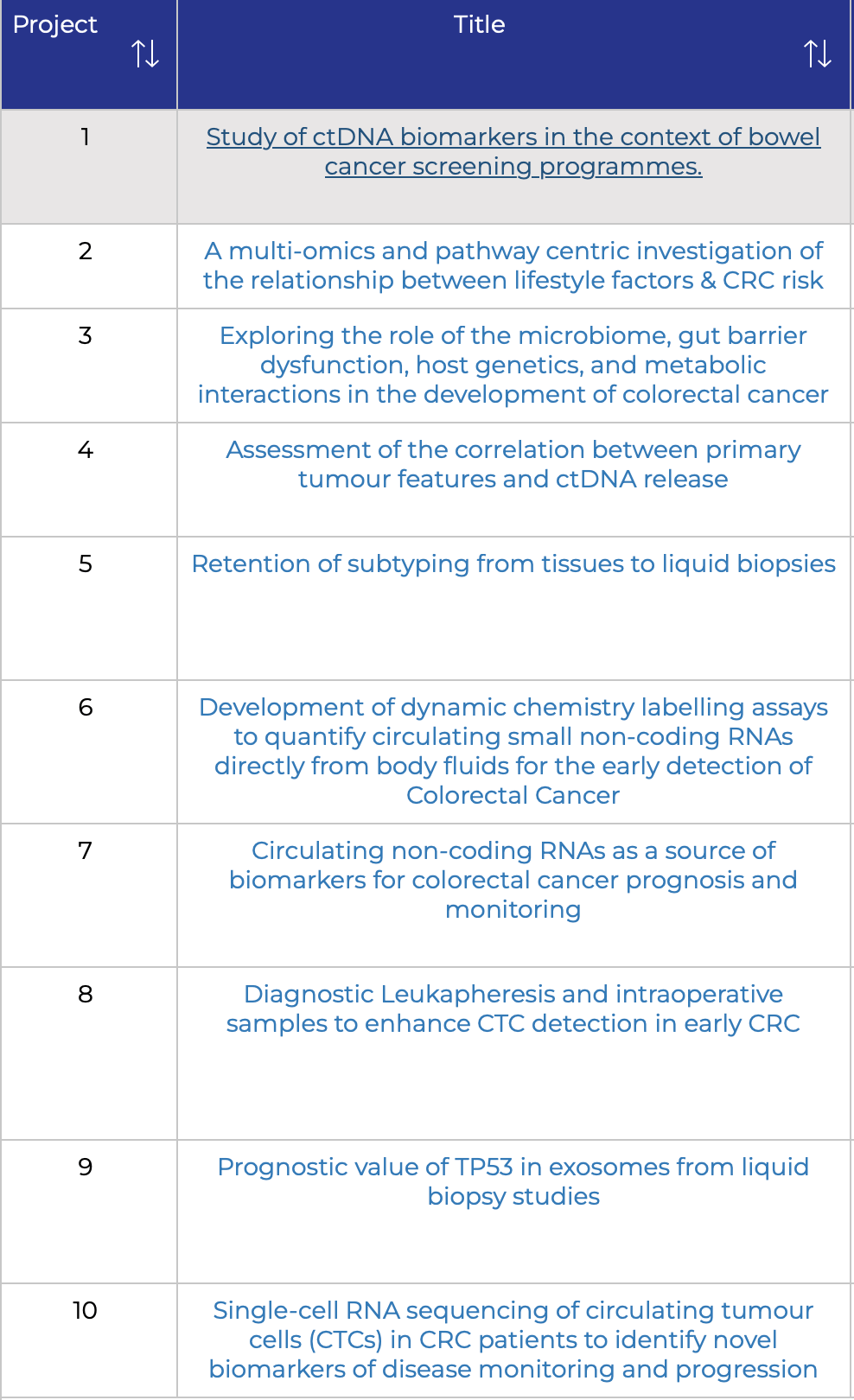
ColoMARK Project!

Identification and development of novel colorectal cancer biomarkers via state-of-the-art liquid biopsy approaches.

The primary scientific objective of ColoMARK will be to generate improved biomarkers for CRC by employing innovative liquid biopsy approaches​. The impact of this project is paramount, as it will play a crucial role in advancing CRC prevention, treatment and management.

This project has received funding from the European Union’s Horizon Europe research and innovation programme under the Marie Sklodwska-Curie Doctoral Network Grant.

ctDNA has been widely evaluated as a novel biomarker for liquid biopsy in colorectal cancer diagnosis, prognosis and monitoring of response to treatment. Liquid biopsy based on ctDNA detection is a very sensitive test. 

https://www.colomark.org

Guidelines for the management of hereditary colorectal cancer from the British Society of Gastroenterology (BSG)/Association of Coloproctology of Great Britain and Ireland (ACPGBI)/United Kingdom Cancer Genetics Group (UKCGG) -2019

Lynch syndrome (LS)

  • We recommend that for all people when first diagnosed with CRC, testing using immunohistochemistry (IHC) for MMR proteins or microsatellite instability is used to identify tumours with deficient DNA MMR, and to guide further sequential testing for LS. (GRADE of evidence: moderate; Strength of recommendation: strong)
  • We recommend that colonoscopic surveillance should be performed at a 2 yearly interval for all LS patients. (GRADE of evidence: moderate; Strength of recommendation: strong)
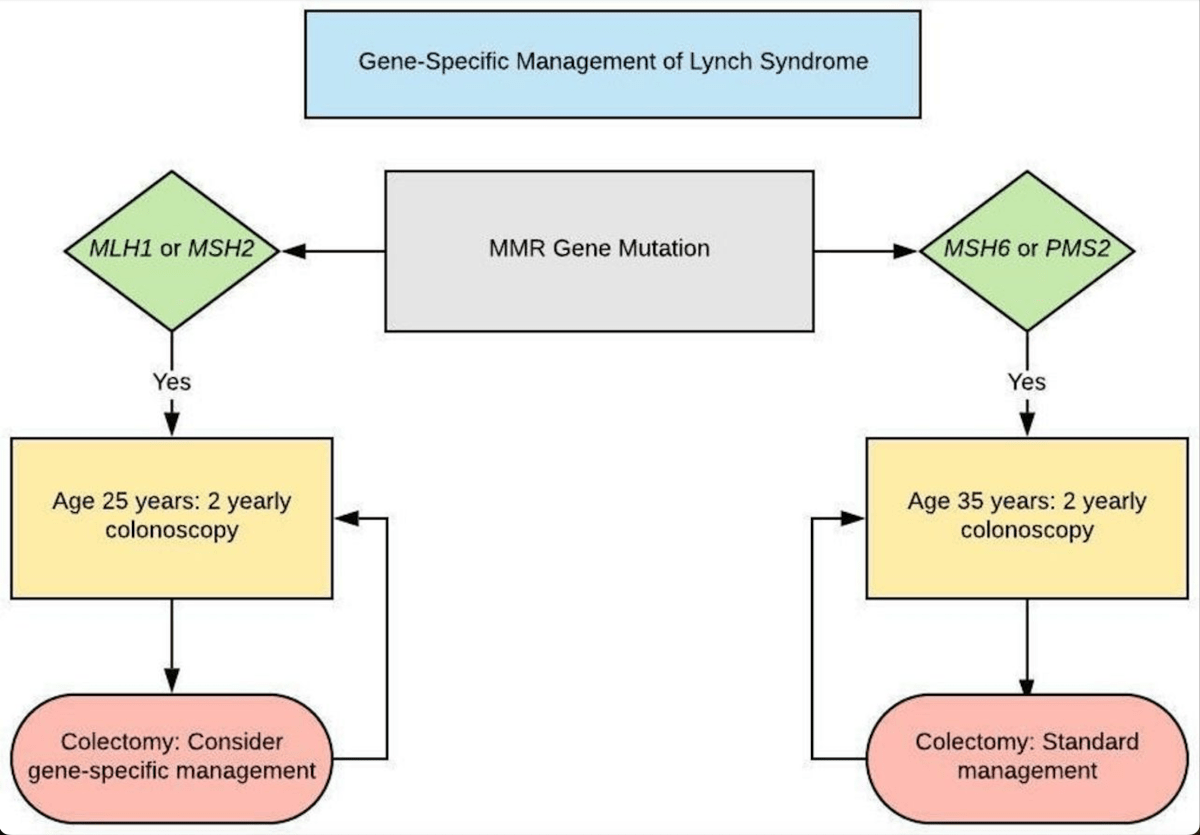
  • We recommend that age of onset of surveillance colonoscopy should be stratified according to the LS-associated gene. We recommend colonoscopy from age 25 years for MLH1 and MSH2 mutation carriers and 35 years for MSH6 and PMS2mutation carriers. There are insufficient data to support stratifying age of onset of surveillance by gender. (GRADE of evidence: moderate; Strength of recommendation: strong)
  • We suggest that for LS patients with MLH1 or MSH2 mutations who develop colon cancer or colonic neoplasia not amenable to endoscopic control, the decision to perform segmental versus total/near total colectomy should balance the risks of metachronous cancer, the functional consequences of surgery, the patient’s age and patient’s wishes. (GRADE of evidence: Moderate; Strength of recommendation: strong)
  • We recommend that for LS patients with MSH6 or PMS2 mutations there is insufficient evidence for oncological benefit of extended colectomy over segmental resection. (GRADE of evidence: low; Strength of recommendation: strong)
  • We suggest that when abdominal-perineal excision can be avoided, a standard low anterior resection is a reasonable option to treat rectal cancers in LS patients, even though the residual colon is at high-risk of metachronous neoplasia. (GRADE of evidence: low; Strength of recommendation: weak)
  • We recommend that gastric, small bowel, or pancreatic surveillance in LS patients is only performed in the context of a clinical trial. (GRADE of evidence: low; Strength of recommendation: strong)
  • We recommend screening for H elicobacter pylori in patients with LS and subsequent eradication therapy if indicated. (GRADE of evidence: low; Strength of recommendation: strong)

https://gut.bmj.com/content/69/3/411

Results of phase I-II bridging study for Nous-209, a neoantigen cancer immunotherapy, in combination with pembrolizumab as first line treatment in patients with advanced dMMR/MSI-h colorectal cancer.

https://ascopubs.org/doi/abs/10.1200/JCO.2023.41.16_suppl.e14665

Conclusions: The combination of Nous-209 and pembrolizumab is safe, well tolerated and shows encouraging clinical efficacy in patients with treatment-naive dMMR/MSI-H mCRC eligible for anti-PD-1 therapy.

The study is ongoing and expanding to Phase II randomisation with a new accelerated Nous-209 vaccination schedule.

Exploring Stakeholders’ Perspectives on Implementing Universal Germline Testing for Colorectal Cancer: Findings From a Clinical Practice Survey

CONCLUSION: This study(Eighty CGA-IGC members participated) demonstrates wide support among hereditary GI cancer experts for implementation of UGT for patients with CRC. However, alternative service delivery models using nongenetics providers should be considered to address the logistical barriers to UGT implementation, particularly the growing demand for genetic testing.

In conclusion, there is broad support for UGT for all newly diagnosed patients with CRC among the members of the CGA-IGC.

However, changes to practice, such as alternative service delivery models or standardization of test choice, will likely have to be implemented to meet the increased patient volume.

Additional studies are needed to compare UGT implementation strategies (eg, traditional or alternative service delivery models) to ensure there is equitable access to genetic testing and improved outcomes for patients with CRC.

https://ascopubs.org/doi/full/10.1200/PO.23.00440

The ins and outs and ups and downs of a colonoscopy

So what is a colonoscopy?

A colonoscopy is a test to look at your bowel using a small camera. The test looks for any small growths called polyps, or signs of disease, such as bowel cancer. If polyps are found they are usually removed during the test. This will reduce the risk of cancer developing. If they are not removed they might turn into cancer. If bowel cancer is found early, it’s easier to treat and there’s a better chance of recovery.

https://bit.ly/3lWzc80

Red flags for colorectal cancer in young adults

https://www.facingourrisk.org/XRAY/red-flags-for-colorectal-cancer-in-young-adults

Researchers were able to identify the following four signs that occurred more often in the group of patients with colorectal cancer compared to the group without colorectal cancer: 

  • rectal bleeding (which may be seen in stool)
  • pain in the abdomen (belly)
  • diarrhea
  • anemia (not having enough red blood cells to carry oxygen to tissues), which is found by a blood test

While these symptoms might be due to other underlying conditions, it is important not to ignore these symptoms if they continue. Among these four signs, rectal bleeding was most commonly associated with developing colorectal cancer.