
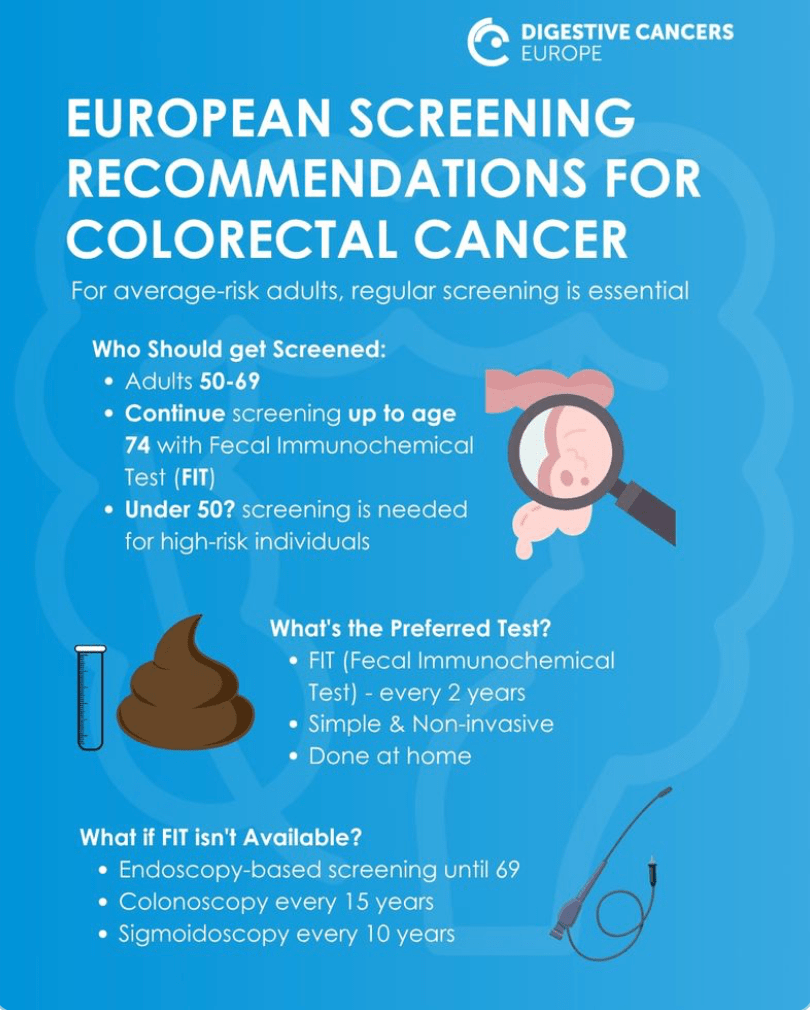
The European Commission’s Joint Research Centre (JRC) has just published updated recommendations on colorectal cancer screening tests and strategies for getting people to participate in screening.
Category: Colon
Study: Two immunotherapy drugs are better than one for some metastatic colorectal cancers

Combining two immunotherapy drugs is a more effective treatment for certain metastatic colorectal cancers than using either treatment drug alone.
CheckMate 8HW trial used together, Opdivo (nivolumab) plus Yervoy (ipilimumab) slowed cancer growth in MSI-High metastatic colorectal cancers, a type of colorectal cancer often found in Lynch syndrome.
The FDA approved this combined treatment for MSI-High metastatic colorectal cancer after progression with chemotherapy.
Note: People with Lynch syndrome who have colorectal cancer commonly have MSI-H or dMMR cancers.
https://www.thelancet.com/journals/lancet/article/PIIS0140-6736(24)02848-4/abstract
A Beginner’s Guide to Lynch Syndrome

Look Back & Track

The latest campaign from Andrex® and Bowel Cancer UK reveals 1 in 4 Brits (24%) won’t look at their poo, despite it being a natural and free health tracker. This partnership aims to change this, encouraging people to be less embarrassed, more in tune with their toilet habits and know what’s normal for them.
The main symptoms to watch out for when tracking your poo are: bleeding from your bottom or blood in your poo, a change in your pooing habits (you might be going more or less often, or have diarrhoea or constipation that might come and go), losing weight but you’re not sure why or feeling very tired all the time but you’re not sure why, or a pain or lump in your tummy.
Having these symptoms doesn’t always mean you have bowel cancer, but it’s still important to find out what’s causing them. Even if you have just one of these, ask your GP for a simple test you can do at home.
https://www.bowelcanceruk.org.uk/news-and-blogs/news/look-back-and-track/
Bowel Cancer in Ireland: Event

PATIENTS, BOWELS, BASICS, AND BREAKTHROUGHS
SEPTEMBER 11TH 2025: 3PM-6PM SEPTEMBER 12TH 2025: 10AM-6PM
“The Last Thing I Expected at This Age”

New Book by Digestive Cancers Europe.
It shares the personal stories of 15 young adults(including Pamela from Ireland) diagnosed with digestive cancer. Many of them faced misdiagnoses simply because of their age.
Bowel Prep. Hints and Tips
LS UK Annual Conference
John Vergil Briones is a Senior Specialist Screening Practitioner for the Bowel Screening Programme (BSCP) at St Marks Hospital. As part of his role, he ensures patients have a safe and comfortable journey in the BSCP pathway-including but not limited to assessment, taking bowel preparation, undergoing the actual investigations and results discussion.
Dr Kevin Monahan-Lynch Syndrome UK Annual Conference 2025
Lynch Syndrome where we were and where we are now.
The Cancer Prevention Project 3 study (CaPP3)

The trial involved 1,879 people with Lynch syndrome who were given three different-sized doses of the painkiller.
The Cancer Prevention Project 3 study (CaPP3), supported by Cancer Research UK, involved patients taking a different daily dose of aspirin: 100mg, 300mg or 600mg. In the trial, a European-sized dose of 100 mg aspirin was used. The established dose is 75mg per day in the UK, and 81mg in the US.
People with Lynch syndrome have inherited a faulty gene which can increase their chances of developing some cancers – including bowel and womb cancer.
Prof John Burn, who led the international study, said he focused his research on those patients “because they get so many cancers”.
“We already have NICE guidance saying people with Lynch syndrome should be recommended to take aspirin. Now we should recommend a baby aspirin.” new results showed the lowest dose worked just as well as the larger doses.
“Roughly speaking, if someone with Lynch syndrome has about a 2% a year chance of getting mostly bowel cancers, we think if they take aspirin, that is halved – down to about 1% a year,” he explained.
In some people, aspirin can cause bleeding, so Prof Burn said he wanted health regulators to now recommend the lowest dose be given to Lynch syndrome patients.
Nonoperative Management of Mismatch Repair–Deficient Tumours

Among patients with mismatch repair–deficient (dMMR), locally advanced rectal cancer, neoadjuvant checkpoint blockade eliminated the need for surgery in a high proportion of patients. Whether this approach can be extended to all early-stage dMMR solid tumours, regardless of tumour site, is unknown.
A total of 117 patients were included in the analysis. Phase 2 study.
CONCLUSIONS
Among patients with early-stage dMMR solid tumours that were amenable to curative-intent surgery, neoadjuvant PD-1 blockade led to organ preservation in a high proportion of patients.
https://www.nejm.org/doi/full/10.1056/NEJMoa2404512?query=WB
 Lynch Syndrome Ireland