InSight

The International Society for Gastrointestinal Hereditary Tumours (InSiGHT) is a multidisciplinary scientific organisation, whose mission is to improve the care of patients and families worldwide with any hereditary condition resulting in gastrointestinal tumours.

They have nearly 300 members, including scientists, clinicians and other healthcare professionals, from all parts of the world.

Lynch Syndrome Risks

The Prospective Lynch Syndrome Database (PLSD) now provides the most accurate estimates of cancer risks in LS, both in individuals who have yet to develop a cancer and those who have survived a cancer. An individual’s risks can be found according to their age, gender and the underlying gene.

Lynch syndrome-related tumours include:

  • Colon and rectal cancer
  • Endometrial cancer
  • Small intestine cancer (MSH2 & MLH1)
  • Hepato-biliary and pancreatic cancer (MSH2 & MLH1)
  • Gastric cancer (MSH2 & MLH1)
  • Ovarian non-serous cancer (MSH2 & MLH1)
  • Renal pelvis and ureter cancer (MSH2 & MSH6)
  • Bladder cancer(MSH2 & MSH6)
  • Sebaceous gland cancer (and adenoma – Muir-Torre syndrome)
  • Prostate cancer (MSH2)
  • Breast cancer (MLH1)
  • Central nervous system cancer

The risks associated with some EPCAM deletions appear not to be restricted to GI cancers.

https://www.insight-group.org/about/

Lynch Syndrome: Similarities and Differences of Recommendations in Published Guidelines

ABSTRACT:

Background: In this review, we aimed to compare the recommendations for Lynch syndrome (LS).

Methods: We compared the LS’s guidelines of different medical societies, including recommendations for cancer surveillance, aspirin treatment, and universal screening.

Results: Most guidelines for LS patients recommend intervals of 1–2 years for performing colonoscopy, though there is disagreement regarding the age to begin CRC screening (dependent on status as a MLH1/MSH2 or MSH6/PMS2 carrier). There are inconsistencies between LS guidelines for gastric cancer surveillance. Most guidelines do not recommend routine surveillance of the pancreas and small bowel. Most but not all of the guidelines support endometrial and ovarian surveillance with trans- vaginal ultrasound and endometrial biopsy. Only two societies recommend urological surveillance, while others recommend surveillance among high-­ risk carriers with family history only. There is significant disagreement between the guidelines about the recommendation for limited or extended bowel resection among patients with CRC. Aspirin use is recommended by most societies, though some with reservations, and most of them recommend universal screening.

Conclusions: There are significant disparities and disagreements in the guidelines and recommendations for patients with LS, causing confusion and difficulties for clinicians. Harmonisation and cooperation are needed between the societies creating LS guidelines.

https://onlinelibrary.wiley.com/doi/pdf/10.1111/jgh.16881

Colorectal Cancer (Bowel Cancer) Risk Factors & Prevention

Certain inherited genetic syndromes: 

About 5–10% of people who develop colorectal cancer have inherited changes (mutations) in their genes (the functional units of our genetic material, also known as DNA) that can lead to them getting the disease. These are often associated with people having colorectal cancer at a younger age than average. The most common hereditary conditions leading to colorectal cancer are:

  • Lynch syndromeThis is the most common hereditary syndrome leading to colorectal cancer. It accounts for about 3–5% of all colorectal cancers. The lifetime risk of colorectal cancer in people with this condition is 20–70%.

Bowel Cancer: the facts

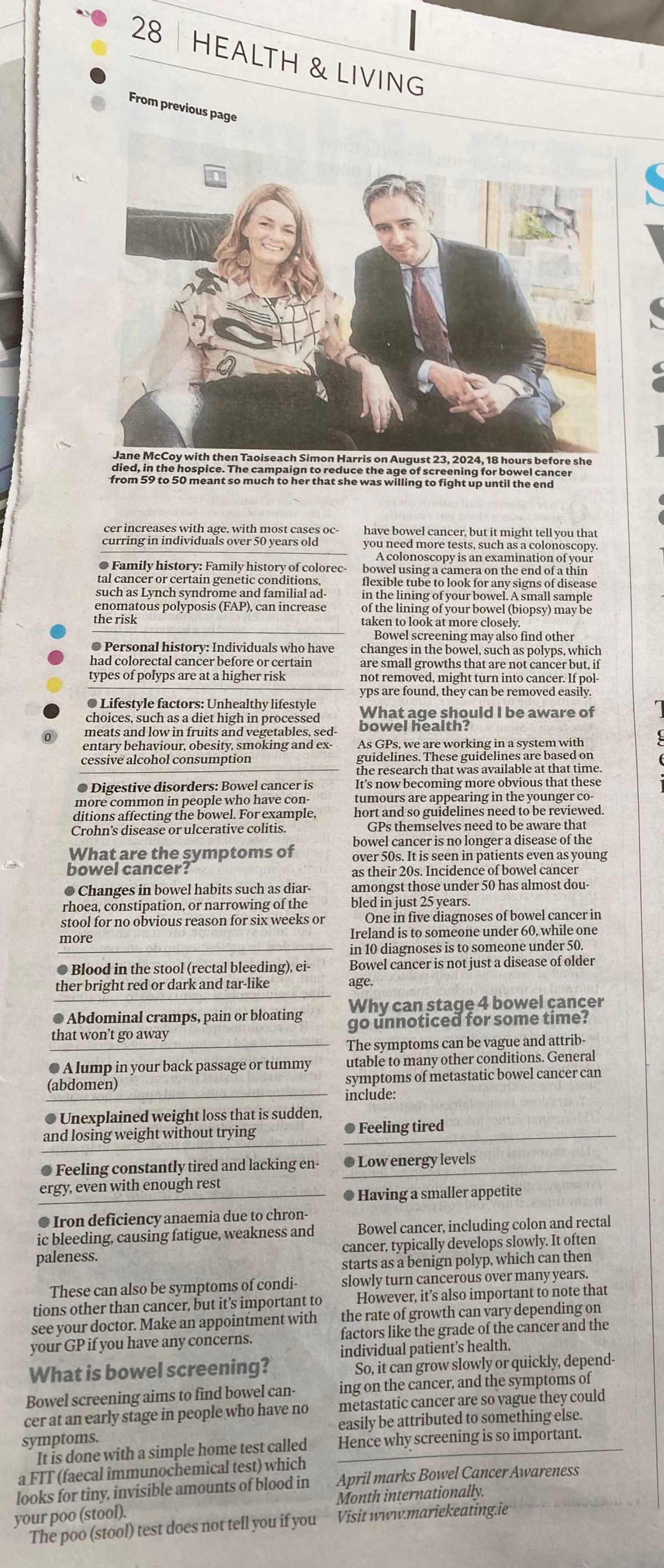
Dr Fiona Macken: Irish Independent – Health & Living

Are there particular risk factors for Bowel Cancer?

Lynch Syndrome

https://www.cancer.ie/cancer-information-and-support/cancer-information/about-cancer/causes-of-cancer/cancer-and-genes/lynch-syndrome

Lynch syndrome increases the risk of a number of cancers. In general, the risk is highest for colorectal (bowel) cancer, but it depends on the gene affected. 

Some colorectal (bowel) cancers are hereditary. Up to 5 people out of every 100 diagnosed with bowel cancer have Lynch syndrome. Other cancers linked to Lynch syndrome include:

https://www2.hse.ie/conditions/lynch-syndrome/

  1. About
  2. Testing and diagnosis
  3. Your results
  4. Help and support
  5. Reducing your risk of cancer
  6. Children and family planning

Metachronous colorectal cancer risks after extended or segmental resection in MLH1, MSH2, and MSH6Lynch syndrome: multicentre study from the Prospective Lynch Syndrome Database

According to the European Hereditary Tumour Group’s latest position report, LS is now considered an umbrella term for four distinct types of LS: MLH1 syndrome, MSH2syndrome, MSH6 syndrome, and PMS2 syndrome. These syndromes vary with regard to the age of onset of the associated cancers, sex predominance, and cancer incidence rates.

PLSD: Analysis of 8500 path_MMR carriers undergoing colonoscopic surveillance .

The aim of this study was to prospectively evaluate the risk of metachronous CRC, stratified by gene and the extent of the resection in previous surgery, contributing to the ongoing discussion on surgical strategies for LS patients.

Bowel Prep for Colonoscopy: Quality Matters

Bowel Prep Is Critical

When we talk about quality in colonoscopy, we’re referring to adenoma detection and sessile serrated lesion detection, along with the associated documentation that we perform. 

Achieving that level of quality is not just about writing a prescription for the prep and instructing your patients to follow through with it. Rather, it means providing guidance around diet modification and medication management and explaining the importance of the prep and how it is integral to colonoscopy performance.

It’s a shared responsibility. You, as well as your staff, need to take the time to discuss it with your patients.

Ensuring a quality prep is central to achieving our overall goals in colonoscopy and also in colorectal cancer prevention. Quality is what the patient should expect when a prep is prescribed. Referring physicians and healthcare providers should expect their patients to receive a high-quality colonoscopy prep. It’s our obligation as gastroenterologists to fulfill these expectations. 

https://www.medscape.com/viewarticle/bowel-prep-colonoscopy-quality-matters-2025a10007al?form=login

The ins and outs and ups and downs of a colonoscopy

Going for a #colonoscopy?

This popular blog answers your-most asked questions: how to get ready for the test, what you can and can’t eat, what happens and how long the test takes…

https://www2.healthservice.hse.ie/organisation/nss/news/the-ins-and-outs-and-ups-and-downs-of-a-colonoscopy/

HSE Health A-Z

https://www2.hse.ie/conditions/?fbclid=IwY2xjawJkYm5leHRuA2FlbQIxMQABHkFLUBpOydNbjldMlqnKhFD4QPIqKDYAcq9evuEd5_8reM0IMb1AqnvBNIVo_aem_MZRw4PsbrQDiYxV5n49fCA#L

Check out new addition on “Lynch syndrome” thanks to NCCP.