
Womb Cancer: Risk Factors and Prevention

Lynch syndrome may affect up to 175,000 people in the UK and is linked to 3% of cases of womb cancer. To develop Lynch syndrome, you need to have one parent that carries the gene. Someone diagnosed with Lynch syndrome has up to 60% chance of developing womb cancer in their lifetime. Lynch syndrome is also associated with an increased risk of bowel cancer. Those diagnosed with Lynch syndrome undergo regular tests to check for bowel cancer and womb cancer, many will be offered a hysterectomy (operation to remove the womb) to prevent womb cancer once they feel their family is complete.

Lynch syndrome is often diagnosed when a strong family history of bowel or womb cancer is noted. If you feel this may apply to you, please speak to your doctor about being referred to a genetics service. More information on Lynch syndrome can be found here.

https://peachestrust.org/womb-cancer/risk-factors-prevention/
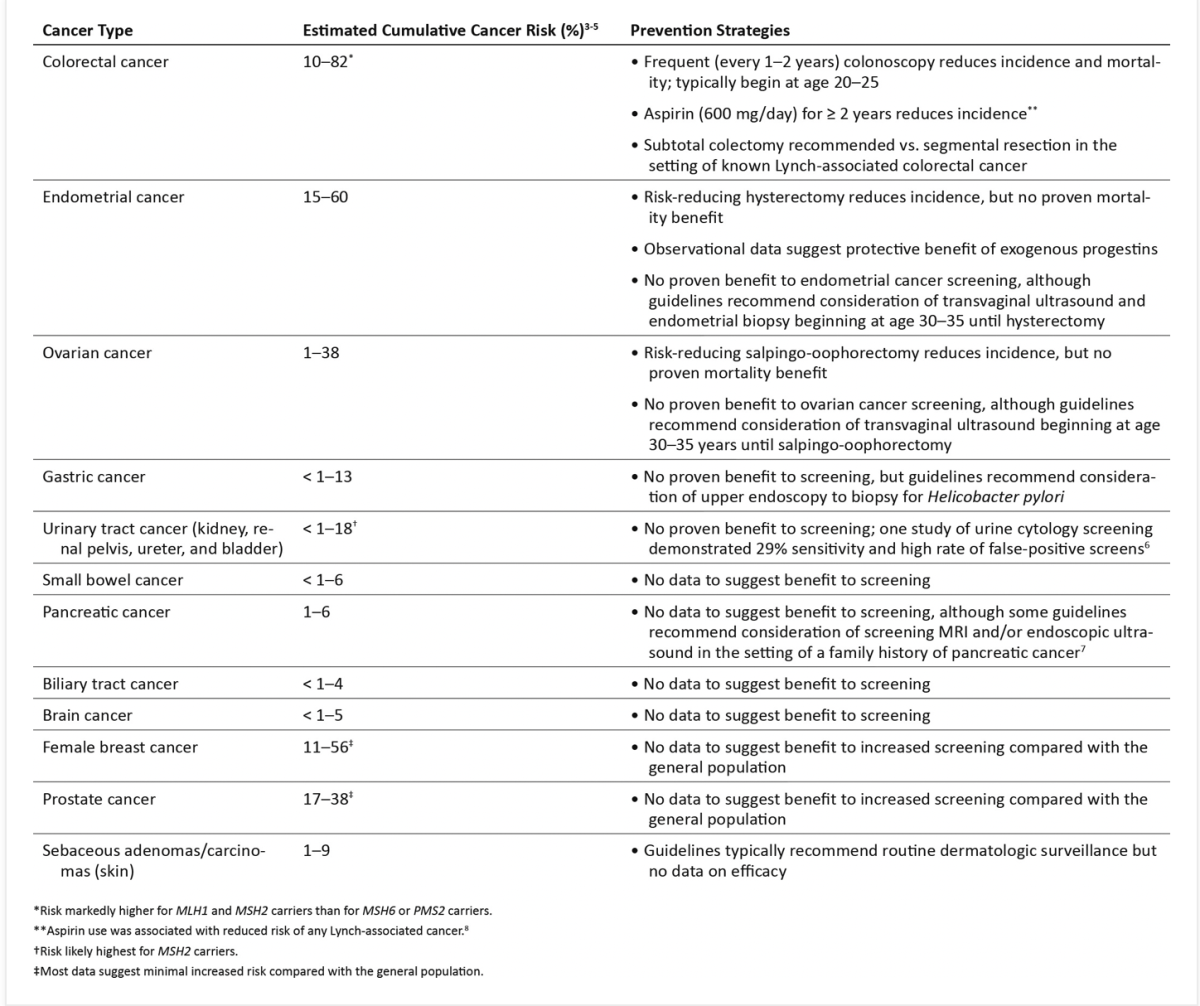
Endometrial, Ovarian, and Other Lynch Syndrome–Associated Cancers

For women with Lynch syndrome, endometrial cancer and ovarian cancer represent the second- and third-most common associated malignancy, respectively, after colorectal cancer. 

Despite gaps in knowledge, most guidelines currently recommend consideration of risk-reducing hysterectomy and salpingo-oophorectomy at the completion of childbearing and/or in the early 40s, with consideration of annual transvaginal ultrasound and endometrial biopsy at age 30 to 35 (continued until risk-reducing surgery).

https://ascopubs.org/doi/10.1200/EDBK_208341

2024 IGCS-IGCAN Gynecologic Cancer Survivor-Caregiver Summit – Dublin

Initiatives Promoting Equity, Diversity, and Inclusion in Patient Outreach Projects (IGCS Grant Recipients)

  • HER REASON FOR BEING: A Multifaceted Community-Based Project to Advance Cervical Cancer Prevention and Awareness
  • Nan men gran m’et la: Pilot Palliative Care Intervention for Vulnerable Women with Advanced Cervical Cancer in Haiti
  • Acceptability of Self-Sampling for Cervical Screening in the LGBTQIA+ Population – The Alternative Cervical Screening (ACES) LGBTQIA+ 2 Study

Empowered by Experience: Insights on Cancer Survivorship

  • The Public Narrative: Using your Lived Experiences to Call for Action
  • Key Findings from the IGCAN Survivorship + Caregiver Survey
  • Voices of Resilience: Survivorship Panel Discussion

Agents of Change: Patient Advocacy Organizations in Action

  • Every Woman Study™ LMIC Edition: World Ovarian Cancer Coalition
  • Ovarian Cancer Australia

A Clinical Perspective: Genetics & Clinical Trial Updates

  • Genetics in Gynecologic Cancer: Enhancing Understanding and Treatment
  • Recent Discoveries in Gynecologic Cancer Clinical Trials

ThisisGo.ie

thisisGO.ie is an online personalised resource for you and yours who have been impacted by a gynaecological cancer.

Also contains: genetic pathway for those impacted by BRCA and Lynch Syndrome. 

Did you know that all national clinical and non clinical trials can be found on the homepage. If your trial is not up there email contact@thisisgo.ie

Lynch syndrome is the most common cause of inherited colorectal cancer

How Is Lynch Syndrome Diagnosed?

Lynch syndrome is diagnosed by genetic testing of a blood sample and often involves testing for multiple gene variants.

Prior to genetic testing for Lynch syndrome, individuals should be counseled about screening benefits (early initiation of cancer screening if Lynch syndrome is diagnosed or reassurance if Lynch syndrome is ruled out) and risks (potential difficulty with insurability and psychological consequences of being diagnosed with a genetic disease).

How Is Lynch Syndrome Diagnosed?

Lynch Syndrome

Lynch syndrome is an autosomal dominant hereditary cancer syndrome, associated with a 40%–80% lifetime risk of developing colorectal, endometrial and other cancers.

Lynch syndrome may be suspected from a family history of bowel cancer and other Lynch syndrome-related cancers, triggering genomic testing in the family.

Lynch syndrome is an autosomal dominant condition, so that each child (son or daughter) and each sibling (brother or sister) of an affected individual has a 50% (1-in-2) chance of inheriting the condition.

It is important to remember that chance has no memory, and the 1-in-2, or 50%, chance of inheriting the altered gene for the condition applies to each child, irrespective of whether or not the parents have already had children with, or without, the condition.

https://www.genomicseducation.hee.nhs.uk/genotes/

Gynaecology and Lynch Syndrome

From LS UK Annual Conference 2024

Neil is a Clinical Lecturer and Gynaecology Oncology Surgical Subspecialty Fellow at the University of Edinburgh and NHS Lothian. His passion is to improve the care of those with Lynch syndrome through prevention and personalised treatment.

“Prevention is better than cure – vaccination for Lynch syndrome”

LS UK Conference 2024 – Dr David Church

Lynch Syndrome Conference 2024

Check out the presentations on YouTube.

Up to date information on Lynch Syndrome

Patterns of cytotoxic T-cell densities in immunogenic endometrial cancers reveal a potential mechanism for differences in immunotherapy efficacy

A new study in BMJ Oncology suggests that Lynch Syndrome patients may be more susceptible to immunotherapy than sporadic MMRd endometrial tumours.

Objective To explore the impact of molecular subtype in endometrial cancer (EC) on CD8+T cell densities. Furthermore, this work will test the assumption that all mismatch repair deficient (MMRd) tumours are immunologically similar which would enable current trial data to be generalised to all MMRd ECs.

Conclusion These data indicate that CD8+T cell numbers and distribution is not equal between MLH1-methylated and confirmed LS ECs. This is relevant when interpreting current trial data looking to the application of checkpoint inhibition treatments in MMRd cancers.

https://bmjoncology.bmj.com/content/3/1/e000320