Worldwide prevalence of Lynch syndrome in patients with colorectal cancer: Systematic review and meta-analysis

Overall, 51 papers were included for the final analyses (N = 51). These studies included 49,557 participants with CRC. The studies reported LS prevalence across 18 countries. 

Our results demonstrate that universal germline testing as a diagnostic tool yields the best estimates of clinically meaningful germline pathogenic variants. 

Lynch syndrome (LS) is the most common hereditary colorectal cancer (CRC) syndrome, with an estimated prevalence of 2% to 3% of CRC. A prevalence study is needed to provide accurate estimates of the true prevalence of LS.

https://www.gimjournal.org/article/S1098-3600(22)00030-2/fulltext#secsectitle0155

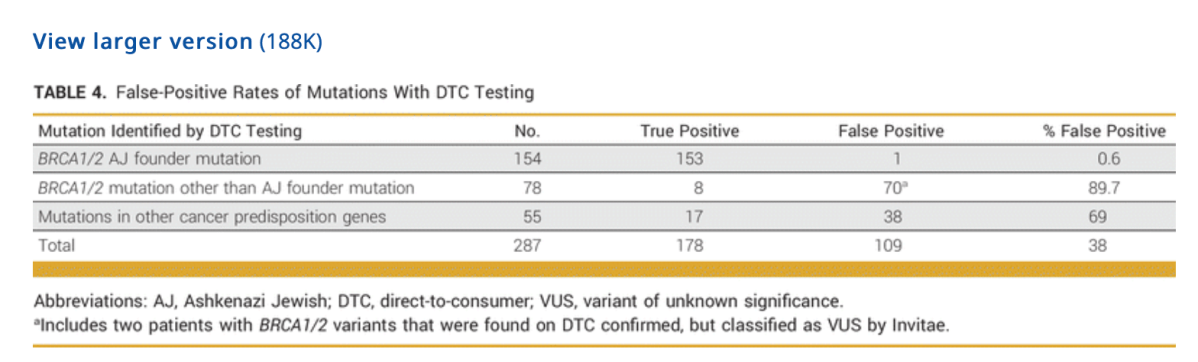
Retrospective Cohort Study on the Limitations of Direct-to-Consumer Genetic Screening in Hereditary Breast and Ovarian Cancer

Among the people who tested positive for non-founder #BRCA mutations, 89.7% [had] false-positive results. A false-positive result means the #genetic test shows you have a genetic mutation when you really don’t.

CONCLUSION

Direct to Consumer genetic testing misses >90% of BRCA1/2 pathogenic/likely pathogenic variants in individuals of non-AJ(non-Jewish) ancestry and about 10% of BRCA1/2 PLPV among AJ individuals. There is a high false-positivity rate for non-AJ BRCA 1/2 PLPV with DTC genetic testing.

https://ascopubs.org/doi/10.1200/PO.22.00695

Inheriting a Cancer Risk

No parent wants to pass a genetic mutation to their child. But once people know they have an increased risk of developing cancer, they can take proactive steps to ensure the best outcome.

Patients often have to make decisions based on incomplete information. But when people learn they have a genetic mutation that increases their risk of cancer, they can arm themselves with information, proactive screening measures and prophylactic procedures to mitigate the risk of getting the disease.

https://www.curetoday.com/view/inheriting-a-cancer-risk

The role of virtual consultations in cancer genetics: challenges and opportunities introduced by the COVID-19 pandemic

There is a clear potential to mitigate geographical barriers, meet increasing patient expectations of implementing virtual consultations, reduce hospital carbon footprints, and decrease hospital costs while increasing efficiency. 

There are also significant challenges… Virtual healthcare consultations introduce another new level of digital exclusion for patients and clinicians. There are also potential challenges for maintaining patient confidentiality, and limited utility in circumstances where a physical exam may be warranted. For clinicians, there may be impacts on empathetic responses delivered and challenges in workflow and workload.

Summary: Both the opportunities and the challenges of virtual care must be considered to ensure the appropriate, successful, and long-term implementation of virtual care in cancer genetic services.

https://www.nature.com/articles/s44276-023-00009-7

Family Tree

A genetic history captures details about the health of multiple generations.

This information can be important in diagnosing an inherited condition, revealing a pattern of inheritance, and informing clinical decisions regarding testing and management.

What is a Biomarker?

A biomarker (also called a biological marker) is a piece of information about your health. Biomarkers include your blood pressure, your blood type, and cholesterol or blood sugar levels measured in a blood test. The biomarkers of cancer are also known as tumor markers. Biomarkers can tell your medical team important information about you and your cancer.

Why are biomarkers important?

Colorectal cancer biomarkers can provide your medical team vital information about you and your cancer that is used to determine prognosis, guide treatment decisions, monitor treatment response, and look for recurrence after treatment. Biomarkers are also used in drug development to create and test targeted therapies for colorectal cancer.

Biomarkers of hereditary colorectal cancer

The biomarkers that can confirm hereditary colorectal cancer are the DNA mismatch repair genes causing Lynch Syndrome, and the genes causing Familial Adenomatous Polyposis (FAP) and associated syndromes. Lynch Syndrome is caused by mutations in MLH1, MSH2, MSH3, MSH6, EPCAM, or PMS2 genes, while FAP and other polyposis syndromes are caused by mutations in APC, MYH, BMPR1A, and SMAD4.

From diagnosis of colorectal cancer to diagnosis of Lynch syndrome: The RM Partners quality improvement project

The UK National Institute for Health and Care Excellence recommends universal testing for Lynch syndrome (LS) in all newly diagnosed colorectal cancer (CRC) patients. However, implementation varies significantly by geography. This project was developed to measure variation and deliver an effective diagnostic pathway from diagnosis of CRC to diagnosis of LS (within the RM Partners (RMP) West London cancer alliance).

Conclusion

The LS project was completed by April 2022. We have implemented a systematic approach with workforce transformation to facilitate identification and ‘mainstreamed’ genetic diagnosis of LS. This work has contributed to the development of a National LS Transformation Project in England which recommends local leadership within cancer teams to ensure delivery of diagnosis of LS and integration of genomics into clinical practice.

So why do people not get tested?

Experts say that millions of people are walking around with a genetic variant that raises their risk of developing cancer. The vast majority of them have no clue.

That’s a problem, because people who know they’re at a higher risk for certain cancers can take action, like going for more frequent screening tests such as colonoscopies and mammograms or even having preventive surgeries.

“Doctors are not up on this”

Asked why so few people get tested, both researchers and patients say that “many cancer doctors aren’t familiar with the latest research on inherited risk or that they don’t know the cost of testing has dropped”

https://www.npr.org/sections/health-shots/2023/08/02/1191419631/cancer-risk-test-genetic-genes-inexpensive-why-dont-more-people-get-tested

The Upsides and Downsides of Cancer Genetic Testing

Living with a hereditary cancer syndrome inevitably brings uncertainty. Despite taking preventative measures, the knowledge of increased risk frequently lingers in my mind.

https://www.curetoday.com/view/the-upsides-and-downsides-of-cancer-genetic-testing

The English National Lynch Syndrome Transformation Project

There is consistent evidence of the cost-effectiveness and clinical benefit of a structured diagnostic pathway in patients with LS following a diagnosis of cancer linked to cascade testing in families. 

Existing guidelines recommend universal testing of newly diagnosed colorectal and endometrial cancer for Lynch syndrome.

….Another approach to deliver effective diagnosis is to develop ‘mainstreaming’ models whereby patients are offered constitutional genetic testing by their cancer treating teams locally, rather than relying on referral of eligible patients to tertiary services such as clinical genetics.

Conclusions

Whilst there is increased awareness of the cancer risks associated with LS, and other aspects of the condition, by clinicians, there remain significant gains which can be made in diagnosis and subsequent lifelong management of people with LS.

Effective diagnosis needs to deliver people with this condition to effective clinical risk mitigation through a range of mechanisms including nationally coordinated and quality-assured colonoscopic surveillance.

In this project, we have aimed to develop expertise within cancer teams across England, with clear responsibilities, leadership from within which will ensure that the patients they are managing with cancer will receive appropriate testing and delivery diagnosis.

The responsibility for managing cascade testing remains with specialist genomics services.

However lifelong care of people diagnosed with this condition depends on awareness of who this population is, as defined through a national registry, and access to regional multidisciplinary expertise.

https://www.bsg.org.uk/service-success-stories/the-english-national-lynch-syndrome-transformation-project/