Closing the communication gap: The new priority in public health

The chasm of credibility between health scientists and the public has led to ongoing questioning of public health agencies and medical doctors. Some even wonder whether it is too late to close the gap.

Kristen Panthagani:  ‘Hey, we need to fix this.’

We need more clinicians and scientists communicating with the public, and to get there, we need to teach them how to do it.

Effective communication should emphasize empathy and clarity over jargon and dismissal

If you are a clinician or scientist interested in communicating with the public— is to just start, even if you’re still a student! 

https://ysph.yale.edu/news-article/closing-the-communication-gap-the-new-priority-in-public-health/

Reliable and effective healthcare messaging in a changing world

https://imj.ie/reliable-and-effective-healthcare-messaging-in-a-changing-world/

The art of listening

Lead author Dr Leonard Berry of the University of Texas, US, argues that the art of listening is a potent tool that not only helps the patient and doctor, but also has the potential to positively affect health systems in their entirety.

Effective listening, he explains, is targeted and is about asking the right questions and showing genuine compassion and empathy.

https://www.sciencedaily.com/releases/2025/08/250820000803.htm

From smart knives to virtual reality tumours: five innovations in understanding cancer

Using virtual reality (VR) coupled with sophisticated imaging and software technologies, scientists will before long be able to step inside interactive maps of patients’ tumours, looking at them in unprecedented detail, and understand better than ever how the cells interact and behave.
And the immersive experience should also open new opportunities for scientific collaboration. Researchers and physicians anywhere in the world could meet in VR spaces to study tumours in ways that simply aren’t possible in 2D.

https://www.cancerresearchhorizons.com/news-and-events/our-articles/smart-knives-virtual-reality-tumours-five-innovations-understanding-cancer

Does cancer run in my family?

Cancer in your family may be caused by an inherited genetic change if:

  • You have a close (‘first degree’) relative, such as a parent, brother, sister or child, who has been diagnosed with 2 separate cancers. For example, bowel cancer and endometrial (womb) cancer
  • 2 or more close relatives on the same side of your family have had the same cancer
  • You or one of your relatives have a cancer most commonly seen in the opposite sex (for example, male breast cancer)
  • You have Ashkenazi Jewish ancestry
  • You have had cancer at a younger age than commonly seen (for example, bowel cancer under the age of 50)

This list is a guide only. If any of the above points apply to you, it is possible, but not certain, that you have an inherited genetic cause for cancer in your family.

https://www.cancer.ie/cancer-information/about-cancer/cancer-and-genes

https://www2.hse.ie/conditions/lynch-syndrome/

Lynch Syndrome UK – New Website

Check out their newly launched version….lots of information that you might find useful.

https://www.lynch-syndrome-uk.org

The responsibility of health: shifting the focus from individuals to systems

Policy translations that solely place responsibility on individuals can exacerbate inequalities and prove counterproductive.

Shifting the focus to systemic actions can promote environments that foster individual healthy choices. This transformation can only be achieved through measures that acknowledge the boundaries of individual responsibility for health and encourage shared accountability within a wider societal context where social and commercial determinants are addressed.

By focusing on systemic solutions rather than individual blame, we can create a society where health equity is achievable and sustainable for all.

https://www.thelancet.com/journals/lanpub/article/PIIS2468-2667(25)00013-1/fulltext?dgcid=bluesky_organic_corr25_lanpub

Universal Healthcare Insurance model

Sláintecare is Ireland’s reform plan to create a universal, single-tier health and social care system based on patient need, not ability to pay, moving away from its current two-tier system

Sláintecare 2025+ aims to forge the way towards accessible, affordable, high-quality, healthcare for the people of Ireland when they need it, where they need it. 

michaeltmccarthy @mccarthymt7


BETWEEN HOPE AND HYPE: WHAT CANCER BLOOD TESTS REALLY MEAN FOR PATIENTS

For us as advocates, the message is clear: celebrate the progress, but guard against the hype. Stories of individual breakthroughs are moving — but without long-term, carefully designed trials that measure not just detection but survival, we risk creating false reassurance or unnecessary harm.

The real “holy grail” is not simply detecting cancer earlier. It is learning to distinguish between cancers that demand urgent treatment and those that do not; between signals of danger and signals of noise. Only then will early detection truly translate into lives saved.

Patients, Bowels, Basics and Breakthroughs

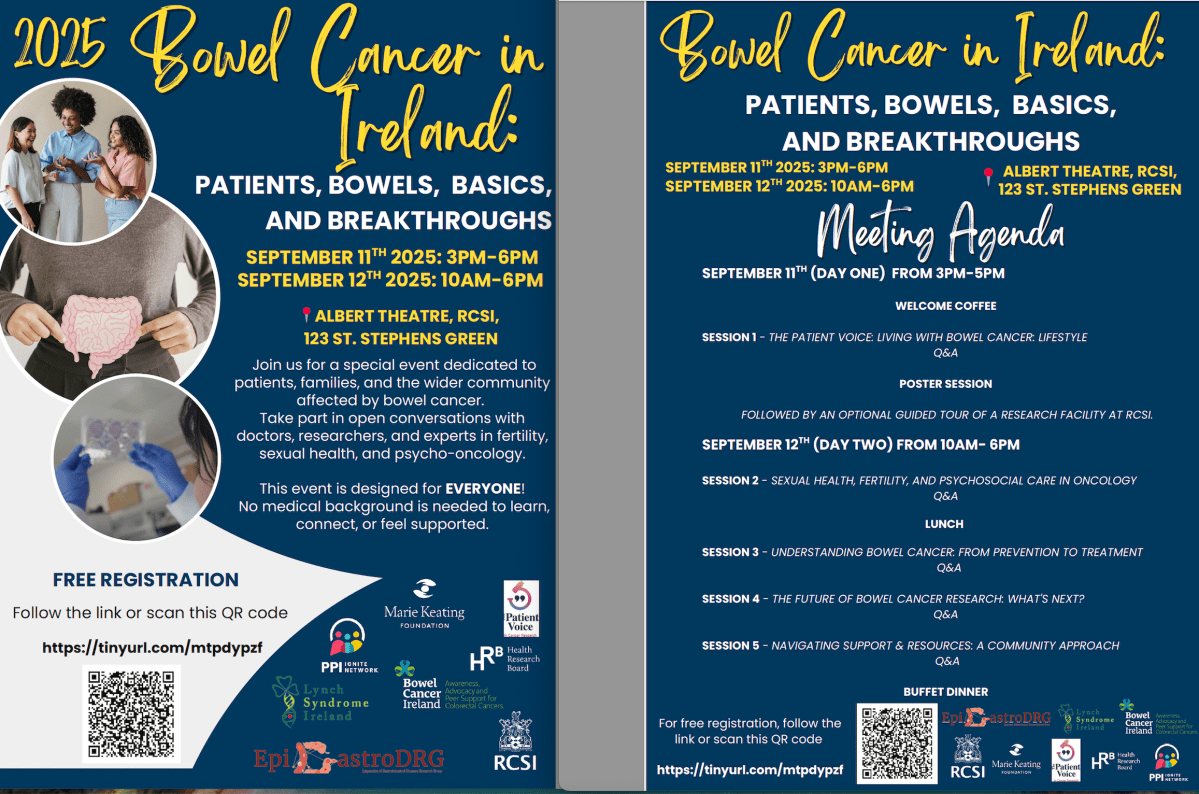
Very excited to share that @rcsi_irl ‘Patients, Bowels, Basics and Breakthroughs’ is back!!!

This two day event is aimed at bringing together the patient & professional community to explore the landscape of bowel cancer, with focus on the unique challenges of early-onset disease like fertility, sexual health and much more!

Learn about the latest research directly from those carrying out the work! It will feature fantastic speakers from across Ireland, the UK and Europe and powerful patient voices sharing their lived experiences.

There’ll be exciting panel discussions, a poster session and even a lab tour! 

What makes this event even more special is the people behind it. The fabulous (and I mean fabulous!) RCSI Epigastro Disease Research Group who have opened their doors to ourselves at @lynchsyndromeireland & @BowelCancerIreland and welcomed us as valued team members to co-organise these important events. This is more than patient involvement this is true PPI partnership. Together we can do more.

This free event is open to patients and their family members, carers, healthcare professionals and members of the public who would like to learn more about this very common cancer. 

When: 11 & 12 September 2025

Where: RCSI St Stephens Green Dublin 

Registration is essential. Scan the QR code on poster to register today. Please share the event with anyone who you feel would benefit or be interested.  

Let’s talk about bowel cancer, let’s do it all together!

#bowelcancer #CancerResearch #PPI#EOCRC