Clinical “noise” in medicine: it’s not what you think

“Women are NOT just men with boobs and tubes.”

“We have our own anatomy and physiology that deserve to be studied.  One of the biggest and most flawed assumptions in medicine is:  if it makes sense in a male body, it must make sense in a female one, too. But in every aspect, our current medical model is based on, tailored to, and evaluated according to male standards.”

Randomised Trials and Their Role in Modern Healthcare!

A free online course in Randomised Trials and Their Role in Modern Healthcare! – No prior knowledge needed – At your own pace and takes approximately 5 hours – This course is free to access on FutureLearn Learn more/enrol at:

https://www.futurelearn.com/courses/randomised-trials-and-their-role-in-modern-healthcare

20 Sleep Hacks For A Better Night’s Rest

Practical tips to help restore energy and wellbeing.

https://www.survivingbreastcancer.org/post/sleep-hacks

Storytelling for human well-being

When we attend to both the story and the body that tells it, we move beyond treating disease. We accompany people. We don’t just understand symptoms — we begin to understand lives.

Illness lives in the body — and so does the story of it. You can hear it in a pause before someone answers. You can see it in the way they shift in a chair, the tightness in a jaw, the way breath catches or slows. These are not incidental details. They are part of the narrative, carrying meaning that lab results and scan reports can’t capture.

This is embodied storytelling: when words and the body work together to communicate the lived experience of health and illness.

https://journalofethics.ama-assn.org/article/narrative-embodiment-and-health/2025-06

Who is responsible?

Is there anyone responsible for figuring this out, or is the whole system just going to drift into the future?

Overall, the National Development Plan is not heavy on specifics. While it refers to the Government’s commitment to health digitalisation, there is no detail.

As regards healthcare, more detail and a clearer sense of long-term ambition will be essential if this plan is to deliver meaningful and lasting reform.

https://www.medicalindependent.ie/comment/editorial/doctors-question-health-commitments-in-ndp-review/


How patients can use medicines before authorisation

In Ireland, medicines need to be authorised before a patient can use them. 

Sometimes, there is no authorised medicine available to treat a patient’s illness or to meet their medical needs. When this happens, a patient may be able to get access to medicines by the following two ways: 

1.Clinical trials

2.Exempt Medicinal Products (EMP)

https://www.hpra.ie/regulation/human-medicine/patients-and-healthcare-professionals/access-to-medicines-before-authorisation

Diagnosed with Colon Cancer: 10 Tips on How to Get The Most From Your Doctor

Be Your Own Advocate

Build your colorectal cancer treatment team: -You, of course, are the starring player.

Make sure you have an overall care coordinator.

Cancer Revolution: Science, Innovation and Hope – Aug 15th to Sept 5th (Free Event)

Through seldom and never-before seen objects and stories, cutting edge treatment and research, reflection, film, photography, interactive exhibits and a breadth of personal stories – this exhibition presents the stories of people affected by cancer, together with those who study and treat it. Revealing how researchers, clinicians, policy makers and patients are fuelling progress in a powerful expression of shared hope.

Shaped through collaboration with people living with and impacted by cancer, the exhibition will take visitors on a journey of discovery with scientists, clinicians and people who have been affected by cancer in their own words. Explore everything known so far about what cancer is and what causes it, why scientists are focusing their research on understanding how and why cancer evolves, and what the future of cancer care looks like.

The exhibition reveals how cancer has been treated over the centuries, from high-risk surgeries to the discovery of the first chemotherapy drugs, and the important challenges that remain to be solved.

 National Electronic Health Record (EHR)

EHR will be a digital system that holds a person’s full health and social care information in one place. It will replace paper files and local IT systems by allowing staff to record, update and access all health information in one place.

Access to digital health records has been a long-sought objective in Irish healthcare for many years.

To date(March 25), the Health Service has rolled out a number of electronic health record (EHR) systems in different sites in recent years. These include the National Rehabilitation Hospital, the National Forensic Mental Health Service, St. James Hospital, Mater Misericordiae University Hospital, roll-out across the bigger Maternity Hospitals extending EHR coverage to 70% of births nationally by the end of 2025. The National Children’s Hospital EHR deployment will be the most comprehensive EHR deployment in the state when the hospital is commissioned.

Ireland needs one digital health record for every citizen that can be access by health professionals across the service.

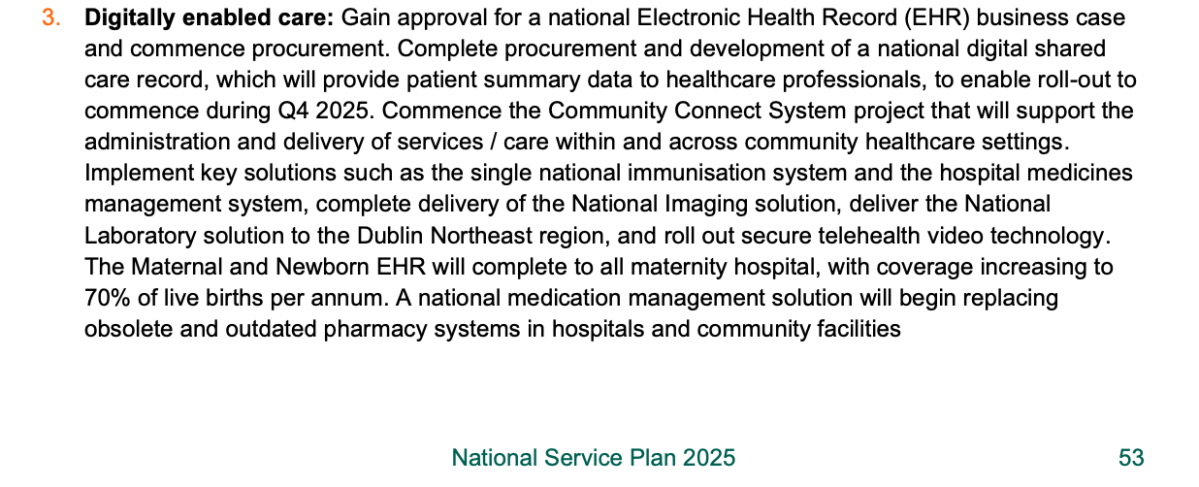
To achieve this, the HSE are following a three-step approach: delivering the HSE Health App, developing a National Shared Care Record (NSCR), and regional deployments of enterprise level Electronic Health Record systems that span acute and community healthcare.

HSE has completed the procurement for the National Shared Care Record (NSCR) programme and has now been mobilised, with the contract for building the NSCR technology platform awarded to EY, Better and Kainos.

The NSCR brings together healthcare information from various sources such as hospitals, GP practices, and Community care into a single place, making them available at the point of care and self-care in read only format. By having access to key healthcare information in one place means healthcare professionals will be able to make more informed, safer decisions and to focus more time on direct patient care while patients will be better informed and empowered to manage their own healthcare. 

A phased roll-out of the national shared care record is due to commence in Q4 2025 in the South-East region with University Hospital Waterford. The system will then extend to other regions from 2026 with additional information being added over time.

https://www.oireachtas.ie/en/debates/question/2025-03-04/696/