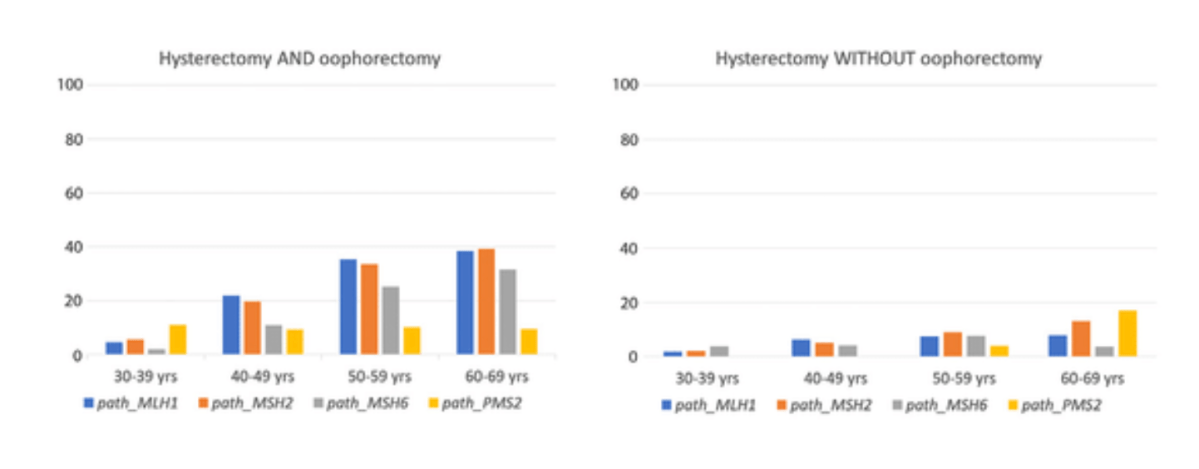
Uptake of hysterectomy and bilateral salpingo-oophorectomy in carriers of pathogenic mismatch repair variants: a Prospective Lynch Syndrome Database report(2021)

Conclusion:

Uptake of RRS before 50 years of age was low, and RRS was rarely undertaken in association with surgical treatment of CRC.

Uptake of RRS aligned poorly with gene- and age-associated risk estimates for endometrial or ovarian cancer that were published recently from PLSD and did not correspond well with current clinical guidelines.

The reasons should be clarified. Decision-making on opting for or against RRS and its timing should be better aligned with predicted risk and mortality for endometrial and ovarian cancer in Lynch syndrome to improve outcomes.

https://www.ncbi.nlm.nih.gov/pmc/articles/PMC8916840/

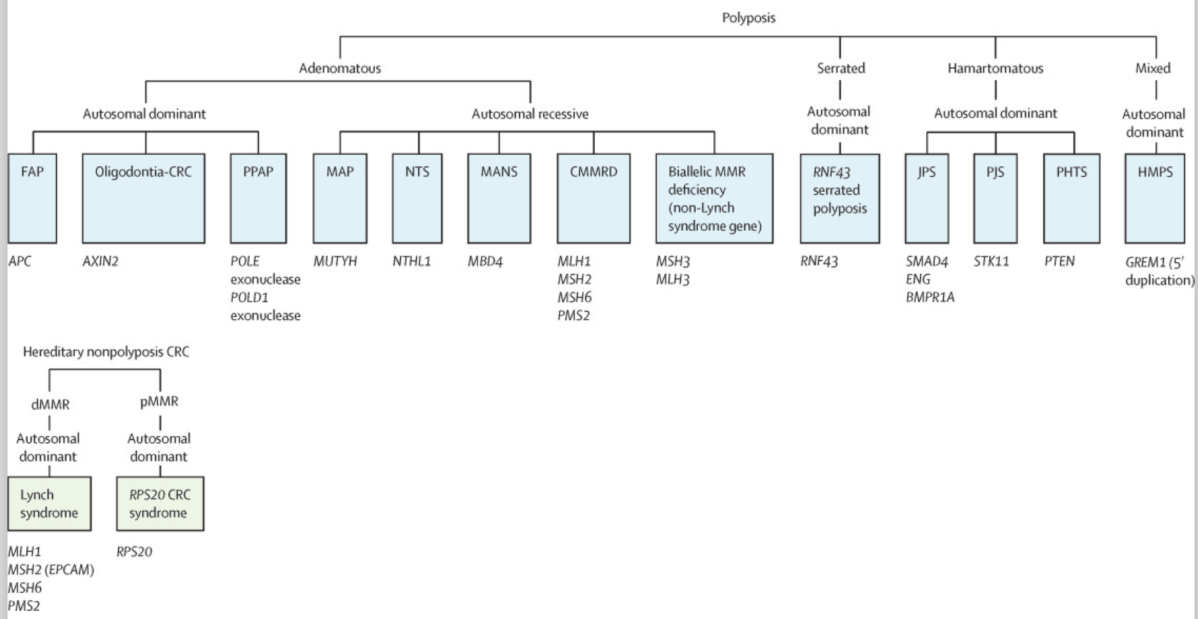
Genetic predisposition to gastrointestinal polyposis:

https://www.thelancet.com/journals/langas/article/PIIS2468-1253(23)00240-6/fulltext

This Review provides an overview of the known syndromes and genes, genetic testing, and clinical management of patients with polyposis, and recent advances and challenges in the field of gastrointestinal polyposis.

How Holiday Conversations About Cancer Can Save Lives

Knowing your family history of Lynch syndrome can be a life-saving intervention.

Broaching the topic of family history, especially when it involves sensitive issues like cancer diagnoses, can be challenging, particularly in families with strained relationships or a history of familial dysfunction. It’s crucial to remember that discussing family history is not to dredge up painful memories or assign blame but to gain a deeper understanding of our collective past and make informed decisions about our health.

Silently plaguing our family is Lynch syndrome, a hereditary cancer syndrome that increases the risk of developing various cancers. This genetic predisposition often goes undetected, affecting approximately 1 in 279 Americans. Lynch syndrome arises from mutations in genes responsible for DNA error repair, potentially leading to tumor formation and triggering cancer.

https://www.curetoday.com/view/how-holiday-conversations-about-cancer-can-save-lives

Prospective Lynch Syndrome Database (PLSD)

The Prospective Lynch Syndrome Database (PLSD) is the largest worldwide database on Lynch Syndrome. 
PLSD collates information on carriers of pathogenic or likely pathogenic MMR variants (path_MMR) who are receiving medical follow-up, including colonoscopy surveillance, which aims to achieve early diagnosis and treatment of cancers.

plsd.eu

Lynch Syndrome? Why it’s important to know about it

Lynch syndrome is caused by an inherited mutation in one of these genes:

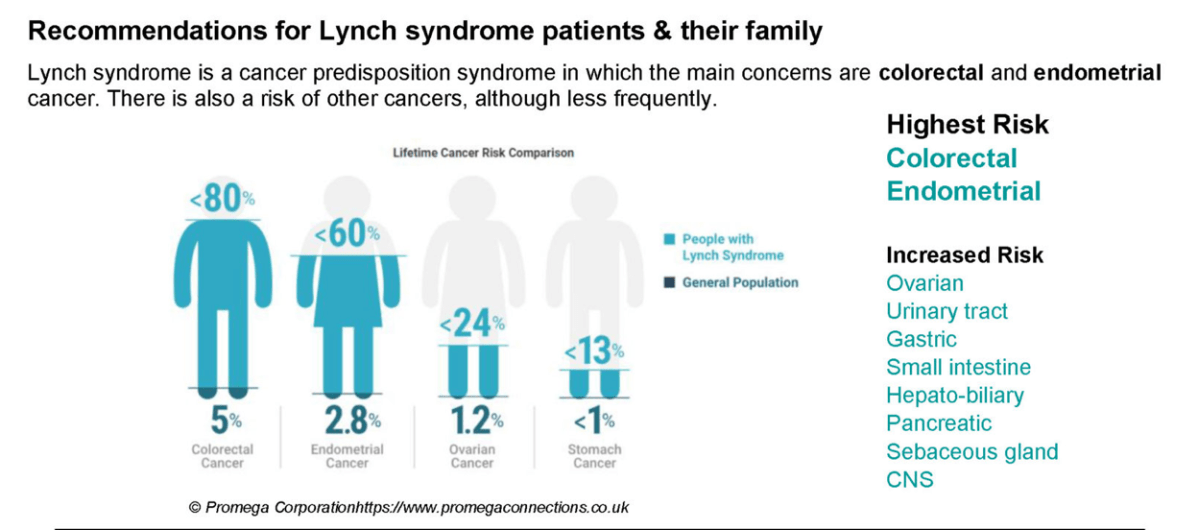
People with Lynch syndrome have an increased risk for colorectal, endometrial and other cancers. The cancer risk varies by gene mutation, therefore it is important for people with Lynch syndrome to know which gene mutation they have.

In the past, the risk-management guidelines were the same for people with an inherited mutation in any of the Lynch syndrome genes. As more research has shown different cancer risks for each gene, experts have started to separate the risks and medical options for each individual mutation. Despite these differences, some references discuss Lynch syndrome as though inherited mutations in these genes carry the same risks. 

If you have been told that you have Lynch syndrome, it is important to know which gene has a mutation, so that you can make informed decisions about your medical care. 

In the past, Lynch syndrome was also referred to as “hereditary nonpolyposis colorectal cancer” (HNPCC). This term has fallen out of favour because mutations in these genes also increase the risk for other cancers besides colorectal cancer. 

Methylated DNA Markers for Sporadic Colorectal and Endometrial Cancer Are Strongly Associated with Lynch Syndrome Cancers

Lynch syndrome (LS) markedly increases risks of colorectal and endometrial cancers. Early detection biomarkers for LS cancers could reduce the needs for invasive screening and surgical prophylaxis.

Prevention Relevance:

Methylated DNA markers previously identified in sporadic endometrial cancer and colorectal cancer discriminate between benign and cancer tissue in LS.

https://aacrjournals.org/cancerpreventionresearch/article-abstract/16/11/611/729696/Methylated-DNA-Markers-for-Sporadic-Colorectal-and?redirectedFrom=fulltext

Transforming the care of people with Lynch syndrome: a system-wide approach

Monahan et al describe progress in addressing the lack of diagnosis of Lynch syndrome in the English National Health Service with a bold attempt to fix a leaking pathway.

There remains much to do, not least inclusion of the many other tumour types seen in LS, but this programme has demonstrated the power of a national system of health provision and the willingness of the professional community to work together to improve the care of people with this common rare disorder.

https://bmjoncology.bmj.com/content/2/1/e000211

“Go ahead and screen” – advice to healthcare systems for routine lynch syndrome screening from interviews with newly diagnosed colorectal cancer patients

Conclusion: Our qualitative findings demonstrate patients with CRC have a strong desire for healthcare systems to regularly implement and offer UTS.

https://pubmed.ncbi.nlm.nih.gov/37978552/

Lynch syndrome quick guide for Primary Care clinicians(NHS)

The training involves watching a short video which covers:

  • A brief overview of Lynch syndrome
  • Their personalised cancer prevention programme
  • An introduction to the Lynch syndrome quick guide and how it can help you identify and manage your patient’s care
  • How to manage their first-degree family members’ care

Guidelines for the management of hereditary colorectal cancer from the British Society of Gastroenterology (BSG)/Association of Coloproctology of Great Britain and Ireland (ACPGBI)/United Kingdom Cancer Genetics Group (UKCGG) -2019

Lynch syndrome (LS)

  • We recommend that for all people when first diagnosed with CRC, testing using immunohistochemistry (IHC) for MMR proteins or microsatellite instability is used to identify tumours with deficient DNA MMR, and to guide further sequential testing for LS. (GRADE of evidence: moderate; Strength of recommendation: strong)
  • We recommend that colonoscopic surveillance should be performed at a 2 yearly interval for all LS patients. (GRADE of evidence: moderate; Strength of recommendation: strong)
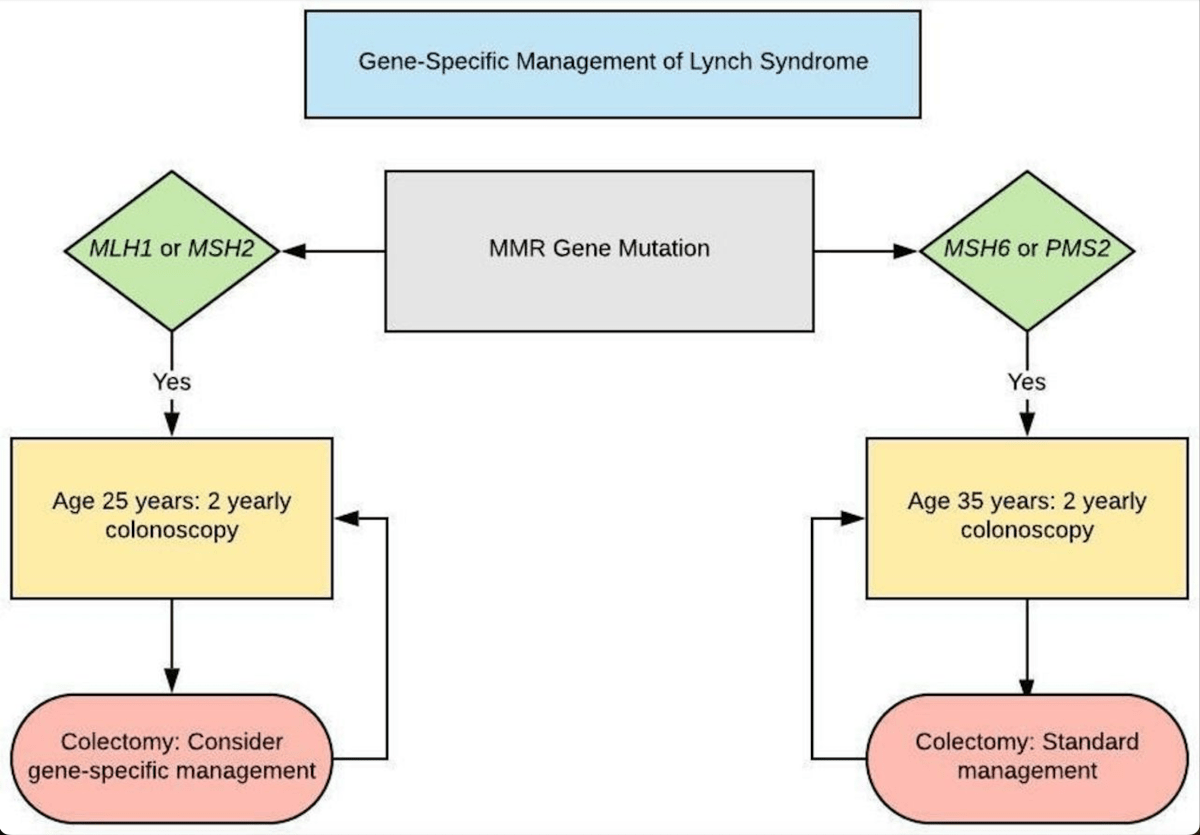
  • We recommend that age of onset of surveillance colonoscopy should be stratified according to the LS-associated gene. We recommend colonoscopy from age 25 years for MLH1 and MSH2 mutation carriers and 35 years for MSH6 and PMS2mutation carriers. There are insufficient data to support stratifying age of onset of surveillance by gender. (GRADE of evidence: moderate; Strength of recommendation: strong)
  • We suggest that for LS patients with MLH1 or MSH2 mutations who develop colon cancer or colonic neoplasia not amenable to endoscopic control, the decision to perform segmental versus total/near total colectomy should balance the risks of metachronous cancer, the functional consequences of surgery, the patient’s age and patient’s wishes. (GRADE of evidence: Moderate; Strength of recommendation: strong)
  • We recommend that for LS patients with MSH6 or PMS2 mutations there is insufficient evidence for oncological benefit of extended colectomy over segmental resection. (GRADE of evidence: low; Strength of recommendation: strong)
  • We suggest that when abdominal-perineal excision can be avoided, a standard low anterior resection is a reasonable option to treat rectal cancers in LS patients, even though the residual colon is at high-risk of metachronous neoplasia. (GRADE of evidence: low; Strength of recommendation: weak)
  • We recommend that gastric, small bowel, or pancreatic surveillance in LS patients is only performed in the context of a clinical trial. (GRADE of evidence: low; Strength of recommendation: strong)
  • We recommend screening for H elicobacter pylori in patients with LS and subsequent eradication therapy if indicated. (GRADE of evidence: low; Strength of recommendation: strong)

https://gut.bmj.com/content/69/3/411