
March is colorectal cancer awareness month, so let me give you a little help in getting screened. For those of you who may be a bit nervous for your first colonoscopy, prep is the worst part! I put this together for a friend a while back, and I hope it helps someone out there.1/n
— Phuong Gallagher (@CancerInsider) March 3, 2021
Category: Monitoring
Risk-stratified faecal immunochemical testing (FIT) for urgent colonoscopy in Lynch syndrome during the COVID-19 pandemic

Lynch syndrome is a hereditary cancer disease resulting in an increased risk of colorectal cancer. Findings are reported from an emergency clinical service implemented during the COVID-19 pandemic utilising faecal immunochemical testing (‘FIT’) in Lynch syndrome patients to prioritise colonoscopy while endoscopy services were limited.
Fifteen centres participated from June 2020 to March 2021. Uptake was 68.8 per cent amongst 558 patients invited.
Conclusion
FIT demonstrated clinical value for Lynch syndrome patients requiring colorectal cancer surveillance …. Further longitudinal investigation on FIT efficacy in Lynch syndrome is warranted and will be examined under the ‘FIT for Lynch’ study (ISRCTN15740250).
https://academic.oup.com/bjsopen/article/7/5/zrad079/7260320?login=false
AliveAndKickn Podcast – Dr Jose Perea
“I talk with Dr Jose Perea Garcia, Digestive Surgeon as well as cancer researcher in Madrid. We talk about how surgery has evolved and management of the Lynch Syndrome patient compared to sporadic cases. We compare some protocols and coverage in the US vs elsewhere such as Spain where there is government run. Urban vs rural is an issue everywhere. I convince Dr Garcia to offer me a ticket to an Atletico Madrid game if I get there, including if they play Real Madrid.”
https://www.aliveandkickn.org/podcast-1/episode/26556485/aliveandkickn-podcast-dr-jose-perea-garcia
Tip

Promoting research and learning in the National Screening Service
Research in healthcare is important. We need to investigate novel approaches to clinical and management strategies, practices and interventions. This also applies to screening programmes. It keeps us informed of new developments and emerging trends in screening.
Research goals are:
- to promote the visibility of our four population screening programmesboth nationally and internationally
- to contribute to international screening literature
- to facilitate the use of anonymised screening data by external partners working with us.
The ins and outs and ups and downs of a colonoscopy

A colonoscopy is a test to look at your bowel using a small camera.
Bowel preparation is required by taking a strong laxative. You will take this the day before the test to empty your bowel. The test works best when your bowel is empty and there is nothing to block the camera going into the bowel and having a look.
You will have to go to a hospital endoscopy unit to have the test.
The test is a day procedure.
The test is done by a doctor or an advanced practice nurse, called an endoscopist.
You will have a choice of doing the test with sedation or no sedation.
Generally the test can take up to 20 minutes.
Before you leave, you will be told what was seen during the test and if any samples were taken or if any polyps were removed.
(Personally I have undergone aprox 15 colonoscopies and I can say that the preparation and procedure are worthwhile particularly if you have a family predisposition to cancer or have symptoms like blood in your stool. They have probably saved my life as during one of these procedures cancer was detected…I had no symptoms).
In oncology family history should NEVER be considered “non-contributory”
We need a genomics-savvy healthcare workforce

Genetics has long been used in specific areas of medicine, such as for the diagnosis of rare diseases caused by pathogenic mutations or in the context of prenatal genetic testing; however, it is now diffusing across many domains of clinical practice.
The interpretation of clinical genetic information and its communication to patients are by no means trivial. In the case of genetic tests, for example, the ideal scenario is that the test provides information on whether the patient carries an actionable pathogenic variant.
The increasingly central role of genomics in healthcare means that not only are more genetic counselors needed, but also multidisciplinary teams are essential for utilising genomic technologies in the clinical setting.
A rapidly evolving genomic revolution is poised to shape the future of healthcare, but its full clinical potential can be realized only with the development of a multidisciplinary healthcare workforce capable of evolving to stay abreast of rapidly developing genetic technologies.
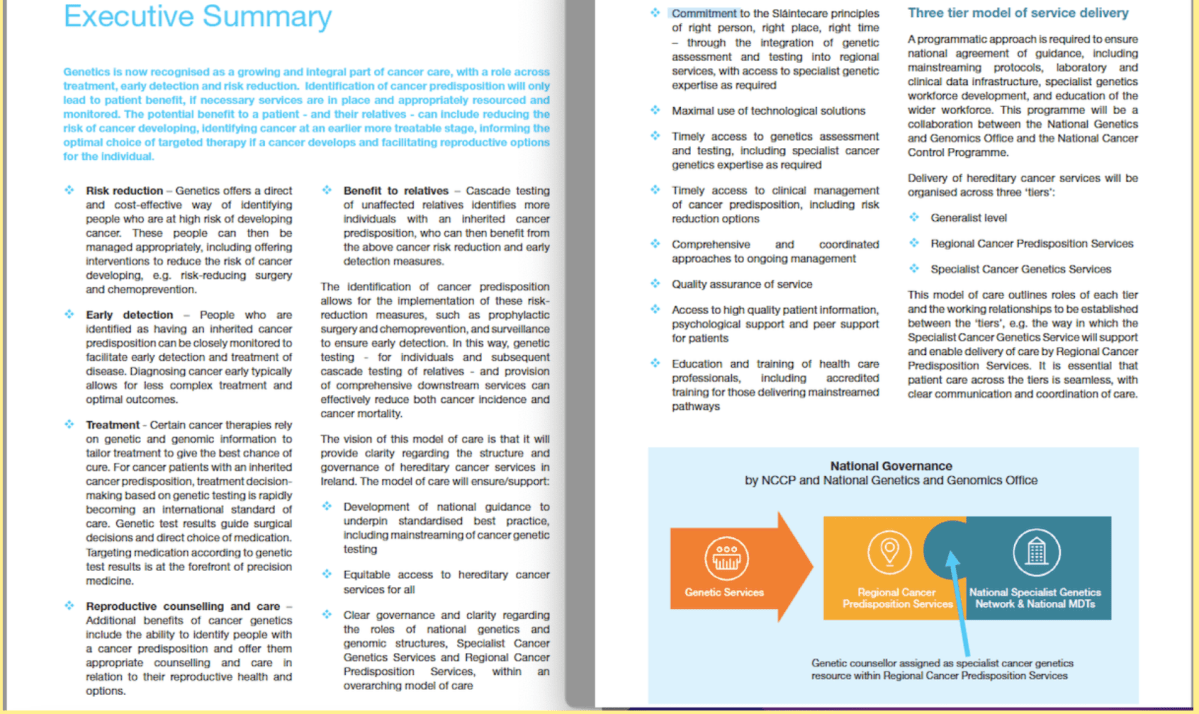
Hereditary Cancer Model of Care
Inheriting a Cancer Risk

No parent wants to pass a genetic mutation to their child. But once people know they have an increased risk of developing cancer, they can take proactive steps to ensure the best outcome.
Patients often have to make decisions based on incomplete information. But when people learn they have a genetic mutation that increases their risk of cancer, they can arm themselves with information, proactive screening measures and prophylactic procedures to mitigate the risk of getting the disease.
 Lynch Syndrome Ireland