The NordICC Trial: The Devil Is in the Details

The NordICC trial was a randomized, pragmatic study that enrolled 84,585 adults aged 55 to 64 years old from Poland, Norway, and Sweden.

[T]he NordICC trialfills an important knowledge gap and provides new insight into the real-world population-wide benefit of colonoscopy for colorectal cancer screening.

Preventing Colorectal Cancer

It is important to highlight an advantage of colorectal cancer screening that distinguishes it from all other cancer screening modalities. Colorectal cancer screening with endoscopy is unique in that it aims to, in part, prevent disease by identifying and removing premalignant lesions.

https://ascopost.com/news/november-2022/the-nordicc-trial-the-devil-is-in-the-details/

Person-based co-design of a decision aid template for people with a genetic predisposition to cancer

https://www.frontiersin.org/articles/10.3389/fdgth.2022.1039701/full

Conclusion: Adopting a co-design process helped ensure that the decision aid components were relevant and accessible to the target population. The template could have widespread application through being adapted for different genetic predispositions. The exact content should be co-designed with people from diverse backgrounds with lived experience of the specific predisposition to ensure it is as useful, engaging and relevant as possible

She With Lynch Syndrome

The future is bright for those of us with Lynch syndrome and, most likely, for most of us with a hereditary cancer syndrome.

She and all of the new medical advances for those with Lynch syndrome give me hope for if and when I ever develop cancer. 

https://www.curetoday.com/view/she-with-lynch-syndrome

A Focused Clinical Review of Lynch Syndrome

In summary, LS care has come a long way over the last twenty years. We now understand the individual cancer risk to inform consent, tests to accurately diagnoses LS and ways by which we can reduce cancer risk.

However, more needs to be done to find those who are undiagnosed, develop less invasive cancer surveillance methods and develop new vaccinations and treatments.

https://www.dovepress.com/a-focused-clinical-review-of-lynch-syndrome-peer-reviewed-fulltext-article-CMAR?fbclid=IwAR33GEIsS9fAA63cUmvwRtWTrGALZ2a74tovR7JMBPYNVjDdsx_dDun9oMQ

Transforming diagnosis of Lynch syndrome in the NHS, working together to “Find the missing 95%

This ongoing transformational project is supported by high levels of engagement across stakeholders in England. Despite barriers, significant quality improvement has been implemented, facilitating systematic delivery of universal testing for LS nationally, with reduction in variation in care. 

Can we appoint Clinical Leads to champion & introduce Universal Testing at Cancer centres in Ireland to improve the service, prevent/detect early genetic cancers and provide a much improved service for people with an inherited predisposition to cancer?

https://www.researchgate.net/publication/364756374_PP031-_The_English_National_Lynch_syndrome_transformation_project_An_NHS_Genomic_Medicine_Service_Programme

How do we screen for bowel cancer?

POO...

In the UK Bowel cancer is a catch-all term for any cancers in the colon or rectum – sometimes called colorectal cancer. 

Faecal immunochemical testing(FIT)checking for blood in your poo – and other types of bowel cancer screening. This includes Lynch syndrome, a hereditary condition increasing the risk of certain types of cancer including bowel cancer.

https://patient.info/news-and-features/how-do-we-screen-for-bowel-cancer

Diagnosis and management of Lynch syndrome

Testing for Lynch Syndrome in all new diagnoses of colorectal or endometrial cancers is now recommended in the UK, and gastroenterologists can offer ‘mainstreamed’ genetic testing for LS to patients with cancer.

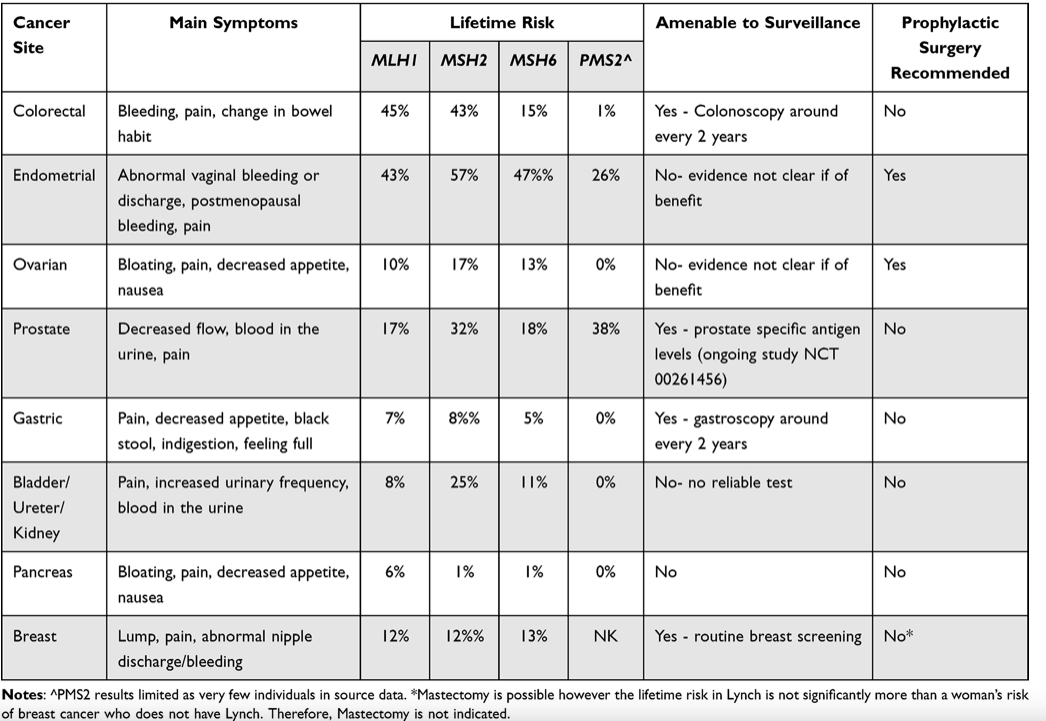
Because LS results in a high lifetime risk of colorectal, endometrial, gastric, ovarian, hepatobiliary, brain and other cancers, the lifelong care of affected individuals and their families requires a coordinated multidisciplinary approach.

Interventions such as high-quality 2-yearly colonoscopy, prophylactic gynaecological surgery, and aspirin are proven to prevent and facilitate early diagnosis and prevention of cancers in this population, and improve patient outcomes. 

A personalised approach to lifelong gene-specific management for people with LS provides many opportunities for cancer prevention and treatment which we outline in this review.

https://fg.bmj.com/content/13/e1/e80

Lynch Syndrome- St Marks

Patient Information – 2019

  1. What is the chance of developing cancer if a faulty gene is found? Not everyone who carries a Lynch syndrome pathogenic variant will develop cancer. The risk of developing cancer is considerably lower in those who know they have Lynch Syndrome compared to those who have it but are unaware of the diagnosis.

Colonoscopy withdrawal time and polyp/adenoma detection rate: a single-site retrospective study in regional Queensland

Bowel cancer is the second most common non-cutaneous cancer diagnosed in Australia among both genders. Colonoscopy withdrawal time of at least 6 min has been accepted as the standard to achieve the target polyp detection rate (PDR) and adenoma detection rate (ADR).

Conclusion

Colonoscopies with withdrawal times of less than 6 min did not achieve the target detection rates. It is clear that achieving the advocated withdrawal time for screening colonoscopy improves detection rates.

https://onlinelibrary.wiley.com/doi/abs/10.1111/ans.15652

Current practice of colonoscopy surveillance in patients with lynch syndrome: A multicenter retrospective cohort study in Japan

Current guidelines recommend that patients with Lynch syndrome should have colonoscopy surveillance every 1–2 years starting at the age of 20–25. However, insufficient data are available to evaluate the quality and safety of colonoscopy surveillance for patients with Lynch syndrome nationwide in Japan.

The proportion of patients developing cancer was significantly higher with a >24 months than a ≤24 months interval.

Conclusion

High-volume experienced endoscopists and appropriate surveillance intervals may minimize the risk of developing colorectal cancers in patients with Lynch syndrome.

https://onlinelibrary.wiley.com/doi/10.1002/deo2.179