Colonoscopic surveillance in Lynch syndrome: guidelines in perspective

The prevention of colorectal cancer through colonoscopy relies on identifying and removing adenomas, the main precursor lesion. Nevertheless, colonoscopy is not an optimal strategy since post-colonoscopy colorectal cancer remains an important issue.

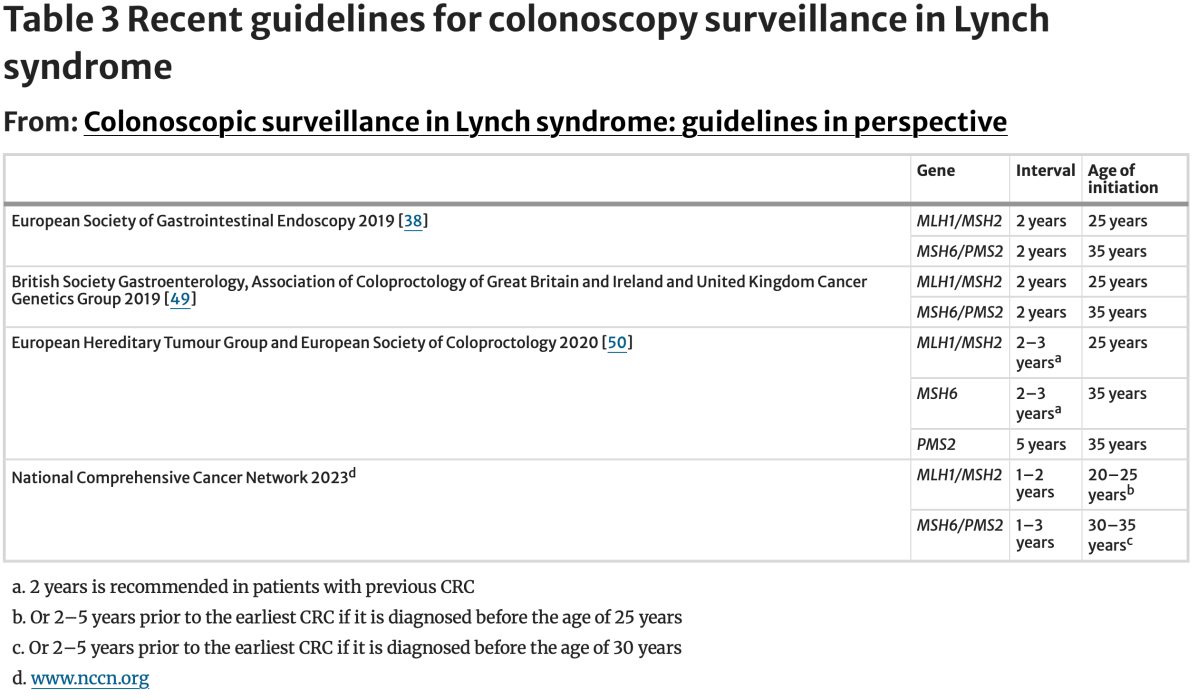
LS is currently understood as a four clinically distinct syndromes with consistent genotype-phenotype associations. Since CRC lifetime risk varies depending on the mismatch repair gene involved, screening guidelines are evolving to become gene specific. 

Despite recent advancements, the definitive role of colonoscopy in LS has yet to be established. Current evidence of the variable effect of colonoscopy effectiveness depending on quality indicators in LS suggests that the full potential of colonoscopy has not been achieved. 

The coming years are going to be very exciting with the results of the CAPP-3 study that will establish the role of different doses of ASA as cancer prevention, as well as the results of the first trials evaluating the effectiveness and safety of preventive vaccines in LS 

https://link.springer.com/article/10.1007/s10689-024-00414-y#Abs1

Lynch Syndrome

Lynch syndrome is an autosomal dominant hereditary cancer syndrome, associated with a 40%–80% lifetime risk of developing colorectal, endometrial and other cancers.

Lynch syndrome may be suspected from a family history of bowel cancer and other Lynch syndrome-related cancers, triggering genomic testing in the family.

Lynch syndrome is an autosomal dominant condition, so that each child (son or daughter) and each sibling (brother or sister) of an affected individual has a 50% (1-in-2) chance of inheriting the condition.

It is important to remember that chance has no memory, and the 1-in-2, or 50%, chance of inheriting the altered gene for the condition applies to each child, irrespective of whether or not the parents have already had children with, or without, the condition.

https://www.genomicseducation.hee.nhs.uk/genotes/

Lynch Syndrome: Diagnosis & Treatment

https://www.mayoclinic.org/diseases-conditions/lynch-syndrome/diagnosis-treatment/drc-20374719

Your GP may want you to consider genetic testing for Lynch syndrome if your family history has one or more of the following:

  • Multiple relatives with any Lynch-associated cancers, including colon cancer and endometrial cancer. Other cancers caused by Lynch syndrome include those that happen in the stomach, ovaries, pancreas, kidneys, bladder, ureters, brain, gallbladder, bile ducts, small intestine and skin.
  • One or more family members who had cancer before age 50.
  • One or more family members who have had more than one type of cancer.
  • More than one generation of family with the same type of cancer.

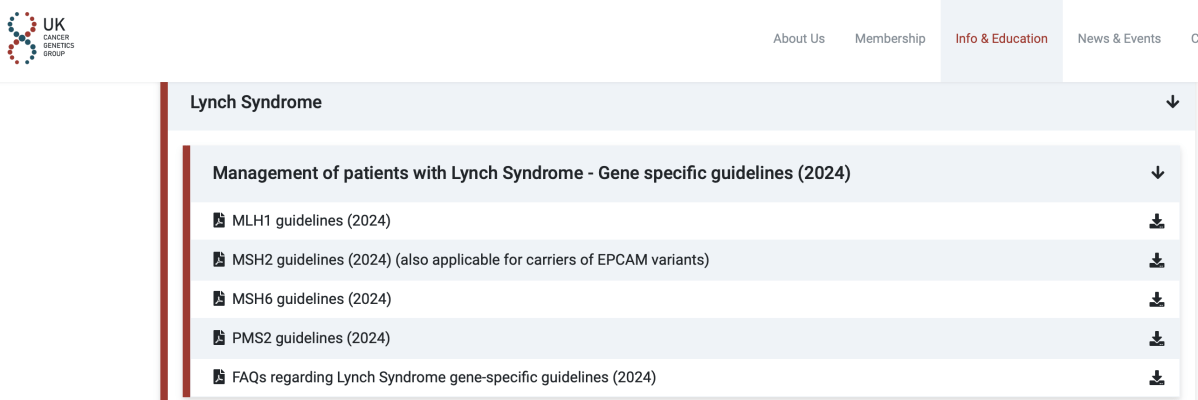
Lynch Syndrome Management Guidelines – Gene Specific 2024 – UKCGG

https://www.ukcgg.org/information-education/ukcgg-leaflets-and-guidelines/

Gynaecology and Lynch Syndrome

From LS UK Annual Conference 2024

Neil is a Clinical Lecturer and Gynaecology Oncology Surgical Subspecialty Fellow at the University of Edinburgh and NHS Lothian. His passion is to improve the care of those with Lynch syndrome through prevention and personalised treatment.

Lynch Syndrome Conference 2024

Check out the presentations on YouTube.

Up to date information on Lynch Syndrome

Lynch Syndrome

  • Lynch Syndrome involves several inherited genes which normally protect the body from cancer, but mutations in any of these genes may inhibit this function.
  • If someone has a Lynch Syndrome mutation it does NOT mean they will definitely get cancer, there are other factors involved.
  • If you have one of the Lynch Syndrome mutations, this has implications for your family. Your elders, siblings and offspring. If they too have the same mutations, they will be more susceptible to bowel and other cancers.
  • You should contact members of your family and advise them to get tested.
  • Anyone with Lynch Syndrome can reduce their cancer risk.
  • People with Lynch Syndrome are entitled to advanced cancer screening, to catch cancer early and cure it.
  • There is evidence that some people with Lynch Syndrome diagnosed with a bowel cancer are more likely to develop secondary cancers.

Adventures in Annual Endoscopies

Today was the day of my annual endoscopies – a flexible sigmoidoscopy, a gastroscopy, and a capsule endoscopy placed via gastroscopy.

Every little win is a win. There’s no point just bouncing onto the next worry, especially if it might never come.

Find joy now, in getting at least one out of three clear tests, and freedom to eat an ice cream sandwich.

Dominantly inherited micro-satellite instable cancer – the four Lynch syndromes – an EHTG, PLSD position statement

In the Lynch syndromes (LS) we now recognize a dynamic balance between two stochastic processes: MSI producing abnormal cells, and the host’s adaptive immune system’s ability to remove them.

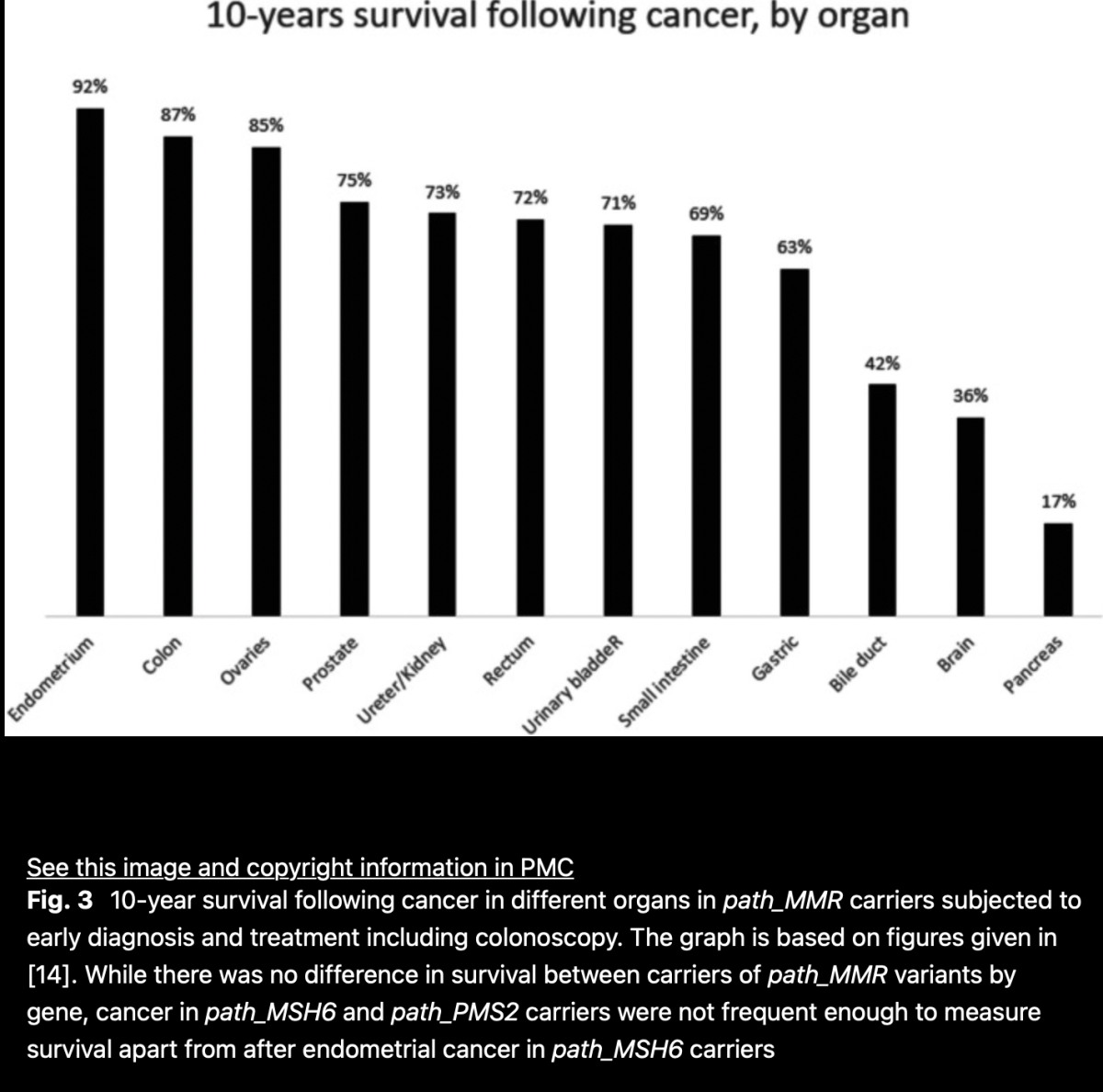
The latter may explain why colonoscopy surveillance does not reduce the incidence of colorectal cancer in LS, while it may improve the prognosis.

Most early onset colon, endometrial and ovarian cancers in LS are now cured and most cancer related deaths are after subsequent cancers in other organs.

Aspirin reduces the incidence of colorectal and other cancers in LS.

Immunotherapy increases the host immune system’s capability to destroy MSI cancers.

Colonoscopy surveillance, aspirin prevention and immunotherapy represent major steps forward in personalized precision medicine to prevent and cure inherited MSI cancer.

https://pubmed.ncbi.nlm.nih.gov/37821984/