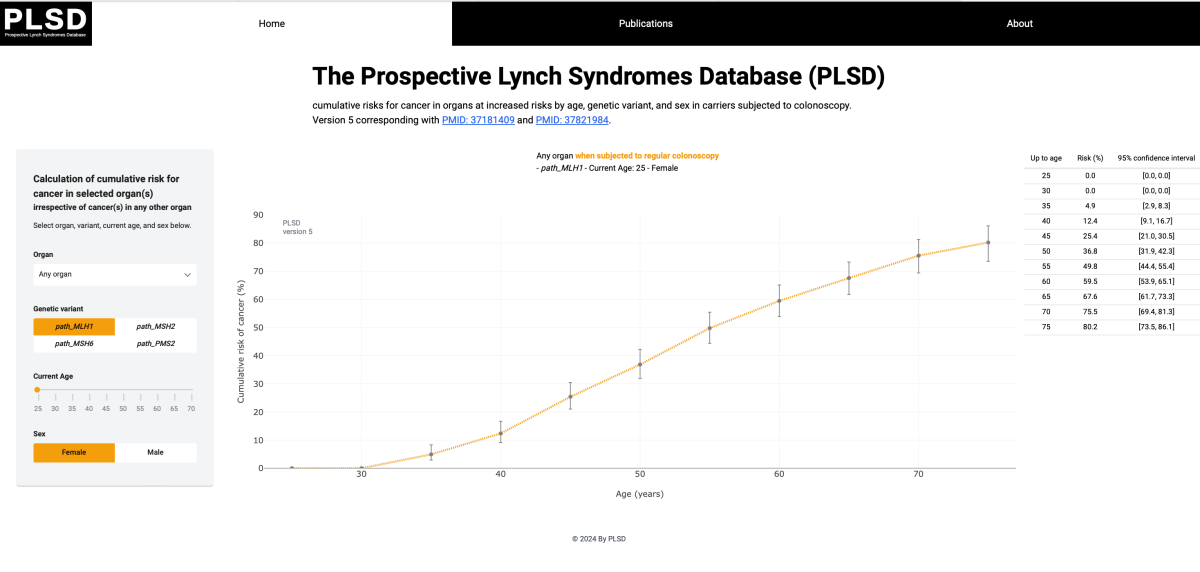
The Prospective Lynch Syndromes Database (PLSD)

cumulative risks for cancer in organs at increased risks by age, genetic variant, and sex in carriers subjected to colonoscopy.

Version 5 corresponding with PMID: 37181409 and PMID: 37821984.

Aims of PLSD

Based on the observation that removal of adenomas with colonoscopy did not reduce CRC incidence as assumed, in 2012 the European Hereditary Tumor Group (EHTG), at that time denoted the Mallorca Group, decided to compile information on follow-up of path_MMR carriers across multiple specialist centres to answer three questions:

  • To what degree does colonoscopy surveillance reduce CRC incidence in path_MMR carriers?
  • What is the penetrance and expressivity of pathogenic variants in each of the four Lynch syndrome-associated genes?
  • What is the survival of carriers when followed-up as recommended, to facilitate early diagnosis and treatment?

http://www.plsd.eu

Men’s Health

Check out our Men’s Health hub, full of helpful tips for healthy living and how to #SpotCancerEarly at: https://brnw.ch/21wKBEG

Also…

Many men with cancer in the family worry that they are at greater risk of getting it themselves. But this isn’t the case for most people. Cancer is a common disease among older people, so most families will include at least one person who has had cancer.

 5 – 10% of cancers are linked to an inherited gene fault.

The strength of your family history depends on:

  • Who in your family has had cancer.
  • How old they were at diagnosis.

The more relatives who have had cancer, and the younger they were at diagnosis, the stronger your family history. You may have a strong family history if any of these situations apply to you:

  • More than two close relatives on the same side of your family have had cancer.
  • The cancers developed when they were young (under the age of 50).
  • One of your relatives has had a gene fault found by genetic tests.

What should I do if I have a family history of cancer?

Talk to your doctor who can help you find out if your family history of cancer is of concern. Your doctor may suggest that you visit regularly for screening. In this way, you can pick up problems early.  

Your family history of cancer can change over time, so it is important to keep your doctor updated about any new cancers diagnosed in your family.

New bowel cancer screening launches for Lynch syndrome patients in England

new NHS testing programme for bowel cancer has been launched for people with Lynch Syndrome, following an initiative to increase genomic testing for the condition.

 Around 10,000 people with Lynch syndrome will start receiving invitations to take part this year.

Dr Kevin Monahan, who led the NHS England Lynch syndrome transformation project, said: “Incorporating people with Lynch syndrome into the national colonoscopy screening programme is game-changing and will save many lives each year.

It will deliver prevention and early diagnosis of bowel cancer through timely and high-quality colonoscopy. Now diagnosis of this hereditary condition in England will be linked to lifelong patient-focused care.

What I Wish I Was Told About Lynch Syndrome

“The most challenging part of dealing with Lynch syndrome for me is the uncertainty surrounding my son’s health. The fear of him possibly inheriting the mutation gives me anxiety, especially since he hasn’t been tested yet. If it were solely about me, I might have approached things differently — I may have postponed my prophylactic surgeries until after achieving menopause.”

“I didn’t have to face Lynch syndrome alone after realizing that support is always available. That support system, as well as staying ahead on check-ups and focusing on my wellbeing, guided my path after being diagnosed.”

The landscape of Lynch syndrome has significantly evolved over the past decade, with advancements in genetic testing, universal screening and predictive models improving early detection.

https://www.curetoday.com/view/what-i-wish-i-was-told-about-lynch-syndrome

Understanding Cancer Ghosting: The Impact of Diagnosis on Relationships

Never heard of the term ‘cancer ghosting’? until you realise that a lot of your friends stop contacting you when you received your cancer diagnosis.

“I felt that people had so much to be getting on with in their own lives and when you’ve been given a cancer diagnosis, you need so much support and care that a lot of the time, people can’t give you that because of what’s going on in their own lives.”

“So when they ask how are you, you go, ah I’m grand and then you go indoors, close the doors and cry because we aren’t comfortable with our emotions either. So I guess we all have a role to play.

“People say don’t be afraid to ask for help and when people offer, you refuse. I’d say to anyone with any illness to ask for help and be specific. Ask them to do a school run or make dinner for the week, give them things to do.

“And most importantly to anyone whose friend has been diagnosed with cancer — send that text.”

https://www.irishexaminer.com/news/arid-41399758.html?fbclid=IwZXh0bgNhZW0CMTEAAR2IZ3lqE3cceBJia_8YQubtmK-HQsijf2q60sfwWB73Ifk7_EAMYAVwL_4_aem_AWsgv8g_4Oqmrj63tZ18kODYkAWqimsAo8gjw1l8ZQJhI4ErYYEvBs7qkTRUWMWi2kdFIK6nW7ZhGbT4Clmrt474

Talking with Healthcare Providers about Lynch Syndrome

Lynch Syndrome Center(Dana Farber-USA) Providers Kim Perez, MD and Margaret Klehm, FNP, MPH review how to talk with healthcare providers about your Lynch syndrome diagnosis and how to utilize the Lynch Syndrome Center care plan to your advantage.

Prospective Lynch Syndrome Database (PLSD) – cumulative risk for cancer by age, genetic variant, and gender in carriers subject to colonoscopy

Objective: Estimates of cancer risk and the effects of surveillance in Lynch syndrome have been subject to bias, partly through reliance on retrospective studies. They have sought to establish more robust estimates in patients undergoing prospective cancer surveillance.

Check out….

http://plsd.eu

Using Immunotherapies to Treat Gyn Cancers

http://gyncsm.blogspot.com/2024/03/march-13-2024-using-immunotherapies-to.html

Does Lynch syndrome itself have any symptoms? 

https://www.mdanderson.org/cancerwise/qa-understanding-and-managing-lynch-syndrome.h00-158589789.html

New Lynch syndrome registry ‘game-changing’ for patients

England’s latest Lynch syndrome patient database may transform the disease’s detection and monitoring, becoming a blueprint for other genomic diseases.

Why Lynch syndrome?

The English National Lynch Syndrome Registry holds over 9,000 patient records, but what is it about Lynch syndrome that warrants a national database? It ticked a number of boxes, from researchers knowing a lot about it to there being a strong public health argument to focus on.

Lynch syndrome is a fairly well-understood condition with a high penetrance. This makes cascade testing, which is where the patient’s family members are considered for testing, very likely to pick up new cases before Lynch syndrome-associated cancer develops – which can include colorectal and endometrial cancers. When new cases are found, there are ways in which risk can be reduced for those affected that are relatively cheap, available and simple. Advice on this includes a NICE recommendation to take aspirin and attending colonoscopies.