

https://www.cancer.ie/cancer-information-and-support/cancer-prevention/mens-health
Category: Prostate Cancer
A NEW CHAPTER IN PROSTATE CANCER CARE IN IRELAND WITH IPCOR

Prostate cancer is the most common cancer affecting men in Ireland.
Thanks to the generosity of Movember fundraisers and donors across Ireland, we are proud to be partnering with University College Dublin on a new and improved Irish Prostate Cancer Outcomes Registry (IPCOR).
It’s all about tracking, learning, and getting better over time.
This research doesn’t just aim to treat the disease—it’s about improving the entire journey of care.
The Mo is Calling….IPCOR is only possible thanks to the generous support of our fundraisers and donors. Join the 12,000 strong Irish community making a difference in men’s health by signing up for Movember.
https://ie.movember.com/story/a-new-chapter-in-prostate-cancer-care-in-ireland-with-ipcor
Attention family & friends of Prostate Cancer Patients
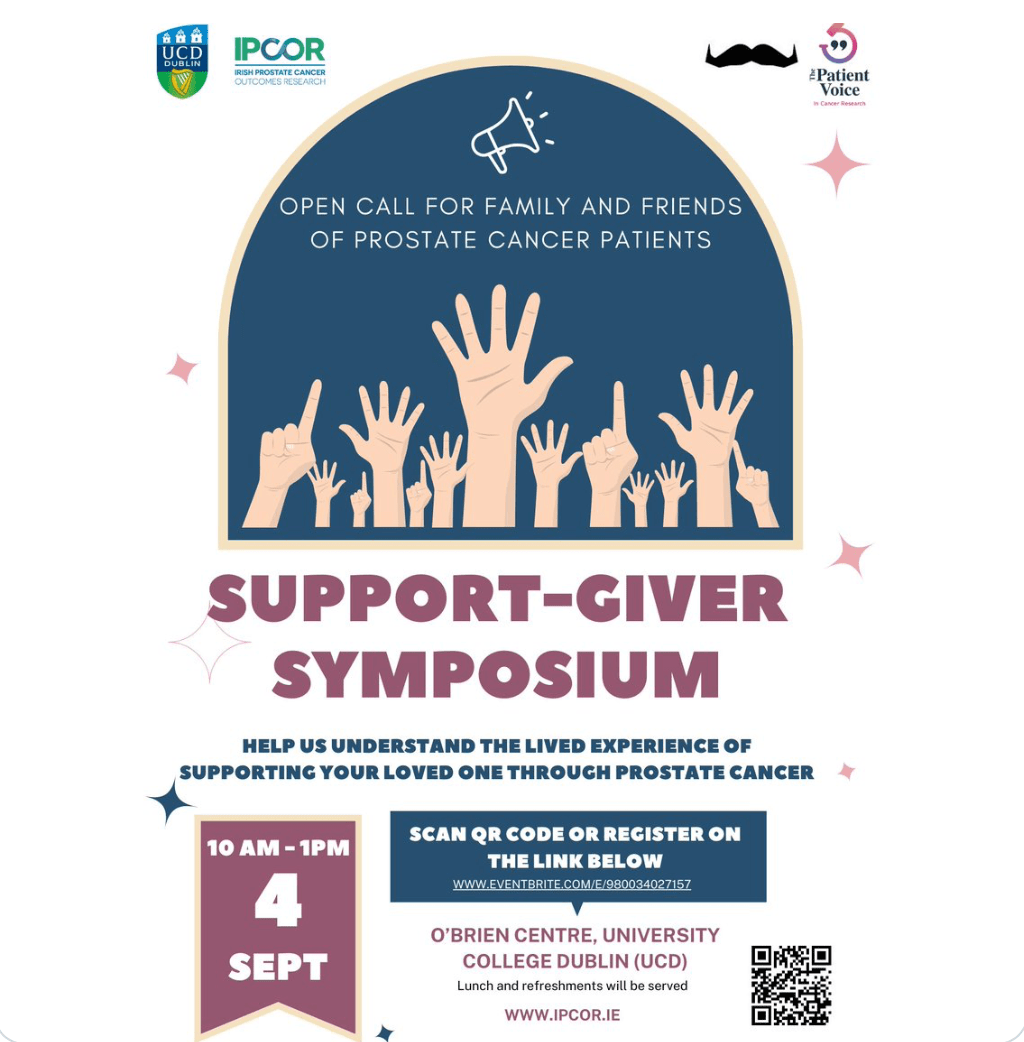
Know anyone who has suffered through prostate cancer? We’re looking for the stories and voices of their support-givers. Share and register now at: https://eventbrite.ie/e/prostate-cancer-support-giver-symposium-tickets-980034027157
PACE-NODES study -(prostate cancer)

The PACE-NODES study for patients with Prostate Cancer is now re-opened at three sites in Ireland.
About this trial
The purpose of this study is to test an advanced type of external beam radiotherapy called stereotactic body radiotherapy (also known as SBRT) in 536 participants with high risk localised prostate cancer (that is, prostate cancer that has not spread beyond the prostate gland but is at high risk of growing quickly or spreading).
Importantly, this treatment delivers a potentially curative dose of radiotherapy in only 5 treatments over two weeks. Half the participants in the trial will receive radiotherapy to the prostate, the other half will have radiotherapy to the prostate as well as the surrounding lymph nodes. The investigators will follow patients in the trial for at least three and half years to see which treatment is best. The investigators will be looking at whether it is safe to give this treatment by reviewing any side-effects that occur and also assessing whether giving SBRT to the lymph nodes as well as the prostate reduces the chance of prostate cancer returning.
A quarter century of lifesaving discoveries in prostate cancer

Today, a patient diagnosed with advanced prostate cancer has options.
Doctors can offer a suite of androgen-suppressing drugs to extend his life. There are genetic tests that can show whether he’s a candidate for more-targeted treatments. These tests can also reveal whether his family members are at higher risk for prostate and other types of cancer. This was not always the case.
https://www.fredhutch.org/en/news/center-news/2024/08/pnw-prostate-cancer-spore-renewal.html
Life after cancer diagnosis
“I do not, however, consider myself to be a cancer survivor, and I do not hesitate to politely point this out to anyone who refers to me as one. ….. Generally, we prefer to be described as people who are living post-cancer (and indeed in some cases with cancer) and this subtle difference is very important, not just for us but for the all too many cancer patients who did not live to get the chance that we have.”
Finding a key word or phrase to replace survivor in the context of cancer is a regular discussion topic among healthcare professionals, patient representatives, researchers, counsellors and of course cancer patients. We are still searching.
Any ideas?
https://www.irishtimes.com/opinion/letters/2024/03/13/life-after-cancer-diagnosis
NCCN guidelines

Genetic/Familial High-Risk Assessment: Colorectal
- NCCN Guidelines Version 1.2023
– Adenomatous Polyposis Testing Criteria
– Attenuated Familial Adenomatous Polyposis
– Colonic Adenomatous Polyposis of Unknown Etiology
– Familial Adenomatous Polyposis
– Juvenile Polyposis Syndrome
– Lynch Syndrome
– MUTYH-Associated Polyposis
– Peutz-Jeghers Syndrome
– Serrated Polyposis Syndrome
The Big Prostate Quiz

Stand Up for Your Prostate and take the Big Prostate Quiz this Blue September to check if you need to be more aware of your prostate health. It will take less than 5 minutes to take the Quiz, about the same time it takes to get your PSA Checked!
We are asking the men of Ireland to once again to Stand Up for Your Prostate.
Get your PSA checked once you reach the age of 50 or at 45 if you have a family history of Prostate or Breast Cancer. It could save your life.
Understanding the Underutilisation of Germline Genetic Testing in Prostate Cancer
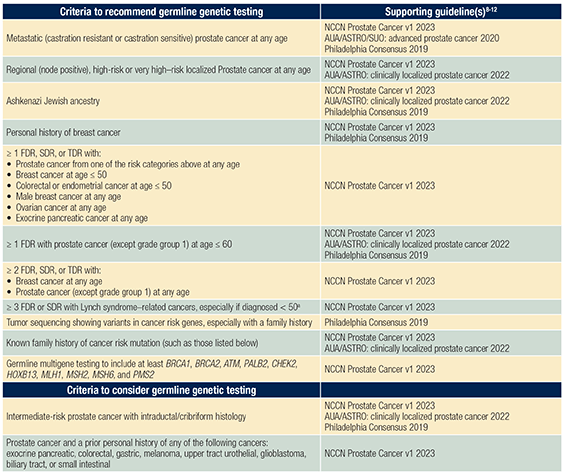
Germline genetic testing, no longer an “exceptional” test offered only to select families with multiple generations of cancer, has become the standard of care for many cancers, including prostate cancer. It is imperative that patients be offered timely testing, as positive results may inform shared patient–physician decision-making for regulatory-approved therapies.
Key Points:
- Indications for and implications of germline testing in patients with prostate cancer have expanded over the past decade, particularly related to precision therapies and management.
- Germline testing for prostate cancer is vastly underused despite many patients qualifying for testing.
- It is imperative that a variety of well-studied genetics service delivery models be used to help overcome recognized barriers to the implementation of germline testing for prostate cancer so that patients and their families receive the most effective care.

 Lynch Syndrome Ireland