Standard treatment for advanced endometrial cancer may soon change.A study found that people with advanced or recurrent endometrial cancer who received immunotherapy with chemotherapy had better outcomes than those who had chemotherapy alone.
In patients with advanced or recurrent endometrial cancer, the addition of pembrolizumab to standard chemotherapy resulted in significantly longer progression-free survival than with chemotherapy alone.
The European Health Data Space (EHDS) seeks to address key challenges facing healthcare systems in Europe resulting from lack of access to health data, and is designed to boost Europe’s competitiveness on the global stage. If passed, individuals will have access to, and control over, their digital health data from anywhere within the EU. It will also make large, anonymised datasets available for research, innovation, and policymaking.
When compared to European countries such as Denmark, that has a similar-sized population, Ireland has traditionally had less access to health research funding. This coupled with a lack of integrated health data availability has meant that finding Irish patients to take part in clinical trials is difficult.
By harnessing the value of health data, the EHDS has potential to enable better healthcare for patients, and improve the lives of the family teams that care for them. Ireland has a unique set of capabilities that can contribute to the vision of the EHDS and support the needs of patients, healthcare professionals, and others working on the frontline of healthcare at home and across Europe.
Awareness will need to be raised among key stakeholders—the healthcare system, patients, citizens—and support provided to help them prepare for the far-reaching changes ahead. Their engagement will in no small part determine Ireland’s ability to make the leap from where it is today to full- scale implementation of the EHDS in 2025.
Discoveries enabled better understanding of how the DNA mismatch repair (MMR) system not only recognises DNA damage but also responds to damage by DNA repair or by triggering apoptosis(cell death) in the injured cell.
What has happened over the past 37 years was not predictable when this journey began, but it does speak to the power of careful scientific experimentation, following the facts, perseverance in the face of opposition, and the willingness to think outside of established paradigms.
The conclusion that CRCs with MSI responded differently to classical cytotoxic chemotherapy than did non-MSI CRCs and eventually, the key clinical paradigm shift was the discovery of ICT(Immune checkpoint therapy and its unique effect on tumours with MSI.
Some of these concepts required brilliant thinking and interpretation and others seemingly announced themselves after the correct understanding of an unexpected observation. Since this astonishing series of events unfolded over about four decades, there is hope that this remarkable progress will continue into the future.
The Six Questions Every Cancer Patient Should Ask Before Choosing Treatment
What is the goal of the recommended treatment? Cure, prolong survival, maintain quality of life?
What is my chance of achieving the goal if I do nothing?
How does the recommended treatment improve the chance of reaching the goal?
What are the side effects of the recommended treatment – many are minimal today?
What is the role of clinical trials in the management of my cancer?
If my cancer comes back, what is the goal and how should i best prepare for it now?
Until recently we thought of cancer as being defined by its location in the body – moving forward it will be defined by the cancer’s unique growth driving mutations and biomarkers. In effect, the genetics – biomarker define the cancer rather than the organ where the cancer began.
Groundbreaking vaccine trials aimed at preventing cancers associated with the genetic disorder Lynch syndrome are currently underway.
Why Lynch syndrome?
Sanchez explained that patients with Lynch syndrome are born with a genetic defect in a gene that is involved in DNA repair.
“What happens is that everytime one of our cells is dividing there is new synthesis of DNA and spontaneously in that process there are DNA errors. There are natural systems in our cells that are equipped to recognize that error and correct it so we don’t get mutations all the time,” Sanchez explained.
“What happens in patients with Lynch syndrome is that the genetic defect they are born with is in one of the genes involved in this process of self repair of DNA errors,” he continued.
This means that people with Lynch syndrome are more prone than others to replicate these DNA errors over their lifetime which means an increased risk of cancer.
Lynch syndrome (LS) markedly increases risks of colorectal and endometrial cancers. Early detection biomarkers for LS cancers could reduce the needs for invasive screening and surgical prophylaxis.
Prevention Relevance:
Methylated DNA markers previously identified in sporadic endometrial cancer and colorectal cancer discriminate between benign and cancer tissue in LS.
A new Australian study published in The Lancet suggests population-wide genetic screening for hereditary breast and ovarian cancer, familial hypercholesterolemia and Lynch syndrome, in people aged 18 to 40, would be cost effective and save lives.
Modelling demonstrates a marked improvement in the overall cost-effectiveness of offering population genomic screening in a combined fashion for multiple conditions together, versus criteria-based clinical genetic testing or screening for individual conditions.
The model structure can be applied to other healthcare systems, making our findings relevant for international jurisdictions, especially countries with national public healthcare systems capable of delivering nation-wide population screening programs.
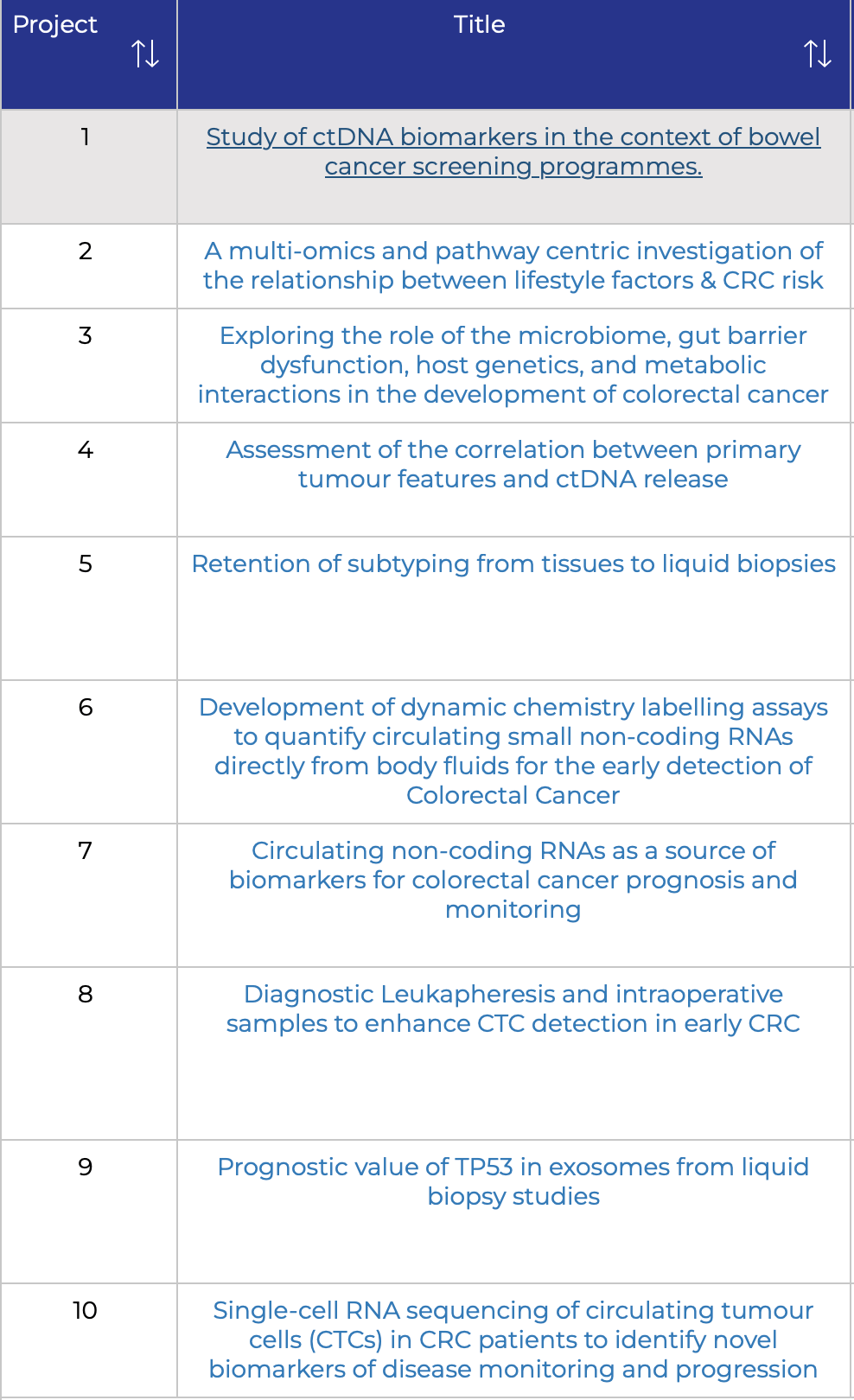
Identification and development of novel colorectal cancer biomarkers via state-of-the-art liquid biopsy approaches.
The primary scientific objective of ColoMARK will be to generate improved biomarkers for CRC by employing innovative liquid biopsy approaches. The impact of this project is paramount, as it will play a crucial role in advancing CRC prevention, treatment and management.
This project has received funding from the European Union’s Horizon Europe research and innovation programme under the Marie Sklodwska-Curie Doctoral Network Grant.
ctDNAhas been widely evaluated as a novel biomarker for liquid biopsy in colorectal cancer diagnosis, prognosis and monitoring of response to treatment. Liquid biopsy based on ctDNA detection is a very sensitive test.








 Lynch Syndrome Ireland