Conclusions: The combination of Nous-209 and pembrolizumab is safe, well tolerated and shows encouraging clinical efficacy in patients with treatment-naive dMMR/MSI-H mCRC eligible for anti-PD-1 therapy.
The study is ongoing and expanding to Phase II randomisation with a new accelerated Nous-209 vaccination schedule.
Phase 1 was launched on September 20th 2021. It is a personalised online resource for women impacted by cervical cancer. If you have a partner in your life, this platform can also support them. If you are a health care provider working in the area this can also support you and your practice.
If you are newly diagnosed, receiving treatment, in surveillance or living well with and beyond cancer thisisGO.ie has information that is tailored to meet your needs.
During 2022 the remaining 4 gynaecological cancers Ovarian, Uterine, Vulval and Vaginal were launched as well as the addition of a genetic pathway for those impacted by BRCA and Lynch Syndrome.
Conclusion: This ongoing transformational project is strongly supported by stakeholders in England. Significant quality improvement has been implemented, facilitating systematic delivery of universal testing for LS nationally and reduction in variation in care.
“Only by ‘mainstreaming’ of genetic testing by the same cancer multidisciplinary teams that diagnose and treat cancer locally can we ever hope to effectively find diagnoses of Lynch syndrome and open up the door to better cancer prevention survival” Kevin Monaghan(Gastroenterologist from @StMarksGenomics)
The study was small (just 21 people), but it builds on a vast body of evidence linking regular exercise to a decreased risk of cancer, particularly colorectal cancer. But the MD Anderson researchers went a step further, investigating how exercise might lower cancer risk.
The novel multitarget stool RNA test (ColoSense) showed high sensitivity for detecting colorectal neoplasia(new, uncontrolled growth of cells) among adults ages 45 and older, according to the phase III prospective CRC-PREVENT trial.
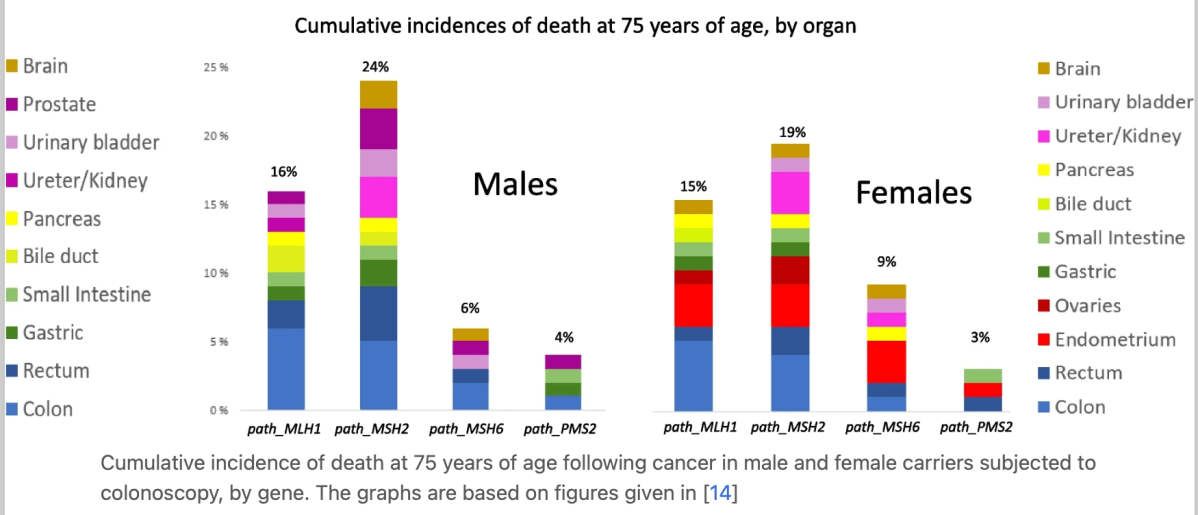
Improved survival following early diagnosis and treatment of MSI cancers of the colon, endometrium and ovary has led to carriers living on and contracting subsequent cancers in other organs.These have worse prognoses.
Tests for MSI have generally been optimised to demonstrate MSI colon cancers, but the different Lynch syndrome genes have different organ specific penetrance and expressivities. The prevalence of MSI in cancers in these other organs is not well studied, with respect to either how to test for MSI cancers in these organs or to estimate the frequency of MSI cancers. Identifying such MSI cancers would be of interest to select cases for immunotherapy tailored against MSI cancers.
The obvious next steps for clinical research on the MSH2 and MLH1 syndromes include determining the effects of immunotherapy for cancers with currently poor prognoses.
Ovarian cancer almost always starts in the fallopian tubes.
Why is it called ovarian cancer if it doesn’t start there? For a long time, the ovaries were assumed to be the source because that is where the cancer is concentrated at the time of diagnosis.
Who should consider the procedure?
Women who have an average risk of ovarian cancer who no longer desire fertility but also want to reduce the risk of developing ovarian cancer might consider the procedure. Women with an elevated risk due to a gene mutation or family history should speak to their genetic counselor or doctor for more information.
What are the benefits and drawbacks?
For women with an average risk of ovarian cancer, the surgery has the potential to reduce the likelihood of ovarian cancer. The surgery is not reversible and causes infertility. Pregnancy is still possible, though only via in-vitro fertilization. For pre-menopausal women, removal of the fallopian tubes only, and not the ovaries, does not induce menopause.
The recovery time for fallopian tube removal is a few days to a few weeks, though the overall recovery time will depend on the primary reason for surgery.
A study led by our Dr. Eduardo Vilar-Sanchez found that intense aerobic exercise may lower the risk of colorectal cancer in patients with #LynchSyndrome.
Our findings show that hysterectomy with BSO at any age reduces the risk of ovarian cancer and that hysterectomy with BSO at a young age is associated with a reduced risk of breast cancer. Nevertheless, this risk reduction should be balanced against the possible increase in the risk of CVD, colorectal cancer, and all-cause mortality in young women. Furthermore, more evidences on the efficacy of hormone replacement therapy in mitigating the adverse effects of the premature cessation of estrogen are needed.
Conclusion:
Hysterectomy with bilateral salpingo-oophorectomy was associated with multiple long-term outcomes. The benefits of the addition of bilateral salpingo-oophorectomy to hysterectomy should be balanced against the risks.







 Lynch Syndrome Ireland