Care after premenopausal risk-reducing salpingo-oophorectomy in high-risk women: Scoping review and international consensus recommendations

CONCLUSIONS

Despite the efficacy of premenopausal RRSO for reducing ovarian cancer risk and improving mortality in high-risk women, many women experience troublesome menopausal symptoms and oophorectomy may have adverse implications for long-term health.

Our panel of international experts has developed evidence-based recommendations for managing vasomotor, sleep, mood, sexual, and genitourinary symptoms and optimising bone and cardiovascular long-term health. Emerging evidence suggests that HRT reduces but does not eliminate the adverse effects of premenopausal oophorectomy. Women and clinicians considering RRSO should be aware of these risks and clinical care should focus on available safe options for symptom management and optimisation of long-term health.

https://obgyn.onlinelibrary.wiley.com/doi/full/10.1111/1471-0528.17511

Is There a Lynch Syndrome Vaccine on the Way?

Lynch Syndrome, a genetic condition affecting around 1 million Americans annually, increases a person’s risk of developing colorectal cancer (CRC) to 20% – 80%.

As a result, Lynch Syndrome patients must complete yearly preventive screenings. However, developing a Lynch Syndrome vaccine could change the narrative for patients, reducing screenings and – more importantly – lowering risks for Lynch Syndrome-related cancers. 

“The advances in vaccine technologies, such as Lynch Syndrome, is a promising field of research that has the potential to reduce the risk of developing cancer, thereby preventing disease and modifying surveillance regimens for high-risk patients,” said David Fenstermacher, Senior Director of Research & Medical Affairs at the Colorectal Cancer Alliance.

https://www.ccalliance.org/blog/research/is-there-lynch-syndrome-vaccine

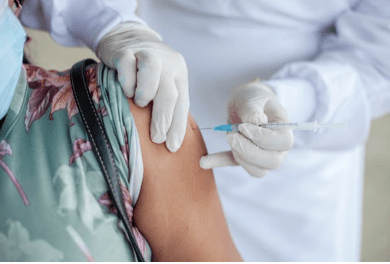
Vaccines to treat cancer possible by 2030, say BioNTech founders

mRNA Covid vaccine technology could be repurposed so that it primed the immune system to attack cancer cells.

BioNTech was working on mRNA cancer vaccines before the pandemic struck but the firm pivoted to produce Covid vaccines in the face of the global emergency. The firm now has several cancer vaccines in clinical trials. Türeci said the development and success of the Pfizer/BioNTech vaccine, which is similar to the Moderna Covid shot, “gives back to our cancer work”.

But Türeci(who co-founded BioNTech, the German firm that partnered with Pfizer to manufacture a revolutionary mRNA Covid vaccine) remained cautious about the work. “As scientists we are always hesitant to say we will have a cure for cancer,” she said. “We have a number of breakthroughs and we will continue to work on them.”

https://amp-theguardian-com.cdn.ampproject.org/v/s/amp.theguardian.com/society/2022/oct/16/vaccines-to-treat-cancer-possible-by-2030-say-biontech-founders?amp_gsa=1&amp_js_v=a9&usqp=mq331AQIKAGwASCAAgM%3D&fbclid=IwAR18d3jSHWXuKBI8FXgJLJWBjUvXvgnxI7zzvx6zkC-xCmPaa8Fk1LOE_QA#amp_tf=From%20%251%24s&aoh=16659558517121&csi=0&referrer=https%3A%2F%2Fwww.google.com&ampshare=https%3A%2F%2Fwww.theguardian.com%2Fsociety%2F2022%2Foct%2F16%2Fvaccines-to-treat-cancer-possible-by-2030-say-biontech-founders

The four primary care (PC) core functions (the ‘4Cs’)

The four primary care (PC) core functions (the ‘4Cs’, ie, first contact, comprehensiveness, coordination and continuity) are essential for good quality primary healthcare and their achievement leads to lower costs, less inequality and better population health. However, their broad definitions have led to variations in their assessment, in the innovations implemented to improve these functions and ultimately in their performance.

Conclusion:

Providing clear, well-defined operational elements for these 4Cs to measure their achievement and improve the way they function, and identifying the complex network of interactions among them, should contribute to the field in a way that supports efforts at practice innovation to optimise the processes and outcomes in PC.

https://www.cambridge.org/core/journals/primary-health-care-research-and-development/article/revisiting-the-four-core-functions-4cs-of-primary-care-operational-definitions-and-complexities/65D55DA15CCF9ADD35CB42B5C06016F0

Lynch Syndrome: Know your risk | Dana-Farber Cancer Institute


Dana-Farber’s Matt Yurgelun, MD, discusses Lynch Syndrome research and the challenges of a Lynch Syndrome diagnosis. Dana-Farber’s Lynch Syndrome Center offers genetic testing to help identify Lynch Syndrome carriers who may be at increased risk for a variety of cancers.

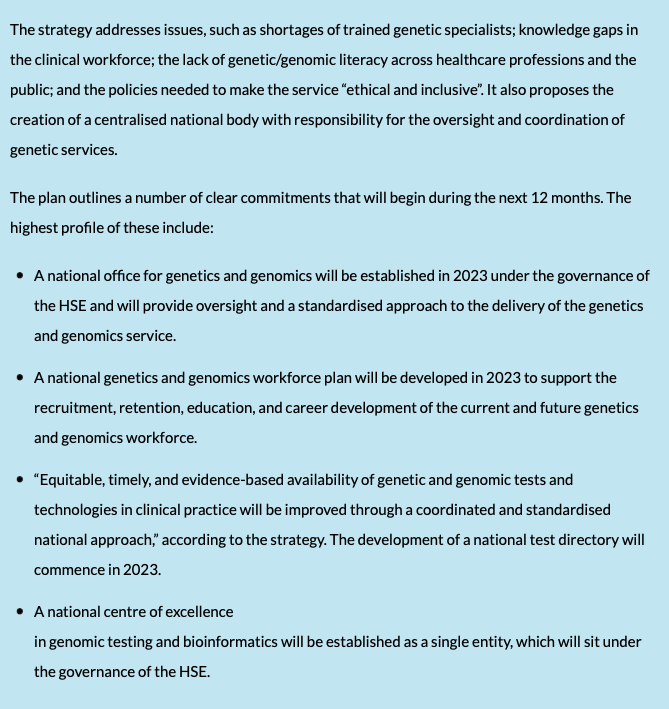
2023: A new start for genetic and genomic medicine in Ireland?

According to the HSE’s website, there is “room for improvement” in the medical genetics and genomics services offered in Ireland when compared to other European countries. (perhaps an understatement???)

The strategy states: “To date, Ireland has made some progress in developing its genetic and genomic services, with pockets of excellence evident throughout the country. However, to fully realise the benefits of genetics and genomics, there is an urgent need to mainstream them so that they can become an integral part of our routine care delivery.

Strategies are very helpful in healthcare because a strategy gives you a sense of direction….

Provided for under this strategy is:

  • the creation of a new national office for genetics and genomics
  • the transition of genetics and genomics into routine care delivery
  • targeted workforce planning and development
  • ensuring Public and Patient Involvement (PPI) and partnership
  • the strengthening of Ireland’s infrastructure to drive advances in this area.

On the impact of the national office, Dr Henry predicted there will be a high level of activity “in year one, and the office will drive it”. He said it will “become the engine of what happens in year two, three, four, and later”.

Also, the office will “advocate” and “compete for funding each year”.

As our understanding of disease evolves, it is very clear that genomics will inform much of the decision-making

Lynch syndrome cancer vaccines: A roadmap for the development of precision immunoprevention strategies

Safe and effective cancer prevention strategies are critically needed to improve the life quality and longevity of LS and other Hereditary Cancer Syndrome carriers. The era of precision oncology driven by recent technological advances in tumor molecular profiling and a better understanding of genetic risk factors has transformed cancer prevention approaches for at-risk individuals, including LS carriers. 

Here, they discuss recent advances in precision cancer immunoprevention approaches, emerging enabling technologies, research gaps, and implementation barriers toward clinical translation of risk-tailored prevention strategies for LS carriers.

https://www.frontiersin.org/articles/10.3389/fonc.2023.1147590/full#h5

The success of FSP neoantigen(mutation)-based cancer vaccines for LS cancer prevention will hopefully demonstrate the potential marketability of cancer preventive vaccines in the next decade, which will bring an increasing interest from the private sector and can lead to the partnership opportunities between academia, government, and industry for the betterment of quality of life for LS and other high-risk populations.

Mortality by age, gene and gender in carriers of pathogenic mismatch repair gene variants receiving surveillance for early cancer diagnosis and treatment: a report from the prospective Lynch syndrome database

The current study found low CRC mortality in path_MMR carriers who receive colonoscopy surveillance while some extracolonic cancers were associated with high mortality. Further improvement of survival in LS may require a focus on the prevention and treatment of non-colorectal cancers, likely including approaches based upon the immune response to MSI pre-cancerous lesions and cancers.

This study also provides more precise cumulative cancer incidences for path_MMR carriers than have been available previously, stratified by age, gene, organ, and gender.

https://www.sciencedirect.com/science/article/pii/S258953702300086X

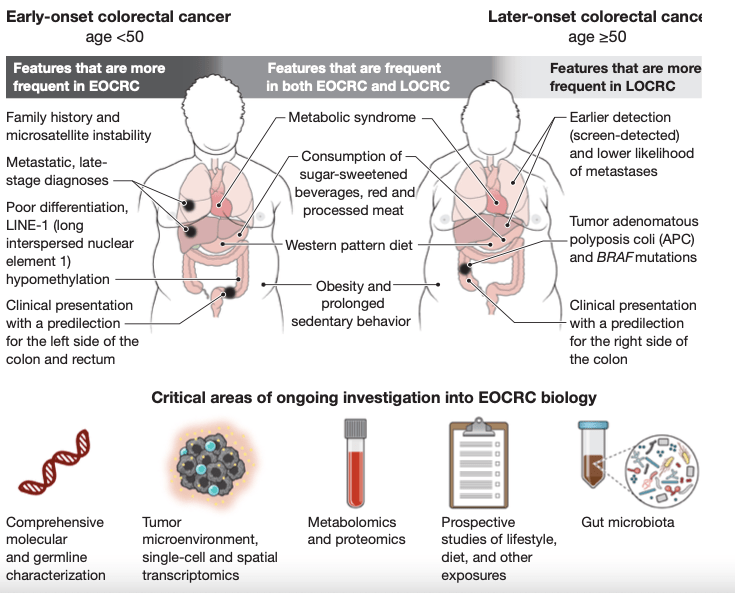
Early-Onset Colorectal Cancer (EOCRC)

Patients with EOCRC have a higher relative prevalence of inherited predisposition to cancer, with Lynch syndrome being the most common cause. 

Colorectal cancer in younger people

Similar factors increase the risk of early-onset colorectal cancer (EOCRC) and later-onset colorectal cancer (LOCRC), such as a sedentary lifestyle, obesity, and metabolic syndrome, but there are also important differences. EOCRC predominantly occurs on the left side of the colon and the rectum, whereas LOCRC arises more commonly on the right side of the colon. EOCRC is also more poorly differentiated and often metastatic at diagnosis.

Research is urgently needed to understand the increasing incidence of EOCRC and its pathophysiology to better detect and treat patients.

Demystifying genomics in cancer care

Cancer is a disease of the genome, caused by unchecked cell growth due to mutations or changes in our DNA. Cancer genomics involves studying the genetic changes in cancer cells, allowing us greater insight into prevention, early detection, treatment, prognosis and recurrence.

In the case of cancer, a change is introduced which causes the cells to multiply uncontrollably – they become cancer cells and allow a cancer to develop. Most of the time these cancer-causing genetic changes are acquired i.e. they occur from damage to genes in a particular cell during a person’s life (also known as sporadic cancer). 

Why does cancer run in families?

Around 5-10% of cancers are caused by inherited or germline changes. This is where a genetic alteration occurs in a sperm or egg cell. It passes from the parent to the child at the time of conception and the alteration in the initial egg or sperm cell is copied into every cell within the body.

As the genetic alteration affects reproductive cells it can pass from parent to child and onwards to subsequent generations. Conditions such as Lynch Syndrome, is an example of an inherited cancer syndrome. This dominantly inherited conditions can greatly increase an individuals risk of developing cancer and mean that there is a 50% (or 1 in 2) chance that a parent can pass the genetic alteration onto their child.

Identifying a person with an inherited form of cancer is important. It means they can be looked after more closely in the future but it also has important implications for the family.

Genomics allows us to develop more precise treatments for cancer. Targeting treatments that focus on a cancer’s genetic makeup rather than where it has grown in the body.

https://www.macmillan.org.uk/healthcare-professionals/news-and-resources/blogs/demystifying-genomics-in-cancer-care