Gimme Shelter from Lynch Syndrome

“There is much to be optimistic about right now for those with Lynch. Many medical discoveries and advances have been made within the past decade. Aspirin is used as a chemoprevention, immunotherapy may put various Lynch syndrome-related cancer in remission, and AI is improving screening measures, specifically for colonoscopies. What excites me the most is the Lynch vaccine in clinical trials now. The Lynch landscape has changed since my diagnosis 12 years ago.”

https://www.curetoday.com/view/gimme-shelter-from-lynch-syndrome

Development of a new urine test for Womb Cancer

If you are having routine gynaecological tests or treatment for womb cancer & would like to take part in a research study?

Many Early Onset Colon Cancers are Caused by Genetic Mutations Through Families

“The prevalence of hereditary cancer syndromes among early-onset colorectal cancer patients – including Lynch syndrome – was quite high, which presents a tremendous opportunity for us to save lives through early detection based on genomic risk factors,” 

Based on this new data, the OSUCCC – James research team recommends genetic counseling and a broad, multi-gene panel test of cancer susceptibility genes for all early-onset colorectal cancer patients, regardless of family history or the results of tumor screening for Lynch syndrome. This differs from current professional guidelines, which recommend all colorectal cancer patients be screened for Lynch syndrome, with referral for genetic counseling and Lynch syndrome-specific genetic testing if the tumor-screening test is abnormal.

We expected to find a high rate of Lynch syndrome among these early-onset colon cancer patients. What was surprising were some of the other gene mutations found in the young colorectal cancer patients, including mutations in genes traditionally linked to breast cancer risk, even in patients whose family history was not suggestive of those mutations,” 

https://news.cancerconnect.com/colon-cancer/many-early-onset-colon-cancers-are-caused-by-genetic-mutations-through-families

HRCI 2023 Position Paper – Embedding research in healthcare

“While there are many aspects of health research in need of attention and support, we believe it is particularly urgent to support the embedding of research within the health service.

To this end, we lay out three recommendations:

Recommendation 1    Progress the implementation of a national electronic health record  

Recommendation 2    Build on momentum to support genetics and genomics research  

Recommendation 3    Establish research support functions within the health service

https://drive.google.com/file/d/1I14EY8MdChGaui6w5iXHU5oxrPuS_C7i/view

The NordICC Trial: The Devil Is in the Details

The NordICC trial was a randomized, pragmatic study that enrolled 84,585 adults aged 55 to 64 years old from Poland, Norway, and Sweden.

[T]he NordICC trialfills an important knowledge gap and provides new insight into the real-world population-wide benefit of colonoscopy for colorectal cancer screening.

Preventing Colorectal Cancer

It is important to highlight an advantage of colorectal cancer screening that distinguishes it from all other cancer screening modalities. Colorectal cancer screening with endoscopy is unique in that it aims to, in part, prevent disease by identifying and removing premalignant lesions.

https://ascopost.com/news/november-2022/the-nordicc-trial-the-devil-is-in-the-details/

How Biobanks WORK

A biobank (“bank of life”) is a place – typically an ultralow temperature freezer – that stores blood and other human tissue samples donated by patients for research in cancer or other serious diseases. It is maintained by specialist personnel, and data is coded for the patient’s privacy and confidentiality, and recorded in a database. Clinical data, including treatment and follow-up, may be linked subsequently.

The patient’s cancer operation specimen – cancer and surrounding normal tissue – is examined by a Histopathologist. The pathological diagnosis and full pathological assessment of the tumour’s aggressiveness and extent determine the patient’s further treatment. Providing the patient has consented, small fragments of cancer and normal tissue, surplus to pathology requirements, may be coded, frozen and stored in the biobank. Samples are released for ethical, scientifically approved research on how cancers develop, grow, spread and respond to treatment.

Cancer clinical trials – Ireland

Cancer trials test new and more effective ways to prevent, diagnose, and treat cancer.

Trials can involve testing new drugs or combinations of commonly used drugs, new therapies, new ways of treating cancer, or new ways of diagnosing cancer.

They may test new radiotherapy schedules, surgical techniques, medical devices, or physical therapies. They can also involve investigating blood samples and tissues.

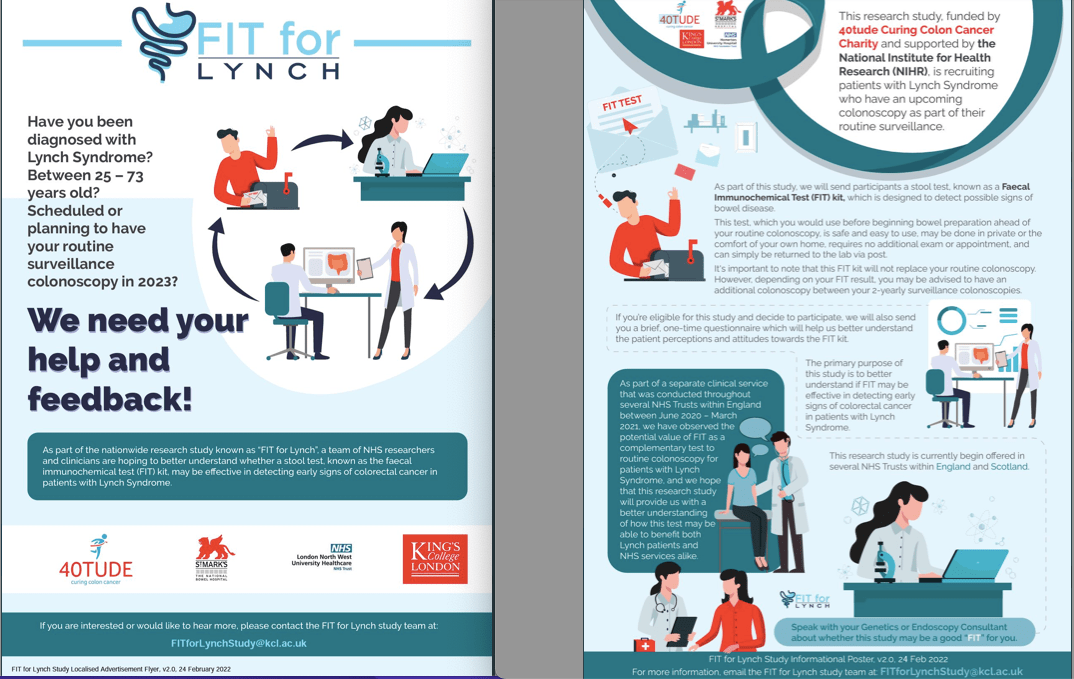
FIT for Lynch Study

This research study is currently being offered in
several NHS Trusts within England and Scotland.

Contact: fitforlynchstudy@kcl.ac.uk

Current practice of colonoscopy surveillance in patients with lynch syndrome: A multicenter retrospective cohort study in Japan

Current guidelines recommend that patients with Lynch syndrome should have colonoscopy surveillance every 1–2 years starting at the age of 20–25. However, insufficient data are available to evaluate the quality and safety of colonoscopy surveillance for patients with Lynch syndrome nationwide in Japan.

The proportion of patients developing cancer was significantly higher with a >24 months than a ≤24 months interval.

Conclusion

High-volume experienced endoscopists and appropriate surveillance intervals may minimize the risk of developing colorectal cancers in patients with Lynch syndrome.

https://onlinelibrary.wiley.com/doi/10.1002/deo2.179