Genetic testing and the future of medicine

More common signs of hereditary cancer include:

  • Multiple cases of cancer on the same side of the family, especially breast, colorectal, endometrial or ovarian cancers.
  • Cancer diagnosed before age 50, especially breast, colorectal or endometrial.
  • Rare cancers at any age, including:
    • ovarian
    • pancreatic
    • male breast
    • metastatic prostate

The future of genetic testing

Dr. Steiner is optimistic about the future of genetic testing and how it can impact healthcare care. “I think in the not-too-distant future, everybody will have comprehensive genetic testing done in order to prepare healthcare providers for any future issues a patient might develop.”

When that happens, genetic testing will be used more often to help people and their healthcare providers prevent unexpected diagnoses.

https://www.facingourrisk.org/XRAY/genetic-testing-and-future-of-medicine

The English National Lynch Syndrome transformation project: an NHS Genomic Medicine Service Alliance (GMSA) programme

ConclusionThis ongoing transformational project is strongly supported by stakeholders in England. Significant quality improvement has been implemented, facilitating systematic delivery of universal testing for LS nationally and reduction in variation in care.

“Only by ‘mainstreaming’ of genetic testing by the same cancer multidisciplinary teams that diagnose and treat cancer locally can we ever hope to effectively find diagnoses of Lynch syndrome and open up the door to better cancer prevention survival” Kevin Monaghan(Gastroenterologist from @StMarksGenomics)

Dominantly inherited micro-satellite instable cancer – the four Lynch syndromes – an EHTG, PLSD position statement

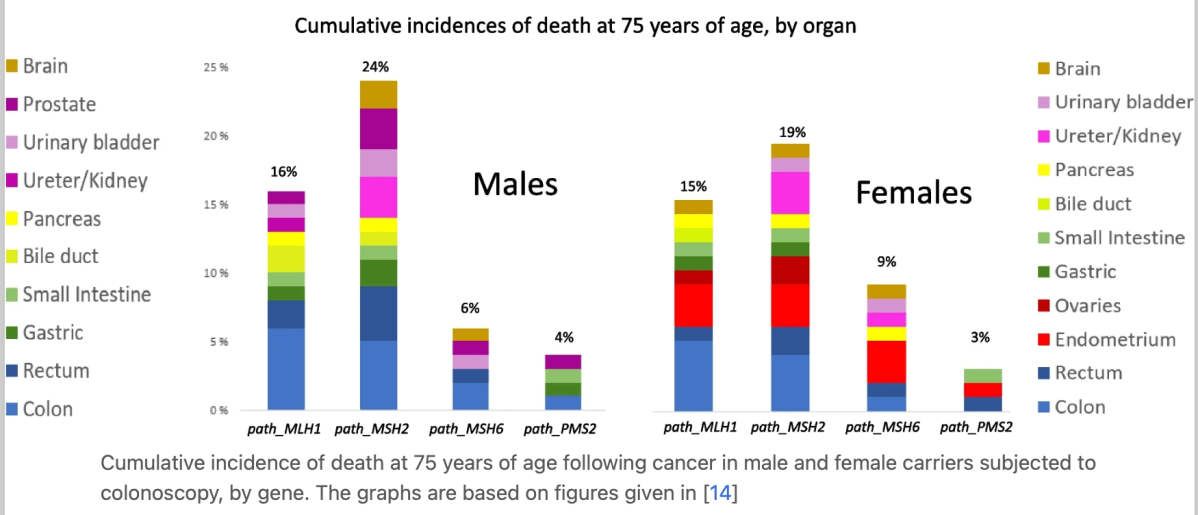
Improved survival following early diagnosis and treatment of MSI cancers of the colon, endometrium and ovary has led to carriers living on and contracting subsequent cancers in other organs. These have worse prognoses.

Tests for MSI have generally been optimised to demonstrate MSI colon cancers, but the different Lynch syndrome genes have different organ specific penetrance and expressivities. The prevalence of MSI in cancers in these other organs is not well studied, with respect to either how to test for MSI cancers in these organs or to estimate the frequency of MSI cancers. Identifying such MSI cancers would be of interest to select cases for immunotherapy tailored against MSI cancers.

The obvious next steps for clinical research on the MSH2 and MLH1 syndromes include determining the effects of immunotherapy for cancers with currently poor prognoses.

https://hccpjournal.biomedcentral.com/articles/10.1186/s13053-023-00263-3

NCCN guidelines

Genetic/Familial High-Risk Assessment: Colorectal

– Adenomatous Polyposis Testing Criteria

– Attenuated Familial Adenomatous Polyposis

– Colonic Adenomatous Polyposis of Unknown Etiology

– Familial Adenomatous Polyposis

– Juvenile Polyposis Syndrome

– Lynch Syndrome

– MUTYH-Associated Polyposis

– Peutz-Jeghers Syndrome

– Serrated Polyposis Syndrome

When Your Family Is Impacted by Hereditary Cancer – An Interview with My Sister

Cancer is scary and heredity (not just BRCA mutations) plays a huge role in some families.

Launch of Hereditary Cancer Model of Care (Ireland)

Hereditary Cancer Model of Care provides the blueprint for the necessary development of services for the identification and management of people with an inherited cancer predisposition (e.g. Lynch syndrome or BRCA gene cancer risk), in order to harness the power of genetics to reduce cancer risk, and improve patient outcomes and quality of life.

The model of care will ensure/support the development of:

  • Development of national guidance to underpin standardised best practice, including mainstreaming of cancer genetic testing
  • Equitable access to hereditary cancer services for all
  • Clear governance and clarity regarding the roles of national genetics and genomic structures, specialist cancer genetics services and regional cancer predisposition services, within an overarching model of care
  • Commitment to the Sláintecare principles of right person, right place, right time – through the integration of genetic assessment and testing into regional services, with access to specialist genetic expertise as required
  • Maximal use of technological solutions
  • Timely access to genetics assessment and testing, including specialist cancer genetics expertise as required
  • Timely access to clinical management of cancer predisposition, including risk reduction options
  • Comprehensive and coordinated approaches to ongoing management
  • Quality assurance of service
  • Access to high quality patient information, psychological support and peer support for patients
  • Education and training of health care professionals, including accredited training for those delivering mainstreamed pathways

https://www.hse.ie/eng/services/list/5/cancer/news/launch-of-hereditary-cancer-model-of-care.html?fbclid=IwAR3vT3_RDbmNM4YhcTQFjNj_mxPEfoFHrIBut6iukmsFyxs2FkHj2hDdbGw

A Guide to Lynch Syndrome

Lynch Syndrome is an inherited condition that increases your risk of developing some cancers, including bowel, womb and ovarian cancer. This is a guide to run through everything you need to know about Lynch.

This guide has been made with input from experts, people with Lynch Syndrome and Ask Eve nurses to provide you with all the information you need when offered testing for, or navigating a diagnosis of, Lynch Syndrome.  

We also have an Easy Read guide to Lynch Syndrome, which you can download here 

Philadelphia Girl, 14, Battling Three Cancers Simultaneously Hoping For a Breakthrough— The Rare Genetic Disorder Involved — How To Screen

Discovering that you or a family member have Lynch syndrome, Li-Fraumeni syndrome, or the BRCA1 and BRCA2 gene mutation, which increases the risk of developing breast and ovarian cancer, can be life-saving.

https://www.survivornet.com/articles/li-fraumeni-syndrome-importance-genetic-testing-sarcomas/

Colonoscopy screening in Lynch syndrome

https://link.springer.com/article/10.1007/s10689-023-00347-y

Evidenced-based modelling studies of gene and gender stratified populations suggest a start age and frequency later and less frequent, for MSH6 and PMS2 variant carriers (35 years and 2–3 yearly). The penetrance of MLH1 and MSH2 variant carriers on the other hand does not allow the later start time at least as agreed in most guidelines. This differential surveillance by gene is now being implemented in various guidelines around the world. Such prescription however needs prudent implementation given variable intragenic and even intravariant penetrance estimates in large studies. Note that the confidence intervals in these estimates is relatively large.

There is still the “here and now” which needs to engage carriers and optimize adherence to whatever scheduling is prudent and advised.

How do we do this?

First, registries. Registries keep track of carriers, can provide automated time alerts for the need to attend scheduling ….Registries save lives.

Secondly, patient navigators. Time and time again it has been shown that navigators personally chaperone carriers through the complexities of the healthcare system, to actually reach colonoscopy. They are worth their cost-benefit weight in gold at least in the syndromic scenarios we are discussing.

Thirdly, a pleasant experience helps maintain adherence – the least offensive and effective bowel preparation, a comfortable colonoscopic experience (sedation is important for adherence), and compassionate staff. Efficient throughput (less time for patients) on the day is also valuable. Bowel preparation regime should be personalized against previous experience.

Fourthly, the governance of the risk management service needs to be comprehensive (not just gastrointestinal), patient-centred, interactive with the patient navigators, general practitioners. associated familial cancer clinics (not losing opportunities for time and age appropriate cascade testing across the family), and hospital electronic medical records.

The current study amongst others is important if we are to benefit from the wealth of science that has been uncovered in the understanding of familial cancer. Minimizing the burden of colonoscopies is an important variable, warranting that debate herein described.

Family history of Colorectal cancer – what’s next?

Expert Guest Kevin Monaghan,Gastroenterologist from @StMarksGenomics with an interest in hereditary bowel cancer.

8th UEG Talks #Podcast episode!

🎙️

http://ueg.eu/podcast Listen to our esteemed host,

@pradeepmundre, and expert guest

@kevinjmonahan