We need a genomics-savvy healthcare workforce

Genetics has long been used in specific areas of medicine, such as for the diagnosis of rare diseases caused by pathogenic mutations or in the context of prenatal genetic testing; however, it is now diffusing across many domains of clinical practice.

The interpretation of clinical genetic information and its communication to patients are by no means trivial. In the case of genetic tests, for example, the ideal scenario is that the test provides information on whether the patient carries an actionable pathogenic variant.

The increasingly central role of genomics in healthcare means that not only are more genetic counselors needed, but also multidisciplinary teams are essential for utilising genomic technologies in the clinical setting.

A rapidly evolving genomic revolution is poised to shape the future of healthcare, but its full clinical potential can be realized only with the development of a multidisciplinary healthcare workforce capable of evolving to stay abreast of rapidly developing genetic technologies.

https://www.nature.com/articles/s41591-023-02522-1

Worldwide prevalence of Lynch syndrome in patients with colorectal cancer: Systematic review and meta-analysis

Overall, 51 papers were included for the final analyses (N = 51). These studies included 49,557 participants with CRC. The studies reported LS prevalence across 18 countries. 

Our results demonstrate that universal germline testing as a diagnostic tool yields the best estimates of clinically meaningful germline pathogenic variants. 

Lynch syndrome (LS) is the most common hereditary colorectal cancer (CRC) syndrome, with an estimated prevalence of 2% to 3% of CRC. A prevalence study is needed to provide accurate estimates of the true prevalence of LS.

https://www.gimjournal.org/article/S1098-3600(22)00030-2/fulltext#secsectitle0155

The role of virtual consultations in cancer genetics: challenges and opportunities introduced by the COVID-19 pandemic

There is a clear potential to mitigate geographical barriers, meet increasing patient expectations of implementing virtual consultations, reduce hospital carbon footprints, and decrease hospital costs while increasing efficiency. 

There are also significant challenges… Virtual healthcare consultations introduce another new level of digital exclusion for patients and clinicians. There are also potential challenges for maintaining patient confidentiality, and limited utility in circumstances where a physical exam may be warranted. For clinicians, there may be impacts on empathetic responses delivered and challenges in workflow and workload.

Summary: Both the opportunities and the challenges of virtual care must be considered to ensure the appropriate, successful, and long-term implementation of virtual care in cancer genetic services.

https://www.nature.com/articles/s44276-023-00009-7

From diagnosis of colorectal cancer to diagnosis of Lynch syndrome: The RM Partners quality improvement project

The UK National Institute for Health and Care Excellence recommends universal testing for Lynch syndrome (LS) in all newly diagnosed colorectal cancer (CRC) patients. However, implementation varies significantly by geography. This project was developed to measure variation and deliver an effective diagnostic pathway from diagnosis of CRC to diagnosis of LS (within the RM Partners (RMP) West London cancer alliance).

Conclusion

The LS project was completed by April 2022. We have implemented a systematic approach with workforce transformation to facilitate identification and ‘mainstreamed’ genetic diagnosis of LS. This work has contributed to the development of a National LS Transformation Project in England which recommends local leadership within cancer teams to ensure delivery of diagnosis of LS and integration of genomics into clinical practice.

So why do people not get tested?

Experts say that millions of people are walking around with a genetic variant that raises their risk of developing cancer. The vast majority of them have no clue.

That’s a problem, because people who know they’re at a higher risk for certain cancers can take action, like going for more frequent screening tests such as colonoscopies and mammograms or even having preventive surgeries.

“Doctors are not up on this”

Asked why so few people get tested, both researchers and patients say that “many cancer doctors aren’t familiar with the latest research on inherited risk or that they don’t know the cost of testing has dropped”

https://www.npr.org/sections/health-shots/2023/08/02/1191419631/cancer-risk-test-genetic-genes-inexpensive-why-dont-more-people-get-tested

The Upsides and Downsides of Cancer Genetic Testing

Living with a hereditary cancer syndrome inevitably brings uncertainty. Despite taking preventative measures, the knowledge of increased risk frequently lingers in my mind.

https://www.curetoday.com/view/the-upsides-and-downsides-of-cancer-genetic-testing

What is the Lynch syndrome registry?

The Lynch syndrome registry pilot study led by The Cancer Screening and Prevention Research Group at Imperial College London, records information about the health status of individuals with Lynch syndrome. A select group of Lynch syndrome patients who have previously taken part in the Cancer Prevention Project 3 (CaPP3) trial will be invited to participate in the pilot study from across four hospitals in England.

The Lynch syndrome registry records and analyses important information about people with Lynch syndrome. This helps to understand how people with Lynch syndrome are looked after and cared for across England. All information is held on a secure and confidential computer database.

The registry will ultimately be an efficient system that with the help of the bowel cancer screening programme will allow nationally coordinated care for Lynch syndrome families. It will also become a valuable central research resource that could be used to support other studies.

https://www.lynchregistry.org.uk/index.html

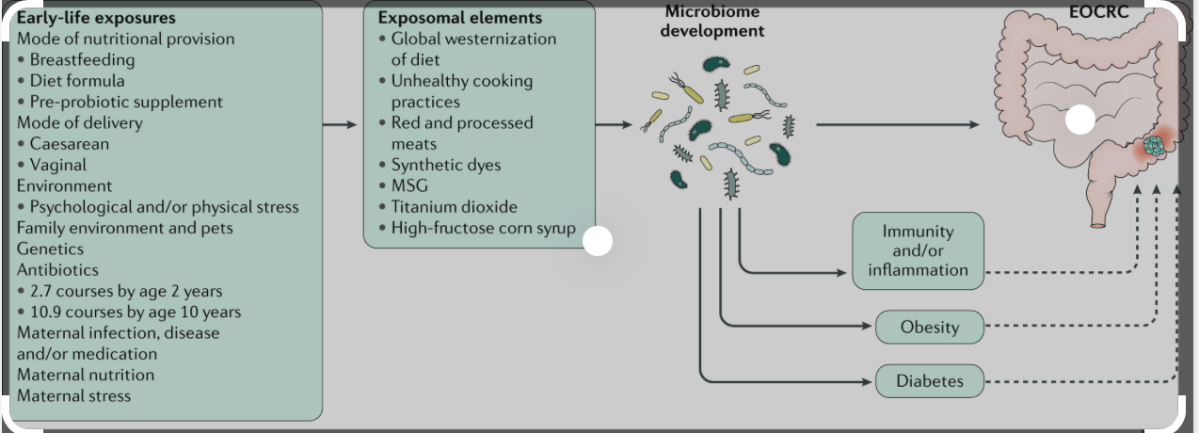
Lights and shadows in the early-onset colorectal cancer management and research: An integrative perspective – Physician scientist with patient advocates

https://www.sciencedirect.com/science/article/pii/S1521691823000318

Practice points

  • -The global importance that Early-onset colorectal cancer (EOCRC) is acquiring, makes a joint and worldwide effort necessary to unravel the problem.
  • -Although most EOCRC cases seem to be sporadic, there is still an important proportion belonging to families with well-defined colorectal cancer predisposition syndromes.
  • Excluding hereditary syndromes, general population screening strategies don’t cover most cases in the majority of countries, except in some defined ones with first-degree relatives with colorectal cancer.
  • -At present, the management of EOCRC should be considered a lifelong process: from the early care of symptoms to avoiding delays in diagnosis; through a multidisciplinary treatment in both the present and future; and with considerations for the possible consequences in the short and long term.
  • -The participation of patients in each step of the process, as well as in the awareness of the problem is especially critical in EOCRC.

Hereditary and Familial Colorectal Cancer

While previous books on the topic have primarily focused on the genetic, molecular and pathological basis for these syndromes, there is a lack of information for busy physicians regarding the clinical management of hereditary cancer predisposition syndromes and colorectal cancer occurring in the familial setting.

The editors of this book have been fortunate to have received contributions from a multinational panel of expert clinicians who specialise in the clinical management of such individuals. They are extremely indebted to their generous contributions.

The Authors envisioned this book to be a leading manuscript and reference tool for those caring for patients and families of those with hereditary and familial colorectal cancer.

They hope to have achieved their aim to consolidate the current best practice and present it in a concise manner and see it as a crucial addition to current literature available.

While principally aimed at medical professionals, they trust that it will be of interest to genetic counsellor and nursing colleagues, as well as all those affected by the conditions described herein.