Blog

Patient perspectives

The medical profession has become much more technologically advanced and aware of the importance of prevention and detection of disease before symptoms appear and before treatment becomes imperative. 

For patients, it is disconcerting to be offered choice in screening decisions or treatment options. … How does one choose without knowing what the doctor knows? The patient often feels a time pressure to decide …

Not everyone is able to clearly articulate their questions, fears, or values. It takes a skilled physician to determine if what is being said is what is meant. It also takes time, often more time than busy doctors have to devote to individual patients, but it is time well spent.

Everyone is different. Every disease takes a different path. Everyone has emotions and values and preferences. So—how to help?


https://www.ncbi.nlm.nih.gov/pmc/articles/PMC5962996/

Advanced Prostate Cancer

Patient webinar for people with advanced prostate cancer, their caregivers, and their families.

Experts provide information and answer questions about advanced prostate cancer to help patients and caregivers compare, discuss, and select treatment options with their doctor.

NCCN Patient Webinar : https://youtu.be/OgqnEyEdzh0

Ovarian Cancer

Know What Your Doctors Know patient webinar for people with ovarian cancer, their caregivers, and their families.

Experts provide information and answer questions about ovarian cancer to help patients and caregivers compare, discuss, and select treatment options with their doctor. 

NCCN Patient Webinar(2021) : https://youtu.be/ggsyEEW98PA 

Cancer clinical trials – Ireland

Cancer trials test new and more effective ways to prevent, diagnose, and treat cancer.

Trials can involve testing new drugs or combinations of commonly used drugs, new therapies, new ways of treating cancer, or new ways of diagnosing cancer.

They may test new radiotherapy schedules, surgical techniques, medical devices, or physical therapies. They can also involve investigating blood samples and tissues.

City of Hope grows its genetic testing program

“Every mutation that is known to be associated with elevated cancer risk is actionable at some level,”

But that is not yet the standard of care. Yes, more and more cancer centers offer genetic testing.

https://www.cityofhope.org/city-hope-grows-its-genetic-testing-program

‘My cancer will eventually take my life, but not before I’ve lived it’

“Prostate cancer is the most common cancer affecting men in Ireland and early detection is vital to a good prognosis”

“I should of course have listened to the warning signals that my body was trying to tell me, but, more fool me, I thought I knew different.”

Discovering you have cancer is undoubtedly difficult, and John would advise anyone who has recently been diagnosed to accept all the support they are offered. He would also encourage everyone to be aware of any changes in their bodies and seek medical advice as soon as they spot any changes.

Transforming diagnosis of Lynch syndrome in the NHS, working together to “Find the missing 95%

This ongoing transformational project is supported by high levels of engagement across stakeholders in England. Despite barriers, significant quality improvement has been implemented, facilitating systematic delivery of universal testing for LS nationally, with reduction in variation in care. 

Can we appoint Clinical Leads to champion & introduce Universal Testing at Cancer centres in Ireland to improve the service, prevent/detect early genetic cancers and provide a much improved service for people with an inherited predisposition to cancer?

https://www.researchgate.net/publication/364756374_PP031-_The_English_National_Lynch_syndrome_transformation_project_An_NHS_Genomic_Medicine_Service_Programme

Constitutional (germline) vs somatic (tumour) variants?

Constitutional (also known as germline) variants are present in all the body’s cells, including the germ cells, and can therefore be passed on to offspring e.g. Lynch Syndrome; Somatic variants arise during an individual’s lifetime in tissues other than the germ cells and so are not passed on.

Constitutional (germline) variants in cancer predisposition genes are present in affected individuals in all the body’s nucleic cells, as well as the cancer genome, and may therefore be inherited. These underlie inherited cancer predisposition syndromes, such as Lynch syndromeand hereditary breast and ovarian cancer syndrome.

https://www.genomicseducation.hee.nhs.uk/genotes/knowledge-hub/constitutional-germline-vs-somatic-tumour-variants/#clinical-example-cancer

How do we screen for bowel cancer?

POO...

In the UK Bowel cancer is a catch-all term for any cancers in the colon or rectum – sometimes called colorectal cancer. 

Faecal immunochemical testing(FIT) – checking for blood in your poo – and other types of bowel cancer screening. This includes Lynch syndrome, a hereditary condition increasing the risk of certain types of cancer including bowel cancer.

https://patient.info/news-and-features/how-do-we-screen-for-bowel-cancer

OvaCare Patient Day

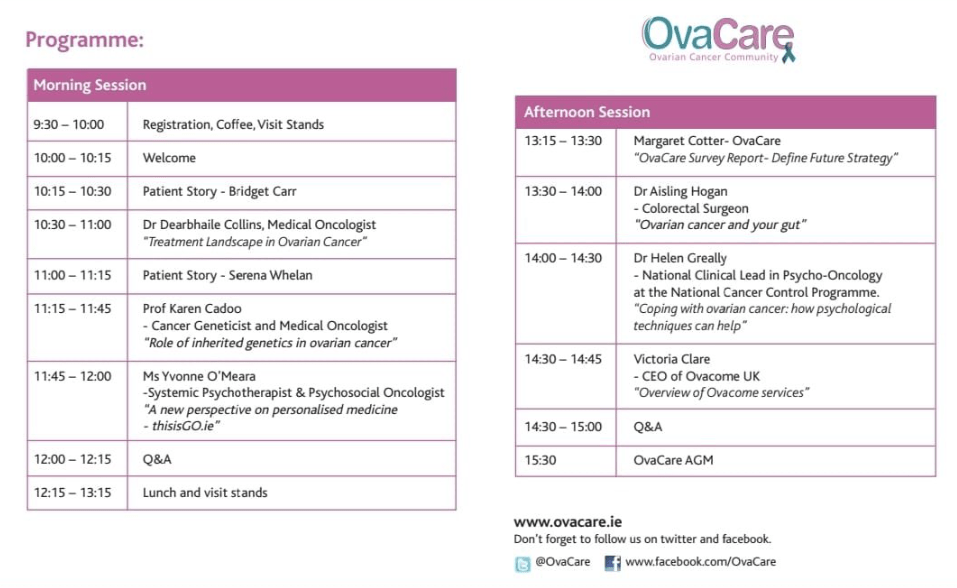
The programme for Ovacare Patient day this coming Sat Nov 19th in #thedeanhotelGalway.

They can’t wait to finally be back in the room with you all!

There’s still time to register on http://Ovacare.ie