Diagnosis Delivery Images

Diagnosis Delivery Cards is an initiative originally created by ISGO-PPI, a member association of ENGAGe from Ireland.

These cards are designed to support physicians in communicating diagnoses to patients in a structured, step-by-step manner, ensuring that key information is conveyed from the very beginning.

Each booklet focuses on a specific disease, featuring perforated pages that allow physicians to visually illustrate the affected areas of the body and outline treatment options.

These pages can be easily torn off and given to patients for their reference, making it easier for them to understand their diagnosis and treatment plan. The illustrations concentrate on the female pelvis and its organs, while the accompanying text details surgical options, potential complications, and side effects.

https://engage.esgo.org/discover/projects/diagnoses-delivery-cards/

Olivia: is a guide and support throughout your ovarian cancer experience.

How can Olivia help you?

Olivia offers a wide range of resources for everyone affected by ovarian cancer, including a guide for the newly diagnosed, detailed information for every step of the ovarian cancer pathway, lifestyle articles, resource directories, and much more.

https://ovarian.gynecancer.org/en/

Permission to Feel: 10 Tips for Navigating Cancer and Treatments with Honesty and Humour

“The medical definition of “urgent” (e.g. appointments, test scheduling, results) may well be different from yours. No, really! Scanxiety is a thing.”

https://www.survivingbreastcancer.org/post/permission-to-feel

Changes in faecal haemoglobin values over sequential rounds of faecal immunochemical tests (FIT) in a surveillance population

ObjectiveColorectal cancer (CRC) screening enables resection of polyp precursor lesions, preventing cancer or detecting it earlier. Post-polypectomy, people can remain at increased CRC risk, prompting surveillance colonoscopy. Less invasive faecal immunochemical tests (FIT) could reduce the burden of surveillance colonoscopy. We investigated whether changes in FIT values over multiple rounds were associated with advanced colorectal neoplasia (ACN) detection.

Conclusion: No change in FIT result across multiple rounds was associated with a low ACN detection rate, while a serial increase was associated with higher ACN detection rates. Further research should consider if sequential rounds of FIT could be used for stratifying individual risk.

https://bmjopengastro.bmj.com/content/12/1/e001651

Creation of a future European Network of National Cancer Mission Hubs (NCMHs)

ECHoS is an European project, funded by Horizon Europe Programme, that aims to support the implementation of the Cancer Mission activities in all Member State and Associated Country (MS/AC) through the establishment and development of National Cancer Mission Hubs (NCMHs) operating at national, regional, and local levels. By establishing NCMHs in each MS/AC, European citizens and organisations in health, research, and beyond, will be voiced and their voices will echo together.

ECHoS broad scope seeks to take cancer-policy dialogues beyond research and innovation, and health systems, covering also other relevant areas in cancer control and support, such as employment, education, and socioeconomic aspects.

To guarantee alignment and progress in the field of cancer, ECHoS will be guided by impacting subareas of Cancer Mission – namely prevention, early detection and treatment, quality of Life and survivorship – as well as equity, sustainability, and cross-cutting EU priorities such as social engagement and digital health.

http://www.cancermissionhubs.eu

Acute Haematology Oncology Nursing Service SOS Hotline

This service provides cancer patients on treatment access to advice and support when they’re feeling unwell, without needing to go to the emergency department.

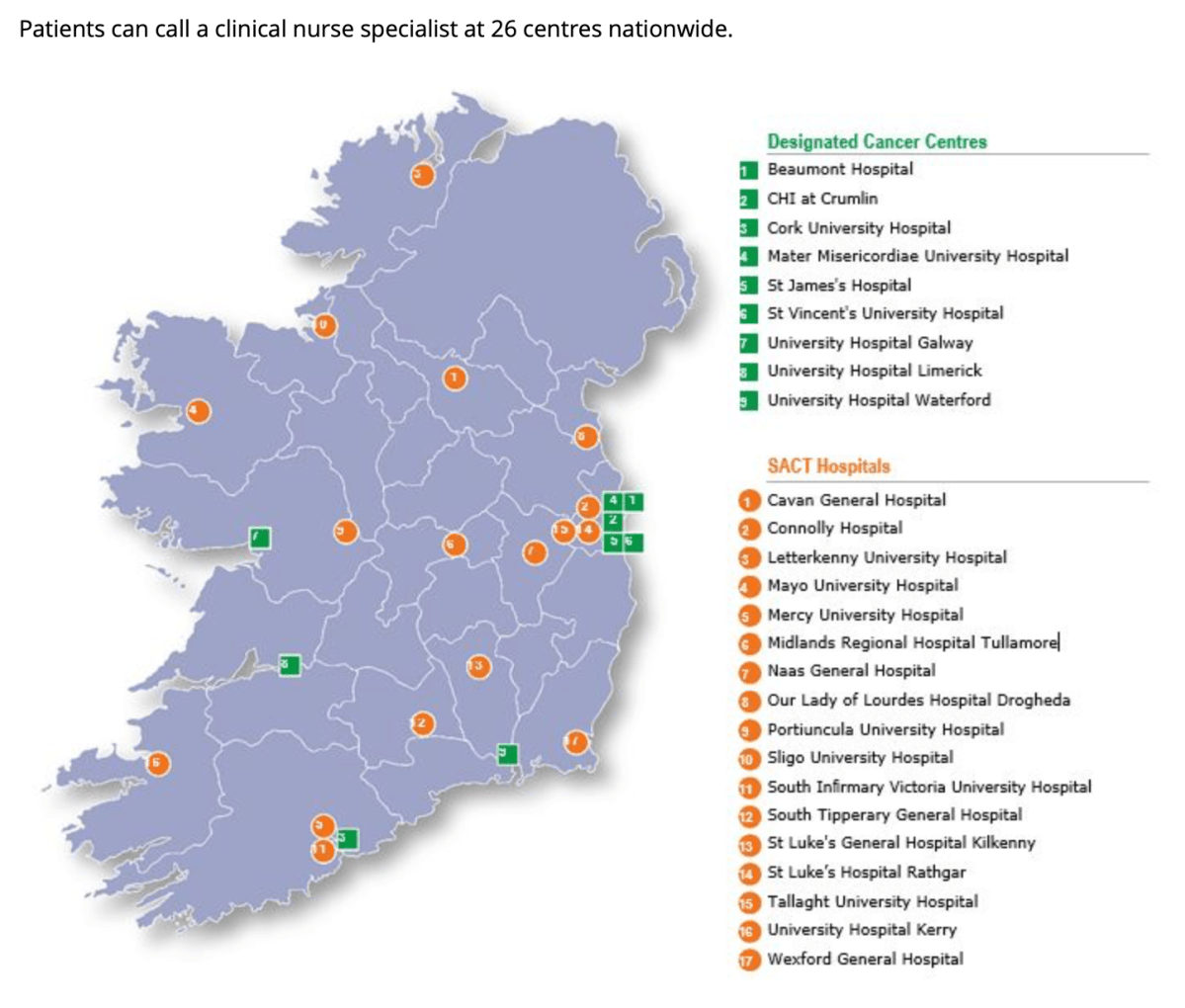
Patients can call a dedicated phone line to speak with a clinical nurse specialist at one of 26 centres across the country that offer cancer treatment. This service helps schedule immediate care for patients who need attention during their active treatment.

Oh….. by the way make sure you are unwell – (Monday -Friday between 0800 hrs and 1600hrs).

Digital for Care —A Digital Health Framework for Ireland: 2024-2030

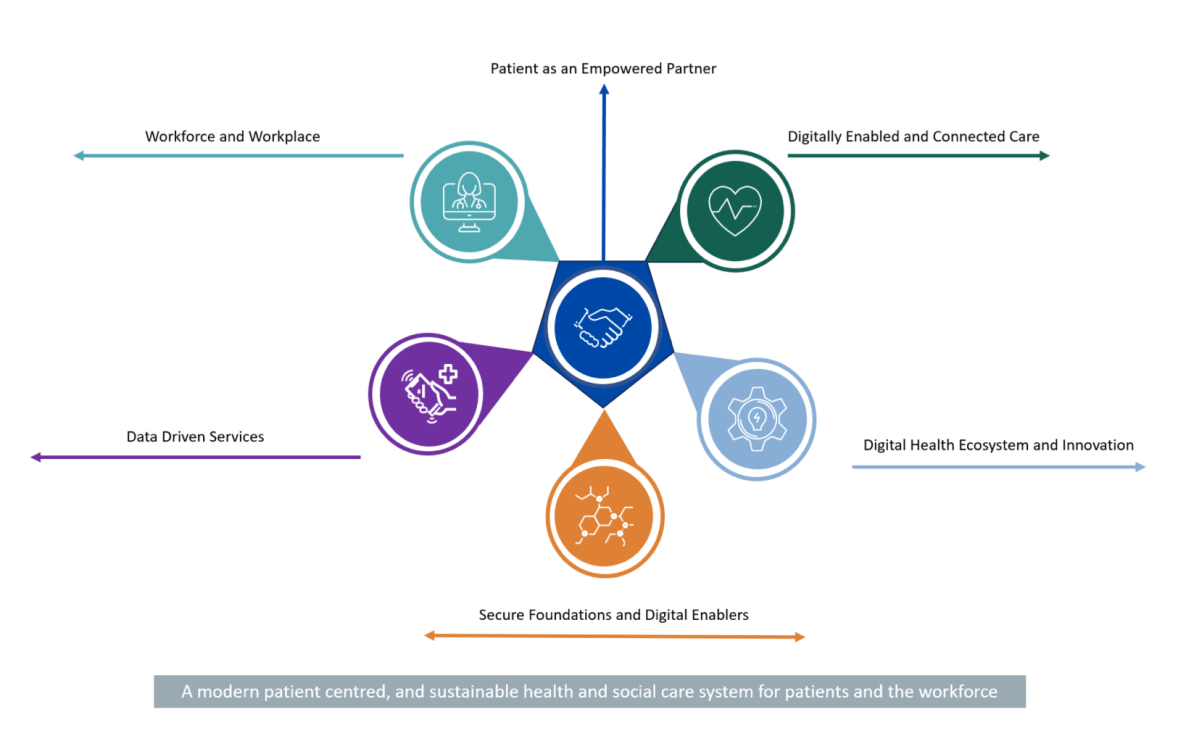
-Patient as an empowered partner: We will empower patients by giving them broader access to their own health information through a patient app, provide access to more digital health services, including virtual care offerings, whilst enabling greater autonomy and choice over their care options.

Workforce and workplace: We will enable our workforce by providing them with the technology, systems, and skills they need to deliver the best possible care and services to patients in the modernised healthcare system. 

Digitally Enabled and Connected Care: We will drive future investment and make architectural decisions based on the ability of systems to share clinical information and deliver connected care. We will make it possible for healthcare professionals, and others who support delivery of care, to be able to access the information needed about their patients when and where they need it, regardless of where those patients were treated previously. 

Data driven services: We will leverage data analytics, business intelligence, visualisation, dashboards, and other digitally enabled management tools to provide greater insights into the health service and its operation. This will create opportunities for increased productivity, efficiency and more precise direction of resources to areas of greatest need, and where they will have the maximum impact. 

Digital health ecosystem & innovation: We will embed continuous improvement within the health and social care system. This will be enabled by innovation via improving ongoing collaboration, improved procurement pathways, increased participation, and promoting research excellence. This strategic principle also details key considerations for the Digital health ecosystem as we prepare for the technologies of the future.

Secure foundations & digital enablers: We will continue to build cyber resilience and put in place the key enablers needed to deliver this digital health strategic roadmap, underpinned by strong governance, cultural change, standards, interoperability, infrastructure, architecture, and legislation.

https://www.gov.ie/en/publication/0d21e-digital-for-care-a-digital-health-framework-for-ireland-2024-2030/

Late side effects of chemotherapy

Most chemotherapy side effects are temporary. They get better once your treatment is over. For some people chemotherapy can cause long term changes in the body months or years after treatment.

https://www.cancerresearchuk.org/about-cancer/treatment/chemotherapy/side-effects/late-effects

 “On days like this I wonder why there is so little help available for those, like me, who suffer from them.”

European Health Data Space (EHDS) Regulation

What are the implications for patients?

The primary goal of the EHDS is to empower patients to access their health data and enable health professionals to consult patients’ medical records, through Electronic Health Records (EHRs). It will enable citizens in the EU to access, manage, and share their health data electronically (primary use), and facilitate its use for public interest, policy making, and research (secondary use). 

To ensure a successful enforcement of the regulation and mitigate any unintended consequences, we call on Member States and the European Commission to prioritise the following key actions during the implementation period: 

  • Accessibility and Usability: EHR systems must be user-friendly, with clear interfaces. 
  • Transparency: Patients should have transparent information in lay language on how their health data is collected, stored, used, and protected within the EHDS framework. 
  • Consent: It is crucial to provide patients with complete information on the opt-out mechanism from the re-use of health data for secondary purposes. 
  • Digital Health Literacy: It is essential to continue promoting digital health literacy programmes, especially in underserved and rural communities. 
  • Stakeholder Engagement: The EHDS stakeholder forum should function as a true advisory board, whose feedback and recommendations are actively incorporated and acted upon. 
  • Financial Considerations: Addressing concerns about the financial burden on Member States and regions is crucial for sustainable implementation.  
  • Security and Privacy: Ensuring state-of-the-art security measures to strengthen the protection and cybersecurity surrounding data storage and processing is of utmost importance. 
  • Minimising Legal Uncertainty: It is critical to reduce legal uncertainties surrounding the implementation of EHDS. 

Drug Approval/Reimbursement Process in Ireland

Once a medicine has been approved at a European level, the pharmaceutical company will make separate applications for reimbursement at a national level in different EU or EEA countries. In Ireland these applications are made to the HSE Corporate Pharmaceutical Unit (CPU) who then commission the National Centre for Pharmacoeconomics (NCPE) to carry out an assessment on that medicine.

A full health technology assessment (HTA) is a systematic assessment of the clinical and cost-effectiveness of a medicine. Only a selection of medicines are required to undergo a full HTA as part of the drug reimbursement process. The NCPE full HTA assessment takes approximately 18 weeks to complete, exclusive of the duration the HTA is queried with the Applicant (approximately five weeks as part of the stop/clock process). The full HTA report consists of the following information:

  • Disease background and epidemiology
  • Detailed description of current clinical practice and treatment options
  • Detailed description of the intervention (drug) under assessment
  • Detailed review of the clinical and comparative efficacy of the drug under assessment
  • Detailed review of the safety and comparative safety of the drug under assessment
  • Detailed review of the cost-effectiveness of the drug under assessment
  • Detailed review of the budget impact of the drug under assessment.

The outcome of a full HTA is a recommendation to the HSE on reimbursement. 

I’m confused…

Do public cancer patients have the same chance of living as those with health insurance? It appears you have across all cancers a better, faster access to cutting-edge drugs in the private system compared to the public system

Are pharmaceutical companies making separate applications for reimbursement at a national level in a timely manner? If so why is this?

Is NCPE adhering to its own time frames? If not why?

It appears that up to 40% of the new medicines approved by the EMA are not even assessed by the HSE because its approval system is so protracted it can sometimes take up to three years for the health authority to decide whether to provide the drug free of charge.Is this a process being used to slow down the approval of new drugs to save money?

Who is actually in Charge of spending the Taxpayers money?????