Colonic Polyp Regression After Nous-209 Cancer Immunotherapy: A Clinical Trial Case Report

https://innovationsjournals-jipo.kglmeridian.com/view/journals/jipo/9/4/article-p124.xml

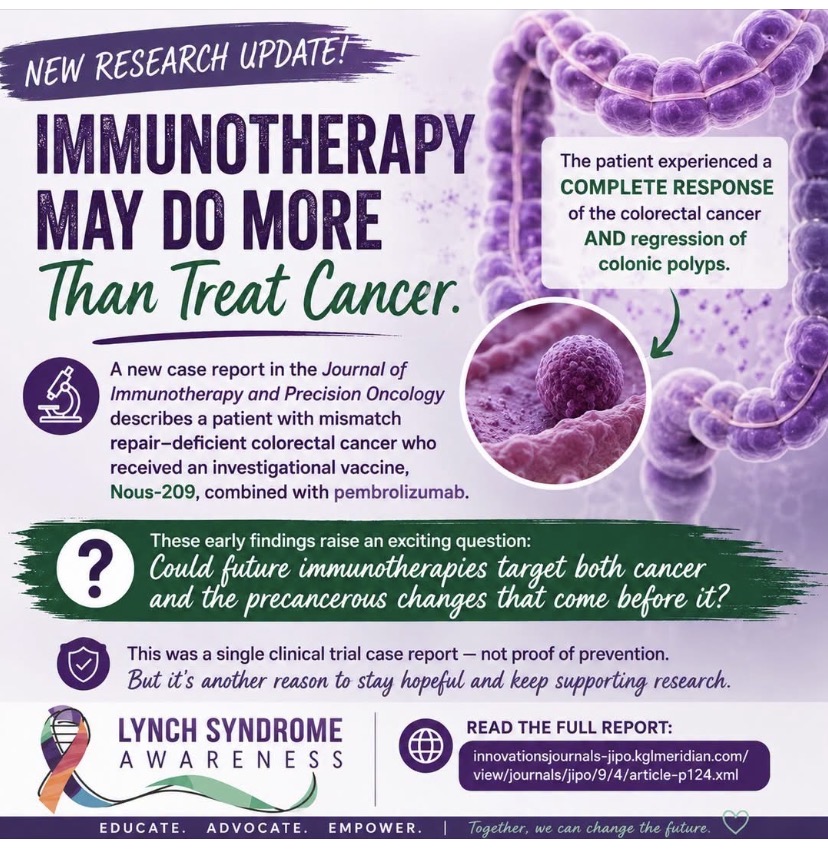
What was studied: Doctors treated a patient with an experimental cancer vaccine called Nous‑209 along side pembrolizumab, a standard immunotherapy drug that works by “releasing the brakes” on the immune system so it can attack cancer.

Who it was for: The patient had a type of bowel (colorectal) cancer known as “dMMR” — a cancer with faulty DNA repair machinery. These tumours make a lot of abnormal proteins, which makes them easier for the immune system to recognise. This patient also had many benign (non-cancerous) growths, called polyps, in the bowel — some of which could eventually turn into cancer.

What happened:

  • The patient’s cancer disappeared completely on clinical assessment (a “complete clinical response”).
  • The number of benign polyps dropped substantially — something not clearly seen before with immunotherapy alone.

Why this matters: The vaccine appears to boost the immune system so strongly that it not only attacks the cancer, but also clears away pre-cancerous growths. In theory, this could:

  • Lower the chance of the cancer coming back
  • Stop new polyps forming
  • Offer a form of “immunoprevention” — using the immune system to prevent cancer before it develops

This could be especially valuable for people with dMMR cancers (such as those with Lynch syndrome) and for people with polyposis syndromes, who develop large numbers of polyps and face a high lifetime risk of bowel cancer.

Important caution: These results come from just one patient. A single case cannot prove that the treatment works reliablyor safely for others — it may have been a one-off response. Larger clinical trials and laboratory studies are needed toconfirm the findings and to understand exactly how the treatment produces these effects.

Factors Associated with Adherence to Recommended Colorectal Surveillance Intervals in Lynch Syndrome

https://pmc.ncbi.nlm.nih.gov/articles/PMC13297535

What This Study Did

Researchers at the University of Pennsylvania looked at 295 people with Lynch Syndrome and reviewed nearly 1,200 colonoscopy/sigmoidoscopy procedures to understand:

  • How many people followed their recommended screening schedule
  • What factors helped or hindered people sticking to their screening plan
Key Findings
Overall Adherence Rates
  • 67.4% of individual procedures were done on time (within the recommended interval)
  • Only 31.2% of patients followed the schedule for all their procedures
  • Most people (68.8%) missed at least one appointment or delayed at least one screening
What Made People MORE Likely to Follow Their Schedule
  1. Finding cancer during previous screening — People who had previously detected colorectal cancer were much more likely to stay on schedule (9× more adherent)
  2. Being married or previously married — Married individuals were 1.7× more likely to adhere; divorced/widowed individuals were 2.3× more likely
  3. Social support appears to matter — The benefit for married/divorced/widowed people suggests that having a support network helps
What Made People LESS Likely to Follow Their Schedule
  1. Current smoking — Current smokers were 3× less likely to stick to the schedule
  2. No significant differences in age, sex, race, or insurance type
Common Reasons for Delays (When Documented)
  • Difficulty tolerating bowel preparation
  • Fear related to COVID-19
  • Missed or canceled appointments
  • Trouble scheduling or not responding to scheduling requests
Why This Matters
  • Regular screening saves lives in Lynch Syndrome by catching cancers early
  • Nearly 70% of patients had at least one delayed screening, which is concerning
  • When screening was delayed, some people developed advanced cancers (5 cancers and 10 advanced adenomas were found in delayed procedures)
Study Limitations
  • Single centre study (may not apply to all populations)
  • Diverse racial/ethnic groups and lower-income patients were underrepresented
  • Data was collected over 22 years when guidelines changed

Bottom Line

While most individual screenings happen on schedule, many Lynch Syndrome patients struggle with consistent adherence. Smokers, single people, and those without prior cancer detection need special support. Better strategies needed include easier appointment scheduling, help with bowel preparation tolerance, and reminder systems—especially in community healthcare settings.

Don’t feel bad if you’ve put it off—just do it

The article “8 Things Doctors Want You to Know Before Your Colonoscopy” (TIME, May 6, 2026) explains what to expect from a colonoscopy and aims to reduce anxiety around the procedure. 

Key takeaways

  1. Colonoscopies are important preventive screenings
    • They are one of the most effective ways to detect colorectal cancer early and can prevent cancer by finding and removing precancerous polyps during the procedure.
  2. The preparation is often the hardest part
    • Doctors say patients typically find the bowel-cleansing preparation more unpleasant than the procedure itself. A clean colon is essential because it helps doctors see abnormalities clearly. 
  3. The procedure itself is usually painless
    • Most people receive sedation or anesthesia and remember little or nothing about the exam. The colonoscopy generally takes only a short time. 
  4. You should follow prep instructions carefully
    • Diet restrictions and laxative instructions may seem inconvenient, but inadequate preparation can reduce the quality of the exam and may require repeating it. 
  5. Finding polyps doesn’t automatically mean cancer
    • Polyps are common, especially as people age. Most are benign, but removing them helps prevent some from eventually becoming cancerous. 
  6. There are risks, but serious complications are uncommon
    • Colonoscopy is considered a safe procedure, though, like any medical intervention, it carries some risks that should be discussed with a healthcare provider. 
  7. Alternative screening options exist
    • Stool-based tests and newer blood tests are available for some patients, but a positive result typically requires follow-up with a colonoscopy. Many specialists still consider colonoscopy the most comprehensive screening tool. 
  8. Don’t delay screening because of embarrassment or fear
    • Doctors emphasise that colorectal cancer is often preventable or highly treatable when caught early, and the temporary inconvenience of screening is far outweighed by its benefits. 
Bottom line

The article’s central message is that while colonoscopies have an intimidating reputation, the procedure is usually straightforward, safe, and highly effective at preventing and detecting colorectal cancer. The preparation is often the most challenging aspect, but completing screening on schedule can have major long-term health benefits.

Cancer almost killed me. We’re treating this disease all wrong

“I am a survivor of early onset rectal cancer(Age 27). Chemotherapy, radiotherapy and brutal surgery saved my life, removing my tumour along with my large intestine, bladder, prostate, rectum, pelvic floor and the base of my spine. I now live with two stoma bags and a body irrevocably changed by treatment.”

I’m confronted by an unpleasant truth: we brace for diagnosis and invest in treatments while neglecting prevention.

Prevention is often deprioritised because its benefits are delayed, less visible, and harder to measure, unlike treatment which delivers immediate, tangible outcomes.

Cancer cases are projected to rise sharply by 2050, making a treatment-focused model economically and practically unsustainable.

Up to 40% of cancers are preventable, yet most research funding is still directed toward treatment rather than prevention.

A common belief is that prevention is a weak market, as it requires convincing healthy people to take action.

This is contradicted by widespread adoption of preventive drugs like statins and Ozempic, showing people will engage when benefits are clear and tangible.

Historical failures in dietary supplement trials created lasting scepticism and made funders more risk-averse toward prevention research.

Advances in genetics, biomarkers, and technology now make targeted, cost-effective prevention strategies more feasible.

Political and media incentives favour treatment, as saving identifiable patients attracts more attention than preventing future cases.

This imbalance in visibility and incentives drives funding and policy decisions.

Reframing prevention as urgent, feasible, and scalable is essential to reduce cancer burden and protect healthcare systems.

https://www.thetimes.com/uk/healthcare/article/cancer-research-cure-prevention-scientist-oxford-fnpmzqfbr

Prospective Lynch syndrome database

A prospective Lynch syndrome database is important because it allows researchers, clinicians, and policymakers to collect and analyse long-term, standardised data on people with Lynch syndrome (LS).

(Using Chat GPT)

📌 In short: A prospective Lynch syndrome database is essential because it produces high-quality, unbiased evidence on cancer risks, surveillance effectiveness, and preventive strategies, directly improving patient care and shaping clinical guidelines.

Here are the key reasons why it matters, based only on reliable clinical and research perspectives:

  1. Natural history understanding
    • Prospective data (collected forward in time) helps clarify the true risks of different cancers (colorectal, endometrial, ovarian, gastric, etc.) in Lynch syndrome carriers.
    • It reduces biases compared to retrospective reports, which often overestimate risks due to selective reporting of severe cases.
  2. Better risk stratification
    • Different mismatch repair (MMR) gene variants (MLH1, MSH2, MSH6, PMS2, EPCAM) carry different cancer risks.
    • A prospective database helps define more precise, gene-specific and even sex-specific risk estimates, which guide personalized surveillance.
  3. Evaluation of surveillance effectiveness
    • Prospective registries allow direct measurement of how colonoscopy intervals (e.g., every 1–2 years) affect cancer incidence, stage at diagnosis, and mortality.
    • They can test whether surveillance reduces advanced cancers, enabling evidence-based guideline updates.
  4. Assessment of preventive strategies
    • Allows evaluation of risk-reducing interventions such as aspirin (e.g., CAPP2/CAPP3 trials), prophylactic surgeries, or lifestyle modifications.
    • Can help identify who benefits most from preventive measures.
  5. Improved clinical counseling
    • Physicians and genetic counselors can give patients more reliable, individualized risk information, reducing uncertainty and supporting informed decisions.
  6. Data for health policy
    • National or international databases provide evidence for cost-effectiveness of surveillance and preventive programs.
    • This supports resource allocation and insurance coverage for Lynch syndrome management.
  7. Research opportunities
    • Creates a resource for studying modifiers of cancer risk (genetic, environmental, lifestyle).
    • Enables collaboration across centers and countries for rare cancers within LS populations.

https://plsd.eu

Lynch Syndrome – Cascade Testing

Cascade testing refers to testing “at-risk” family members for a gene mutation, once the mutation has been found in a family member.

For Lynch syndrome, once family members get cascade testing, they can also benefit from screening, cancer prevention, and early detection strategies.

So if a family member has Lynch syndrome

You can ask your GP to refer you to a cancer genetics service.

Family members who can get a test include:

  • parents
  • brothers or sisters
  • children age 18 and over

Ask your relative for a copy of their Lynch syndrome test result or a letter you can bring to your GP appointment – if they have one.

If you get a Lynch syndrome diagnosis, your relatives can ask their GP to refer them to a cancer genetics service. This is known as cascade testing. It is also known as predictive testing.

Lynch syndrome test results can help your healthcare team:

Creation of a future European Network of National Cancer Mission Hubs (NCMHs)

ECHoS is an European project, funded by Horizon Europe Programme, that aims to support the implementation of the Cancer Mission activities in all Member State and Associated Country (MS/AC) through the establishment and development of National Cancer Mission Hubs (NCMHs) operating at national, regional, and local levels. By establishing NCMHs in each MS/AC, European citizens and organisations in health, research, and beyond, will be voiced and their voices will echo together.

ECHoS broad scope seeks to take cancer-policy dialogues beyond research and innovation, and health systems, covering also other relevant areas in cancer control and support, such as employment, education, and socioeconomic aspects.

To guarantee alignment and progress in the field of cancer, ECHoS will be guided by impacting subareas of Cancer Mission – namely prevention, early detection and treatment, quality of Life and survivorship – as well as equity, sustainability, and cross-cutting EU priorities such as social engagement and digital health.

http://www.cancermissionhubs.eu

EVERY STORY COUNTS

Especially on World Cancer Day.

Cancer is more than just a medical diagnosis—it’s a deeply personal matter. Behind every diagnosis lies a unique human story – stories of grief, pain, healing, resilience, love and more.

That’s why a people-centred approach to cancer care that fully integrates each individual’s unique needs, with compassion and empathy, leads to the best health outcomes.

Why is it so hard to….TREAT THE PERSON, NOT JUST THE DISEASE.

People living with cancer don’t always feel heard, seen, or understood. They might feel alienated and voiceless at a time when they’re also learning to navigate an unfamiliar and confusing health system, not to mention dealing with the emotional highs and lows of cancer diagnosis, treatment, or recovery.

People-centred cancer care represents an opportunity to refocus, rewire, and rewrite how we think about cancer, to embrace people’s differences, and to make sure that everyone is seen for who they really are and has access to the care they need. 

Colonoscopies – Why bother?

It just might save your life.

During my third colonoscopy colon cancer was discovered and it had advanced to my Lymph Nodes. I had no symptoms.

Why was I having colonoscopies? I had a family history of colon cancer and my sibling had tested positive for Lynch syndrome (an inherited predisposition to certain types of cancers including colon and endometrial.

I can understand why many people are nervous about getting colonoscopies. Some wonder how long a colonoscopy will take, how best to prepare for the procedure, how much time you’ll need to take off from work and how embarrassing or disruptive this important cancer screening procedure will be.

Why should people get colon cancer screenings?

The answer is simple: colon cancer screenings can detect colorectal cancer early and prevent unnecessary deaths. Colorectal cancers also are highly preventable and treatable if detected early. In fact, if doctors detect pre-cancerous polyps during a colonoscopy, they can remove the polyps during the procedure.

Prior to Colonoscopy:

Some may think…it’s not pleasant(although having had more than 15 to date I can say I do not find it so, but including the preparation, in most cases you’re spending less than 24 hours to help prevent cancer

Typically, people prepare for a colonoscopy in their homes the day or the night before along with amending their diet for a few days prior to the procedure. The Bowel preparation prescribed — which involves drinking a lot of water along with prep – can take a number of hours . That’s because you’ll be peeing and pooping out all the waste from your body, so you’ll have a clean, empty colon.

Colonoscopy Procedure:

The actual procedure is quick – usually less than 30 minutes. The doctor inserts a scope into your rectum. You are fully sedated prior to the start of the procedure and you wake up after it is over and you usually don’t remember any of the procedure. For nearly everyone, the actual colonoscopy is painless and relatively quick. You wake up, and you’re done. Aside from not being able to drive themselves home from the procedure, most people feel well and are able to eat and drink normally after a colonoscopy.

What are polyps and how common are they?

Polyps are like skin tags that form on the lining of the colon. Some of them are pre-cancerous, which means that over a period of time, they could become cancerous. So, when polyps are found during a colonoscopy, they can easily remove the vast majority of them. That’s how colon cancer is prevented through colonoscopy.”

https://www2.hse.ie/conditions/bowel-screening/colonoscopy-after-bowel-screening/

Primary Care Research into Cancer(PRICAN)

What is PRICAN?

Cancer represents a significant public health challenge in Ireland. Forecasts also indicate a potential doubling of cancer diagnoses between 2010 and 2040, primarily due to an ageing population. 

In recent years, there has been a shift in cancer control strategies towards prioritising prevention and early diagnosis, as the most cost-effective long-term approach to cancer control.

The National Cancer Strategy explicitly calls for an expanded role for general practitioners (GPs) in managing the entire cancer continuum, from prevention and early diagnosis to treatment and ongoing survivor support.

Despite its increasing importance in cancer control, primary care research has historically received less funding compared to laboratory and hospital-based research.

Whilst screening enables early detection of some presymptomatic cancer, approximately 85% of cancers are diagnosed after the onset of symptoms . This fact underscores the importance of equipping primary care with robust clinical guidelines and efficient referral pathways. 

The anticipated rise in cancer incidence demands proactive measures to strengthen the Irish healthcare system. By recognising the critical role of primary care across the cancer care continuum, and adopting a strategic approach to investment in research, Ireland can develop and implement evidence-based policies and strategies. This approach will not only mitigate the impacts of increasing cancer incidence but also position Ireland at the forefront of innovative and effective cancer care.

https://prican.eu