Lynch Syndrome

Lynch syndrome is an autosomal dominant hereditary cancer syndrome, associated with a 40%–80% lifetime risk of developing colorectal, endometrial and other cancers.

Lynch syndrome may be suspected from a family history of bowel cancer and other Lynch syndrome-related cancers, triggering genomic testing in the family.

Lynch syndrome is an autosomal dominant condition, so that each child (son or daughter) and each sibling (brother or sister) of an affected individual has a 50% (1-in-2) chance of inheriting the condition.

It is important to remember that chance has no memory, and the 1-in-2, or 50%, chance of inheriting the altered gene for the condition applies to each child, irrespective of whether or not the parents have already had children with, or without, the condition.

https://www.genomicseducation.hee.nhs.uk/genotes/

Sugar-free diets, high dose vitamin C and other false cures for cancer – an expert guide to spotting misinformation

As social media has become less regulated in recent years, and the influence of conspiracy theorists has grown, cancer misinformation has grown along with it. Here is how you can find trustworthy sources….

https://www.independent.ie/life/health-wellbeing/health-features/sugar-free-diets-high-dose-vitamin-c-and-other-false-cures-for-cancer-an-expert-guide-to-spotting-misinformation/a805384138.html

Lynch Syndrome: Diagnosis & Treatment

https://www.mayoclinic.org/diseases-conditions/lynch-syndrome/diagnosis-treatment/drc-20374719

Your GP may want you to consider genetic testing for Lynch syndrome if your family history has one or more of the following:

  • Multiple relatives with any Lynch-associated cancers, including colon cancer and endometrial cancer. Other cancers caused by Lynch syndrome include those that happen in the stomach, ovaries, pancreas, kidneys, bladder, ureters, brain, gallbladder, bile ducts, small intestine and skin.
  • One or more family members who had cancer before age 50.
  • One or more family members who have had more than one type of cancer.
  • More than one generation of family with the same type of cancer.

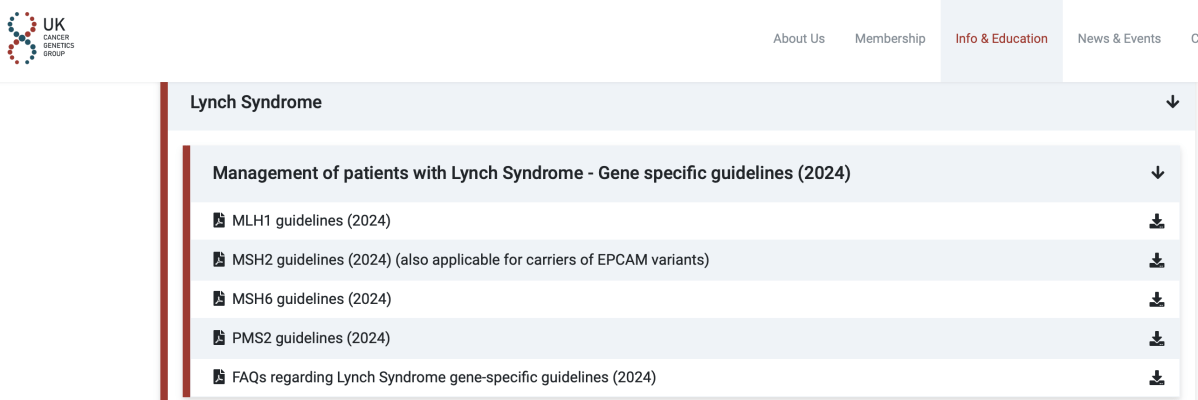
Lynch Syndrome Management Guidelines – Gene Specific 2024 – UKCGG

https://www.ukcgg.org/information-education/ukcgg-leaflets-and-guidelines/

Gynaecology and Lynch Syndrome

From LS UK Annual Conference 2024

Neil is a Clinical Lecturer and Gynaecology Oncology Surgical Subspecialty Fellow at the University of Edinburgh and NHS Lothian. His passion is to improve the care of those with Lynch syndrome through prevention and personalised treatment.

“Prevention is better than cure – vaccination for Lynch syndrome”

LS UK Conference 2024 – Dr David Church

Four vaccine schemes could prevent 1,400 deaths – report

https://www.rte.ie/news/2024/0703/1457891-adult-vaccination-programmes/

A shingles vaccine is available on the market, but it is not given routinely in Ireland. 

https://www2.hse.ie/conditions/shingles/

Universal Germline Genetic Testing for Hereditary Cancer Syndromes in Patients With Solid Tumour Cancer(2022)

Historically, professional society guidelines have recommended limited genetic testing for hereditary cancer syndromes (HCS) to patients with cancer thought to be at highest risk for carrying pathogenic/likely pathogenic germline variants (PGVs) in a few selected genes.

Reasons for this approach were largely based on the high costs of testing, perceptions that HCS were rare in the general population, and a paucity of clinical utility.

Discussion of the current evidence that challenges these assumptions and supports the implementation of universal HCS testing among patients with solid tumours.

https://ascopubs.org/doi/10.1200/PO.21.00516

Lynch Syndrome Conference 2024

Check out the presentations on YouTube.

Up to date information on Lynch Syndrome