Postgraduate Certificate in Cancer Genetics and Genomics

https://courses.rcpi.ie/product?catalog=Postgraduate-Certificate-in-Cancer-Genetics-and-Genomics

What is the Lynch syndrome registry? (England)

The Lynch syndrome registry records and analyses important information about people with Lynch syndrome.

This helps to understand how people with Lynch syndrome are looked after and cared for across England. All information is held on a secure and confidential computer database.

Why have a Lynch syndrome registry? 

The registry will collect information from people with Lynch syndrome and help to better understand how these people are currently being monitored and managed.

The registry will ultimately be an efficient system that with the help of the bowel cancer screening programme will allow nationally coordinated care for you and others with Lynch syndrome.

It will also become a valuable central research resource that could be used to support other studies.

Lynch Syndrome Ireland: office assistant

Eddie argues….It’s a no brainer get testedit could save you or your family members a lot of trouble in the future.

Lynch Syndrome and me: Leanne’s story

There are two things I want people to know. Firstly, the understanding about LS at all the different touch points in the NHS is amazing. Secondly, having LS isn’t necessarily a bad thing. I have the MSH2 variant. It’s not great to know all the associated risks, but it gives me the opportunity to better both my and my family’s future chances. It’s a blessing in disguise to discover this.”

“When we found out, we spoke with other family members as I felt that I needed to let them know. Some of my relatives came forward and got themselves tested to see if they could make the same informed decisions; others didn’t.”

Having this knowledge has enabled me to make decisions about my life.

Mainstreaming. Cancer Test: Predisposition to cancer

Check out RTE Nine O Clock News…starts at 11.30 min. into programme.

https://www.rte.ie/player/series/rté-news-nine-o-clock/SI0000001468?epguid=IH10000961-23-0182

See recently launched National Hereditary Cancer Model of Care (NCCP)

Why do GPs need to know about Lynch syndrome?

Find out during

@kevinjmonahan‘s talk at

@PULSE365_Hub on 6 July. This virtual conference gives you a brilliant selection of talks to choose from – find out more: https://bit.ly/3qUTLnl#generalpractice#primarycare

When your doctor doesn’t listen — 10 tips to help change that.

Bowel cancer: What role do our genes play?

A person’s risk of developing colorectal cancer is influenced by lifestyle factors, such as a low-fibre diet and lack of regular physical activity; however, as is the case with breast cancer, some inherited genetic variants increase the likelihood of a person developing colorectal cancer.

Lynch syndrome

A person who inherits Lynch syndrome will have a high lifetime risk of colorectal cancer, as well as increased risk of some other types of cancer. It can be caused by variants in one of four different genes (MLH1, MSH2, MSH6and PMS2) that code for essential DNA repair proteins.

In all four genes, only one affected copy is needed to cause the increased cancer risk. This means that Lynch syndrome is inherited in a dominant pattern in families.

People who have Lynch syndrome are generally advised to have a colonoscopy every two years so that cancers can be identified and removed at an early stage. For affected women, a hysterectomy and removal of the ovaried and fallopian tubes are often considered too, because there is a significant risk of endometrial and ovarian cancer.

Lynch Syndrome Booklet -Eve Appeal(UK)

Lynch Syndrome and understanding your options

People with Lynch Syndrome are at a higher risk than the general population of developing some cancers. Identifying people who have Lynch Syndrome can have important benefits, including prevention of cancer, spotting it early and helping doctors decide on the best treatment for people who do develop cancer.

This booklet aims to help you understand more about the syndrome, what your options are

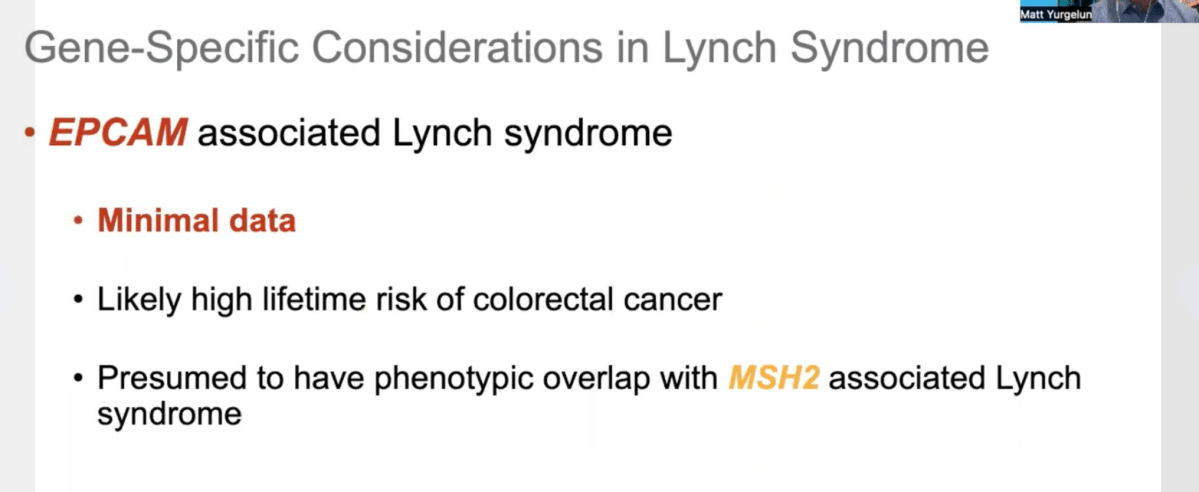
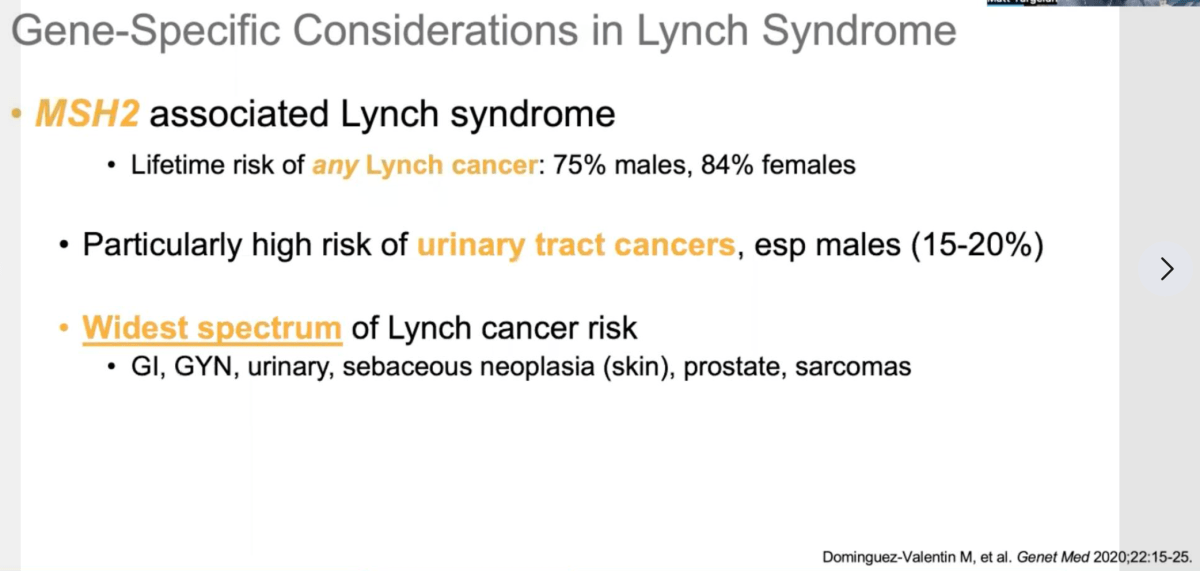
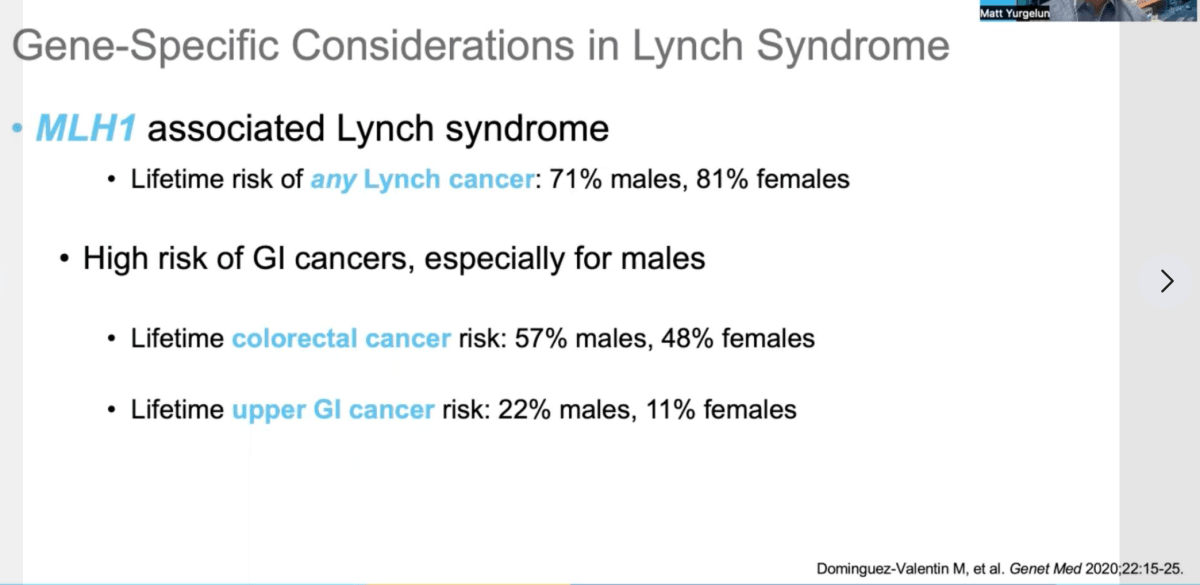
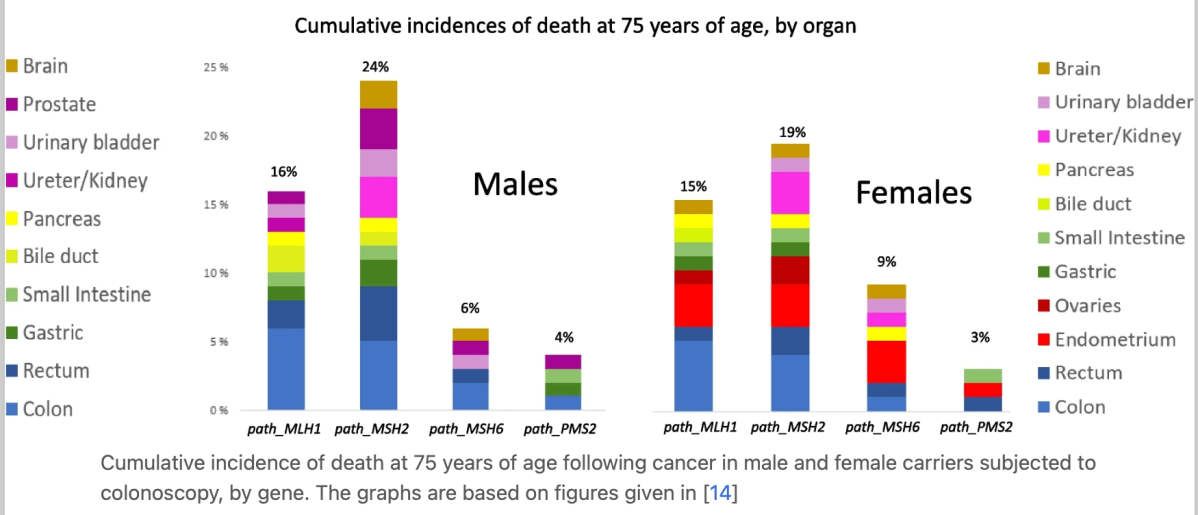
Lynch Syndrome: A Single Hereditary Cancer Syndrome or Multiple Syndromes Defined by Different Mismatch Repair Genes?

The risks of cancer (cumulative risks for various cancer types) differ among Lynch syndrome patients based on the specific altered MMR gene.

It may be appropriate to consider categorising Lynch syndrome as 4 distinct syndromes based on the specific altered MMR gene.

The varying carcinogenic mechanisms and associated cancer risks indicate the need for gene-specific surveillance recommendations in Lynch syndrome.

Moreover, the growing understanding of gene-specific differences will likely affect treatment options and efficacy of Lynch syndrome vaccines.

Studies of larger sample series are needed to definitively confirm the differences in mutational features identified across Lynch syndrome tumors and to evaluate the associated clinical consequences.

https://www.gastrojournal.org/article/S0016-5085(23)00696-0/fulltext