
Author: Lynch Syndrome Ireland

A Focused Clinical Review of Lynch Syndrome
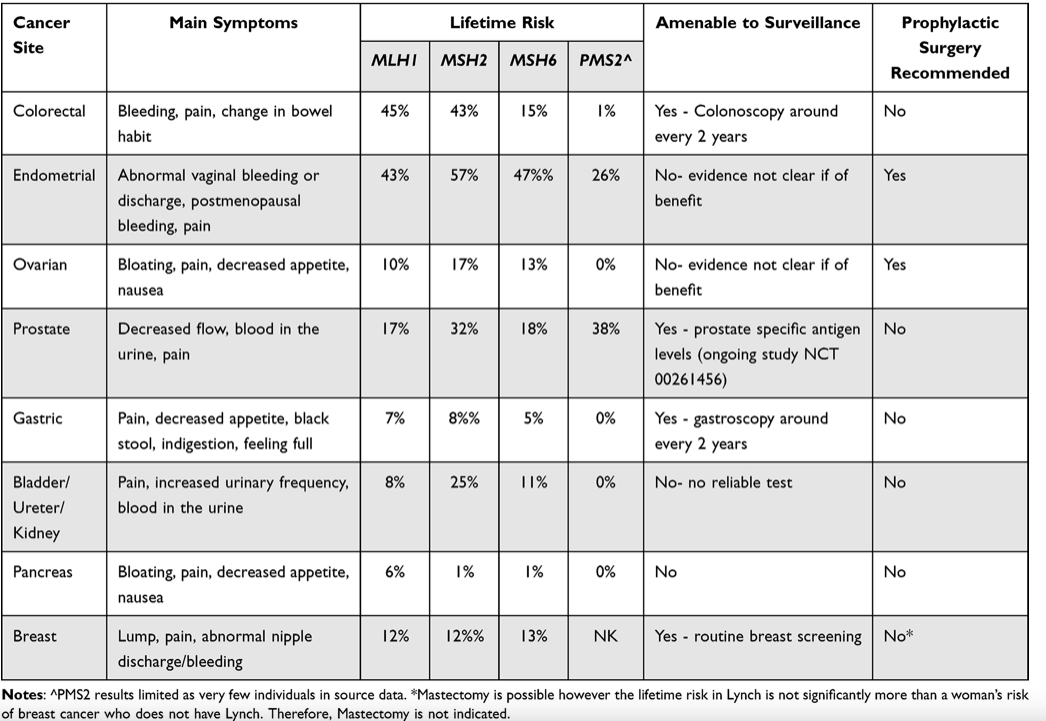
In summary, LS care has come a long way over the last twenty years. We now understand the individual cancer risk to inform consent, tests to accurately diagnoses LS and ways by which we can reduce cancer risk.
However, more needs to be done to find those who are undiagnosed, develop less invasive cancer surveillance methods and develop new vaccinations and treatments.
Lynch Syndrome and the Risk of Ovarian Cancer
Lynch syndrome increases the risk of many different types of cancer, including ovarian cancer. The exact level of risk depends on which gene contains the mutation.
Overall, ovarian cancer is rare. The American Cancer SocietyTrusted Source estimates that 1 in 78 (1.2%) of people with ovaries will develop ovarian cancer during their lifetime. Additionally, more than half of people receive a diagnosis at age 63 or older.
In contrast, people with Lynch syndrome have a 3% to 17% lifetime risk of developing ovarian cancer. They also often develop cancer at a younger age than people without Lynch syndrome.
https://www.healthline.com/health/ovarian-cancer/lynch-syndrome-ovarian-cancer#ovarian-cancer-risk
PERCS study
PERCS is a research project funded by the Irish Cancer Society and run by a team based in the Trinity St James’s Cancer Institute.
Through PERCS, we will run and evaluate a new exercise rehabilitation triage and referral system for people who have completed cancer treatment in St James’s Hospital.
The aim of the rehabilitation and referral system is to help people who have had cancer to become more active and improve their overall health.
How Biobanks WORK
A biobank (“bank of life”) is a place – typically an ultralow temperature freezer – that stores blood and other human tissue samples donated by patients for research in cancer or other serious diseases. It is maintained by specialist personnel, and data is coded for the patient’s privacy and confidentiality, and recorded in a database. Clinical data, including treatment and follow-up, may be linked subsequently.
The patient’s cancer operation specimen – cancer and surrounding normal tissue – is examined by a Histopathologist. The pathological diagnosis and full pathological assessment of the tumour’s aggressiveness and extent determine the patient’s further treatment. Providing the patient has consented, small fragments of cancer and normal tissue, surplus to pathology requirements, may be coded, frozen and stored in the biobank. Samples are released for ethical, scientifically approved research on how cancers develop, grow, spread and respond to treatment.
Study: Prostate cancer screening may benefit people with Lynch syndrome

What is this study about?
The IMPACT trial is an international study looking at how well PSA (prostate-specific antigen) screening for prostate cancer works for people with inherited mutations. This report shared early results of screening in people with Lynch syndrome.
Summary
Initial results from the IMPACT trial show that PSA testing to screen for prostate cancer in people with Lynch syndrome can detect aggressive early prostate cancers. These findings support the use of PSA screening in men with Lynch syndrome, particularly men with an inherited mutation in an MSH2 or MSH6 gene.
https://www.facingourrisk.org/XRAY/prostate-cancer-screening-benefits-for-Lynch-syndrome
National GMSA Transformation Project: Lynch Syndrome
Delivery of a comprehensive service for the detection of Lynch syndrome
Led by the North Thames and South East GMSAs, the NHS GMS National Lynch Syndrome project is working to improve the identification and management of Lynch Syndrome, bridging the gap in testing and diagnosis of Lynch Syndrome and supporting the early detection of cancer and access to personalised care.
The project will initially focus on colorectal and endometrial cancer patients and over time the programme will aim to extend LS screening across relevant tumour types.
https://www.norththamesglh.nhs.uk/national-gmsa-transformation-project-lynch-syndrome/
How Biobanks Work?
Women with womb cancer are to be offered a genetic test for Lynch syndrome
Oct 2020 -UK
Women with Lynch syndrome are likely to develop womb cancer before showing signs of bowel cancer. A diagnosis of the genetic condition means they can be offered regular checks, and aspirin therapy, to reduce their risk of bowel cancer.
Researchers found that, of 305 UK women offered testing for Lynch syndrome around the time of their treatment for womb cancer, 302 accepted.
Women’s family members can also be offered testing. The researchers found that protecting family members was the main reason why women wanted to be tested. They were most receptive at follow-up appointments after surgery for their womb cancer.
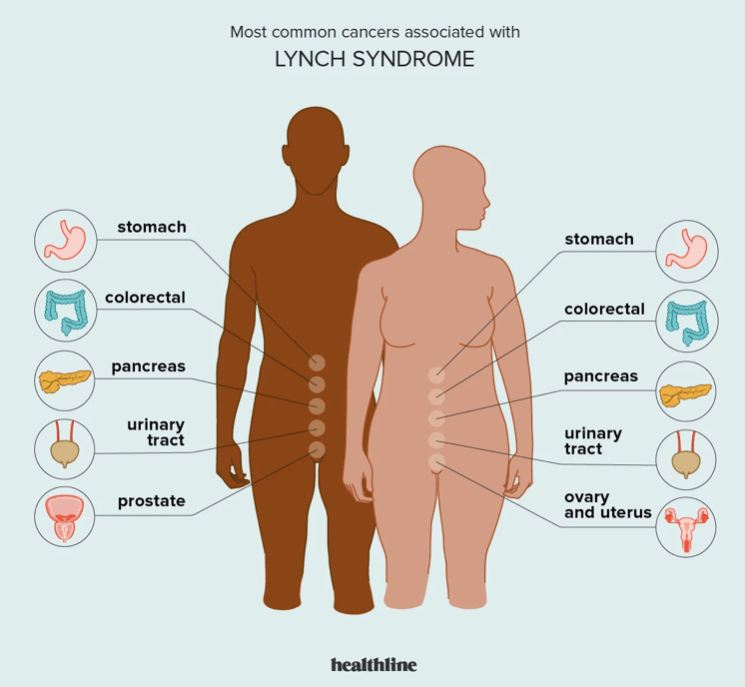
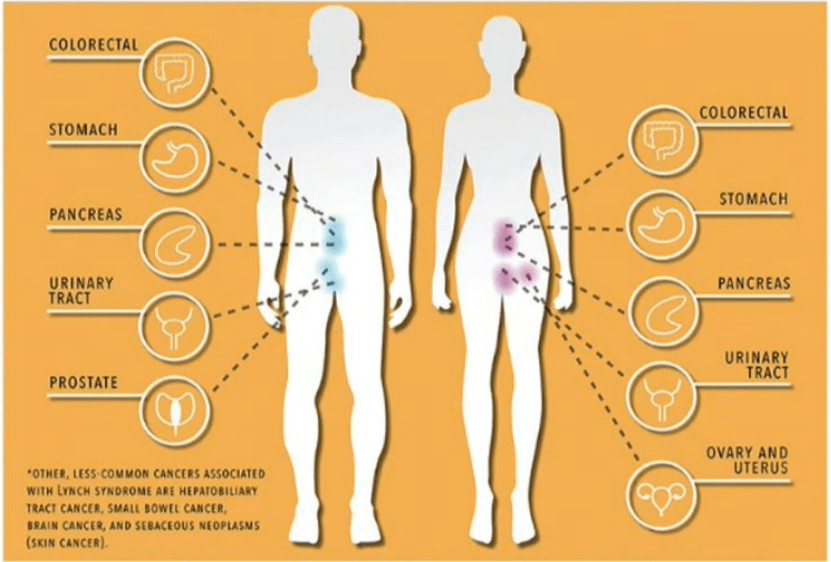
The most common cancers in Lynch syndrome
Content provided courtesy of speaker.
Dana-Farber Cancer Institute. Lynch Syndrome: Are You at Risk? Accessed Nov. 2022 from
http://www.dana-farber.org/health-library/articles/lynch-syndrome-are-you-at-risk/
 Lynch Syndrome Ireland