thisisGO.ie is an online personalised resource for you and yours who have been impacted by a gynaecological cancer.
Also an excellent resource for Lynch Syndrome.
thisisGO.ie is an online personalised resource for you and yours who have been impacted by a gynaecological cancer.
Also an excellent resource for Lynch Syndrome.
These workshops are aimed at nurses looking for an introduction to Lynch syndrome and the project, and will cover the basics.
Lynch Syndrome is an inherited condition that increases your risk of developing some cancers, including bowel, womb and ovarian cancer. We have developed a guide to run through everything you need to know about Lynch.
This guide has been made with input from experts, people with Lynch Syndrome and our Ask Eve nurses to provide you with all the information you need when offered testing for, or navigating a diagnosis of, Lynch Syndrome.
We also have an Easy Read guide to Lynch Syndrome, which you can download here
Lynch Syndrome
Lynch syndrome (LS) is associated with varying cancer risks depending on which of the five causative genes harbors a pathogenic variant; however, lifestyle and medical interventions provide options to lower those risks.
“We developed MyLynch, a patient-facing clinical decision support (CDS) web application that applies genetically-guided personalized medicine (GPM) for individuals with LS. MyLynch informs LS patients of their personal cancer risks, educates patients on relevant interventions, and provides patients with adjusted risk estimates depending on the interventions they choose to pursue. MyLynch can improve risk communication between patients and providers while also encouraging communication among relatives with the goal of increasing cascade testing. As genetic panel testing becomes more widely available, GPM will play an increasingly important role in patient care, and CDS tools offer patients and providers tailored information to inform decision-making. MyLynch provides personalised cancer risk estimates and interventions to lower these risks for patients with LS.”
https://www.mdpi.com/2072-6694/15/2/391
“The MyLynch risk estimates and their clinical utility should be validated on larger samples of patients in future studies. We also plan to produce a mobile compatible version of the app as well as incorporate risk uncertainty into the estimates.”
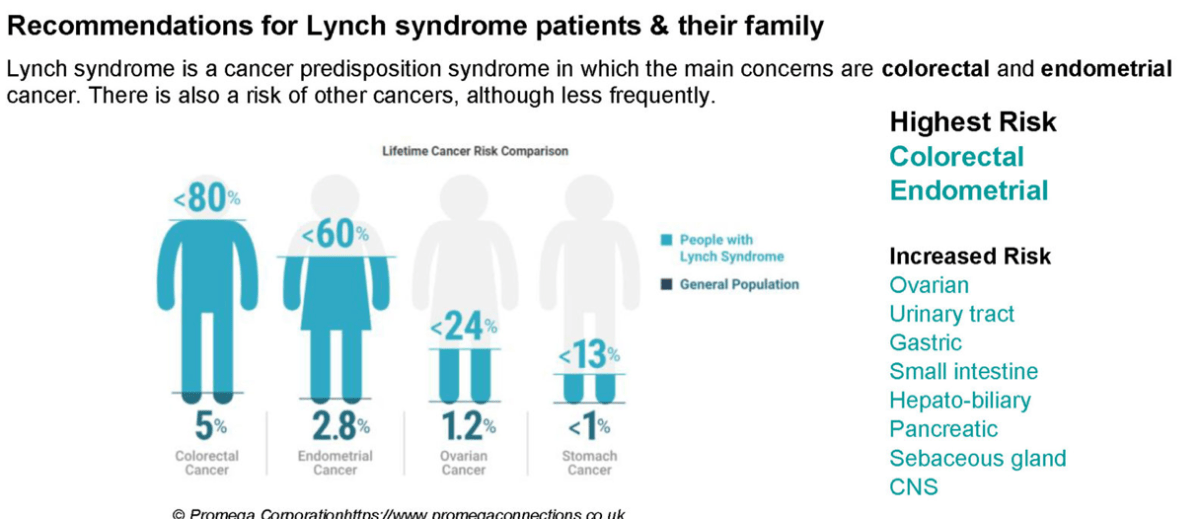
Researchers have recruited the first vaccine candidates to one of two new prevention trials that seek to immunize high-risk individuals against Lynch syndrome, the most common cause of hereditary colorectal cancer. Individuals who inherit the condition have an estimated lifetime risk as high as 80% for developing one of these malignancies, as well as an above-average risk for cancers arising in other organs, often at an early age, and regardless of race or gender.
The Nous-209 vaccine—named partially for the number of neoantigens or “new” antigens it contains, and in part for the Switzerland-based company (Nouscom) that developed it—employs what investigators call “a brute force” approach. The vaccine contains 209 bits and pieces of cancer-specific neoantigens expressed only in premalignant or malignant tissues of individuals with Lynch syndrome that researchers hope will stimulate a robust immune-system attack that stops cancer progression at its origin.
In comparison, the Tri-Ad5 vaccines, developed through the National Cancer Institute’s (NCI’s) intramural program, rely on three tumor-associated antigens that are overexpressed in cancer cells, but are also found to a lesser degree in healthy tissues. Because early studies suggested that the approach with only the MUC-1 antigen showed promise, investigators added two other antigens (CEA and brachyury) in the Tri-Ad5 vaccines, which will be combined with an Interleukin-15 (IL-15) “superagonist,” a vaccine stimulant, to increase the vaccine’s potential for destroying premalignant lesions or early tumors.
“Right now, we are focused on helping high-risk populations, and they, in turn, are teaching us how to develop better cancer preventive vaccines for the future.”
“There is much to be optimistic about right now for those with Lynch. Many medical discoveries and advances have been made within the past decade. Aspirin is used as a chemoprevention, immunotherapy may put various Lynch syndrome-related cancer in remission, and AI is improving screening measures, specifically for colonoscopies. What excites me the most is the Lynch vaccine in clinical trials now. The Lynch landscape has changed since my diagnosis 12 years ago.”
https://www.curetoday.com/view/gimme-shelter-from-lynch-syndrome
If you are having routine gynaecological tests or treatment for womb cancer & would like to take part in a research study?
The right to be forgotten is the concept that cancer survivors who have gone a period of time without needing treatment should have their previous diagnosis disregarded when accessing insurance, life policies and financial products.
Insurance Ireland claims plans for mandatory action will undermine ‘fairness’ in the market, while the Department of Finance stalled the bill which would have stopped survivors being penalised.
“We published research in February 2022 which found that of the people who reported experiencing difficulties with financial providers, 49 per cent of the survey respondents who were affected by cancer were refused by one or more providers,”
Gynaecological cancers refer to any cancer of the female reproductive system which includes the uterus (womb), the ovaries, the cervix (the neck of the womb), the vulva (the outer part of the female genitals) or the vagina.
Ovarian cancer and was launched in February 2022 and the genetic conditions, BRCA and Lynch Syndrome, were added in May 2022. Uterine cancer went live in September 2022. Vulva cancer and vaginal cancer will be live before the end of 2022.
Just log on to https://thisisgo.ie and select “My Profile”
“The prevalence of hereditary cancer syndromes among early-onset colorectal cancer patients – including Lynch syndrome – was quite high, which presents a tremendous opportunity for us to save lives through early detection based on genomic risk factors,”
Based on this new data, the OSUCCC – James research team recommends genetic counseling and a broad, multi-gene panel test of cancer susceptibility genes for all early-onset colorectal cancer patients, regardless of family history or the results of tumor screening for Lynch syndrome. This differs from current professional guidelines, which recommend all colorectal cancer patients be screened for Lynch syndrome, with referral for genetic counseling and Lynch syndrome-specific genetic testing if the tumor-screening test is abnormal.
“We expected to find a high rate of Lynch syndrome among these early-onset colon cancer patients. What was surprising were some of the other gene mutations found in the young colorectal cancer patients, including mutations in genes traditionally linked to breast cancer risk, even in patients whose family history was not suggestive of those mutations,”