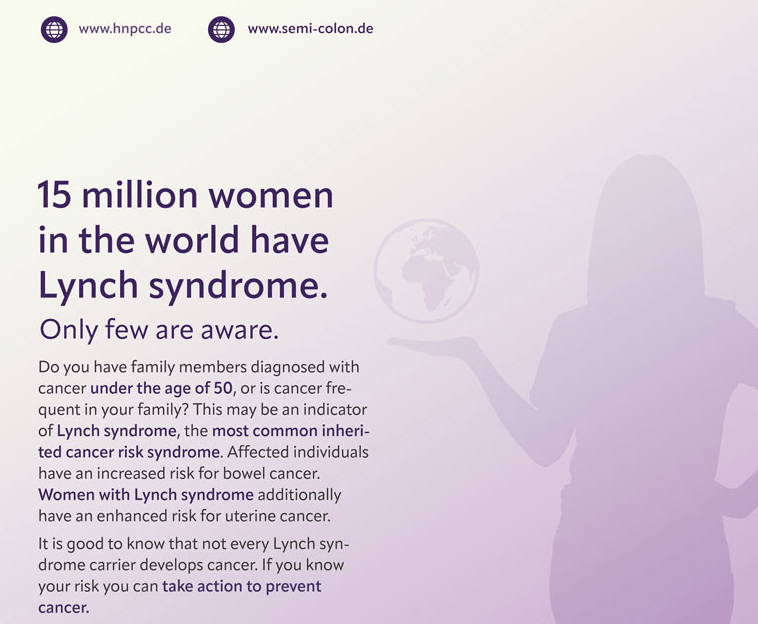
Transforming Lynch Syndrome Limitations Into Opportunities

“I had to transform my challenges into opportunities.”

The key to focus on when we are confronted with challenges is to become focused on what is possible rather than what is not. 

https://www.curetoday.com/view/transforming-lynch-syndrome-limitations-into-opportunities

Lynch Syndrome Cancer Risk to Age 70

Individuals with Lynch syndrome are at increased risk for multiple cancer types (common ones shown here). Note: MLH1 has the highest pancreatic cancer risk, MSH2 has the highest urothelial & prostate cancer risk, & PMS2 risks are mainly CRC & EC.

Lynch Syndrome: Know your risk | Dana-Farber Cancer Institute


Dana-Farber’s Matt Yurgelun, MD, discusses Lynch Syndrome research and the challenges of a Lynch Syndrome diagnosis. Dana-Farber’s Lynch Syndrome Center offers genetic testing to help identify Lynch Syndrome carriers who may be at increased risk for a variety of cancers.

What is Lynch Syndrome?

Be aware of gene changes and cancer in your family and take part in screening to reduce your risk of cancer.

https://www.cancer.ie/node/982

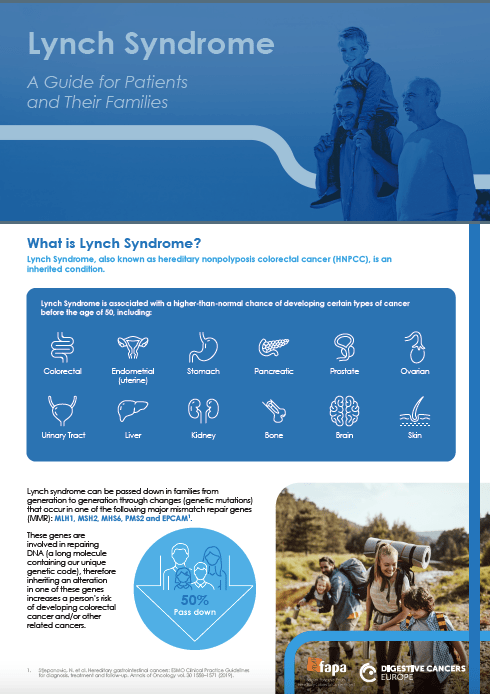
 Lynch Syndrome 

A Guide for Patients and Their Families 

 Lynch Syndrome is associated with a higher-than-normal chance of developing certain types of cancer before the age of 50.

What does it mean to live with Lynch Syndrome? 

Womb Cancer Genomics – Research and Patient Benefit

Peaches Womb Cancer Trust is proud to present part one of their womb cancer genomics webinar. Originally aired in November 2022.

With Dr Neil Ryan, who shares his wealth of expertise in Lynch Syndrome.

Note: Can be viewed on You Tube

For more information on the topics discussed, please visit:

https://peachestrust.org/

https://peachestrust.org/peaches-pati…

https://www.lynch-syndrome-uk.org/

https://www.genomicsengland.co.uk/

A Cancer Journey: My Lynch Syndrome

 I hope will put a Lynch Syndrome diagnosis in the proper perspective and keep you and your loved ones alive.

First, do not bury your head in the sand…

If you have a family history of cancer–of the uterus, ovaries, bladder, ureter, kidney, stomach, small intestine, liver, pancreas, prostate, and oil glands (there may be others), take seriously the possibility that there is a hereditary component to such histories.

Especially–I repeat ESPECIALLY–if there’s a family history of colon or uterine cancer at a young age, talk to your doctors and get tested for Lynch.

And if you happen to test positive for the Lynch mutation, don’t hide it from your family. Because sharing that information may save others in your family as well.


Second, if you discover that you or a loved one has Lynch Syndrome, DON’T FREAK OUT!

https://frankjpeter.com/category/cancer/

Realise that such knowledge—as upsetting as it—invites you to design a surveillance program with your doctors that will enable you to “stay ahead” of the most common types of Lynch cancers, and thus to swing your odds of living a relatively healthy life hugely in your favor.

Harvard Model Identifies Women at High-Risk For Endometrial Cancer

Endometrial cancer is the most common form of uterine cancer and the fourth most frequent cancer diagnosis in women throughout the United States. A new study shines a light on recognizing high-risk individuals.

Key takeaways:

  • Endometrial cancer is the most common gynecological malignancy in the U.S., with mortality rates on the rise.
  • New research has produced a model that identifies those at increased risk of acquiring endometrial cancer.
  • Individuals with Lynch syndrome are more at risk of developing endometrial cancer.

https://healthnews.com/news/harvard-model-identifies-women-at-high-risk-for-endometrial-cancer/

thisisGO – Lynch Syndrome

thisisGO.ie is an online personalised resource for you and yours who have been impacted by a gynaecological cancer.

Also an excellent resource for Lynch Syndrome.