Getting the CMMRD Facts Straight After Family Loses 3 Children in 6 Years to Hereditary Cancer Syndrome

Originally published February 29, 2016

Lynch syndrome is an autosomal dominant condition. This means that a person who carries one copy of a mutation in any of the genes known to cause Lynch syndrome is at increased risk to develop multiple adult-onset cancers, especially those of the colon, uterus, and ovaries.

A person who carries two mutations in the same gene in any of the genes associated with Lynch syndrome (MLH1MSH2MSH6PMS2) has a completely different syndrome called Constitutional Mismatch Repair Deficiency (CMMRD). This usually occurs when a person inherits one mutation from their father and the other from their mother. This rare condition is associated with a high risk of early-onset cancers, including childhood onset cancers of the brain and blood. Café au lait spots, flat light-brown birthmarks on the skin, are also common.

https://www.mygenecounsel.com/getting-the-cmmrd-facts-straight/
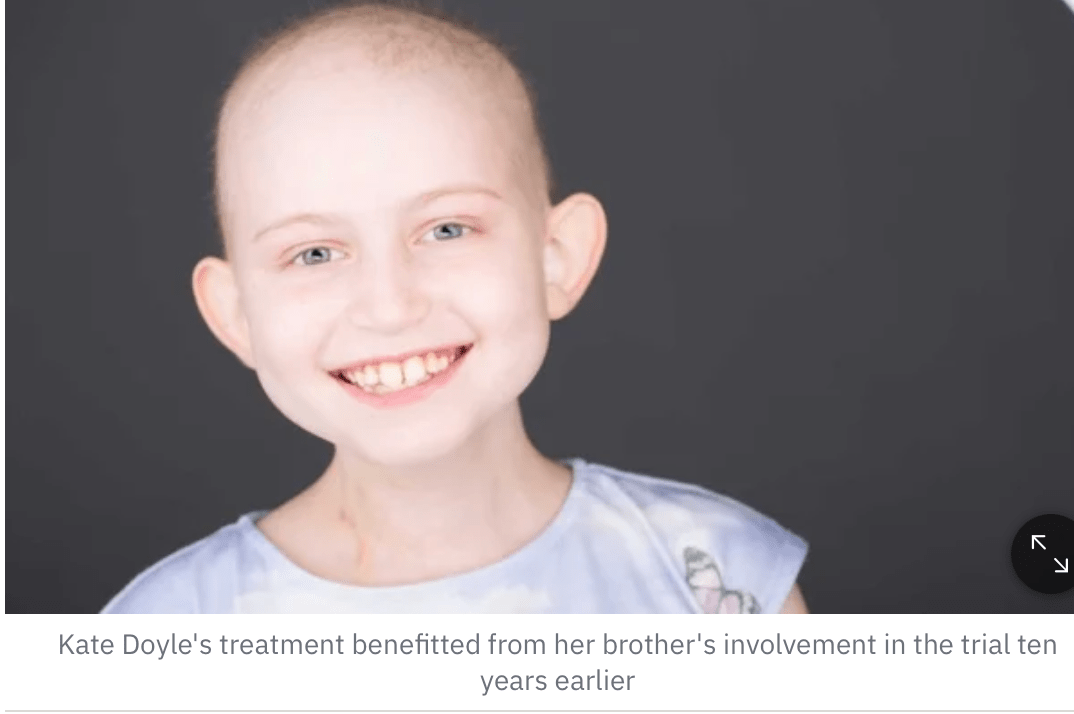
‘Phenomenal’ – study hailed a significant milestone in child cancer care

Professor Owen Smith, Consultant Paediatric Haematologist at Children’s Health Ireland (CHI), has launched Ireland’s first clinical study of genomics approaches in cancer care.

Genomic sequencing allows medical teams to better identify cancerous cells and target them specifically.

“We need to stop carpet bombing cancers and go for a more sniper fire or precision way of killing the cancer and reducing the side effects to the patient,” Prof Smith said.

“Genomic sequencing of the cancer and the patient will allow us to define the patients where chemotherapy can be safely reduced,”

The primary objective of MAGIC-I is to evaluate the clinical and health economic impact of implementing genomic diagnostics in paediatric cancer care in Ireland.

Lynch Syndrome

https://www.cancer.ie/cancer-information-and-support/cancer-information/about-cancer/causes-of-cancer/cancer-and-genes/lynch-syndrome

Lynch syndrome increases the risk of a number of cancers. In general, the risk is highest for colorectal (bowel) cancer, but it depends on the gene affected. 

Some colorectal (bowel) cancers are hereditary. Up to 5 people out of every 100 diagnosed with bowel cancer have Lynch syndrome. Other cancers linked to Lynch syndrome include:

https://www2.hse.ie/conditions/lynch-syndrome/

  1. About
  2. Testing and diagnosis
  3. Your results
  4. Help and support
  5. Reducing your risk of cancer
  6. Children and family planning

Lynch syndrome for the gynaecologist (Nov 2020)

Key content
  • Lynch syndrome is an autosomal dominant condition closely associated with colorectal, endometrial and ovarian cancer.
  • Women with Lynch syndrome are at increased risk of both endometrial and ovarian cancer and should be offered personalised counselling regarding family planning, red flag symptoms and risk-reducing strategies.
  • Surveillance for gynaecological cancer in women with Lynch syndrome remains controversial; more robust data are needed to determine its effectiveness.
  • Universal testing for Lynch syndrome in endometrial cancer is being adopted by centres across Europe and is now recommended by the National Institute for Health and Care Excellence; thus, gynaecologists must become familiar with testing strategies and their results.
  • Testing strategies involve risk stratification of cancers based on phenotypical features and definitive germline testing.

https://obgyn.onlinelibrary.wiley.com/doi/10.1111/tog.12706

HSE Health A-Z

https://www2.hse.ie/conditions/?fbclid=IwY2xjawJkYm5leHRuA2FlbQIxMQABHkFLUBpOydNbjldMlqnKhFD4QPIqKDYAcq9evuEd5_8reM0IMb1AqnvBNIVo_aem_MZRw4PsbrQDiYxV5n49fCA#L

Check out new addition on “Lynch syndrome” thanks to NCCP.

What is the Lynch syndrome registry? (UK)

Lynch syndrome can run in families. It increases your risk of being diagnosed with bowel cancer, as well as other cancers including endometrial (womb), ovarian, stomach, bladder, kidney, and skin cancers. This condition is diagnosed by having a genetic test.

The Lynch syndrome registry records and analyses important information about people with Lynch syndrome. This helps to understand how people with Lynch syndrome are looked after and cared for across England. All information is held on a secure and confidential computer database.

Why have a Lynch syndrome registry? 

The focus of the Lynch syndrome registry is to address the differences in access, quality and timeliness of regular check-ups that people with Lynch syndrome in England currently experience.

The registry will collect information from people with Lynch syndrome and help us to better understand how these people are currently being monitored and managed. 

https://www.40tude.org.uk/news/kevin-monahan-award-25

https://lynchregistry.org.uk/#:~:text=The%20Lynch%20syndrome%20registry%20records,secure%20and%20confidential%20computer%20database.

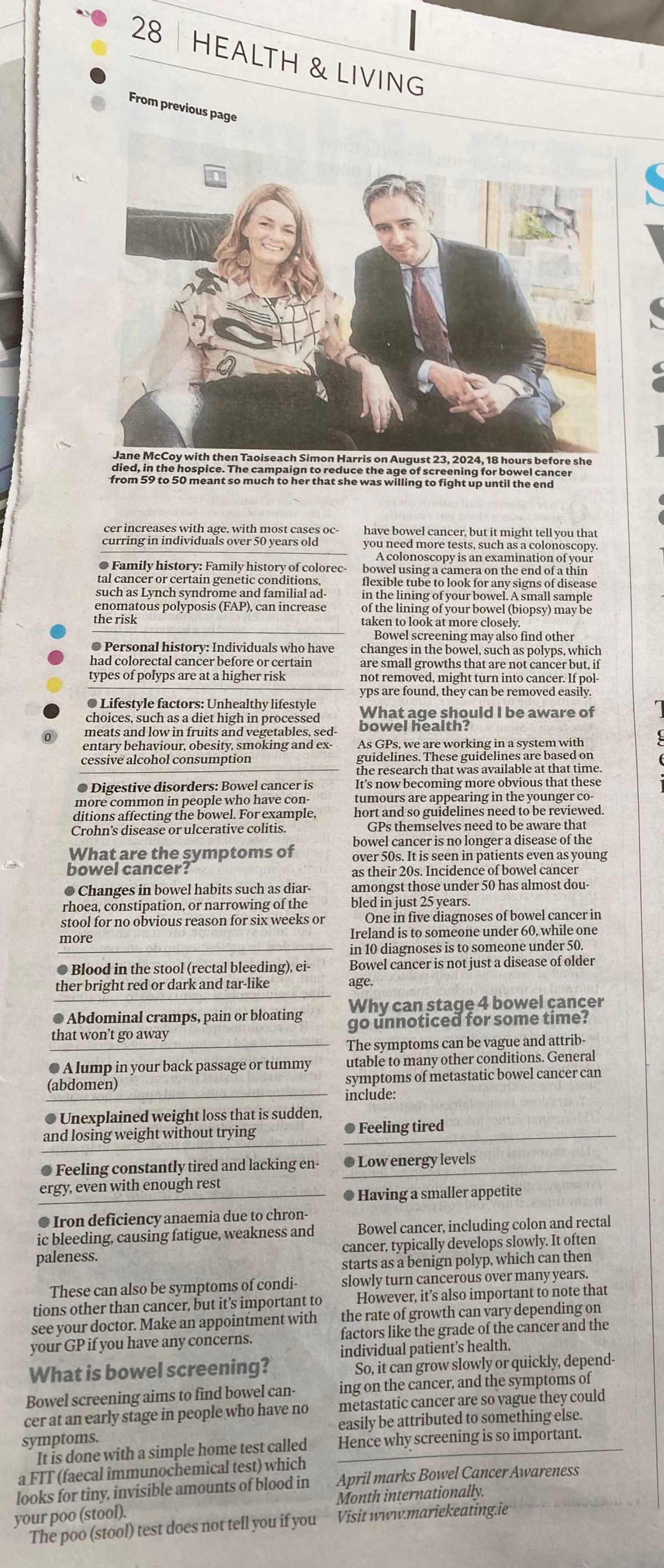
April is Bowel Cancer Awareness Month

According to the 2023 National Cancer Registry of Ireland (NCRI) report, around 2,500 men and women are diagnosed with bowel cancer in Ireland every year 1,452 men and 1,047 women. To learn more about the condition and some helpful advice to support you at every step of your bowel cancer journey, click below.

Lynch Choices

  • Lynch syndrome is an inherited condition that increases the chance of developing certain cancers. The type of cancer depends on the genes involved.
  • This website helps people with Lynch to make choices that are right for them. It is designed to be used with support from the genetics service, GPs, healthcare teams in the community, charities and patient groups.
  • If you are concerned about Lynch but have not been diagnosed, please speak to your GP or genetics service.
  • You’ll find two sections which help you think about your choices at home, so you are ready to talk through these choices with a GP, genetics or other specialist.
  • There are also another six sections providing support and information for people with Lynch. These sections may also be useful to family members and healthcare professionals of people with Lynch.

https://lynchsyndromeireland.wordpress.com/wp-admin/post-new.php

Hospital to award €2.4m for cancer genetic testing service

St James’s is the national referral centre for adult inherited cancer genetics. Patients are referred from general practitioners, regional hospitals and cancer centres for cancer genetic counselling, risk assessment, and genetic testing. 

The testing provider would be responsible for subcontracting a courier service to track the sending and receipt of genetic testing kits; processing of the sample for cancer genetic testing; bioinformatics and data analysis and result outcome; and confidentiality of information submitted to the online portal to order the test.

As of early 2025, more than 2,600 adults nationally were awaiting a genetics outpatient appointment, with more than 750 waiting more than 18 months.

  • Genetic counsellors are healthcare professionals who provide support to those who are at risk for or affected by an inherited cancer condition.
  • Genetic counselling is not officially recognised by the HSE. This is challenging because it restricts access to genetic services.
  • 90% of genetic cancers go undetected.
  • The work of genetics counsellors is vital in improving identification of inherited cancer and cancer prevention. Currently there is an 80% deficient in GC resources in cancer care